Pulvinaria mesembryanthemi
Ice plant scale
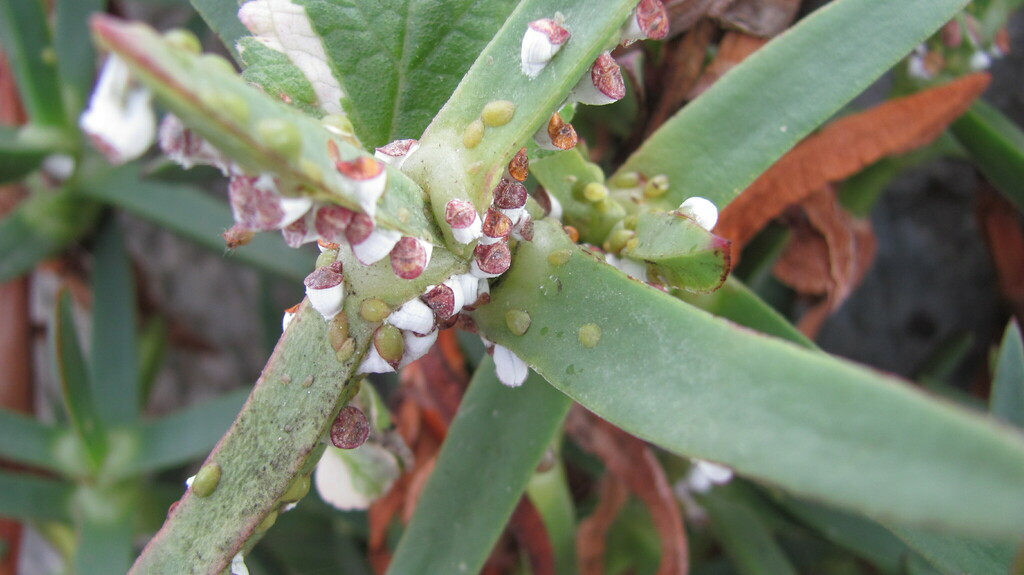
(c) zebedeugalinha, some rights reserved (CC BY) · licence
Family: Coccidae · Class: Insecta · Order: Hemiptera
Pulvinaria mesembryanthemi (Ice plant scale) is a California animal in the Coccidae family.
The ice plant scale (Pulvinaria mesembryanthemi) is a soft scale insect in the family Coccidae that specializes on ice plant species (Mesembryanthemum spp.). This hemipteran is part of the cottony scales group, characterized by the production of waxy, cotton-like ovisacs by adult females during reproduction. Like other soft scales, females are typically oval-shaped, flattened, and lack the hard protective covering found in armored scales. The species exhibits sexual dimorphism, with males being smaller, winged, and short-lived compared to the sessile females. The ice plant scale occurs along the California coast, particularly in areas where its host plants are established. Based on iNaturalist observations and taxonomic databases, the species is documented from coastal California locations where ice plant species are present (BugGuide.Net). The distribution appears to be closely tied to the presence of non-native ice plants, which have become widespread along the California coast. This scale insect inhabits coastal environments where ice plant species grow, including coastal terraces, dunes, and disturbed areas. Ice plants (Mesembryanthemum crystallinum and M. nodiflorum) are succulent plants that thrive in sandy, well-drained soils and salt-tolerant conditions typical of coastal environments (NatureServe Explorer). The scale insects attach themselves to stems and leaves of these host plants, where they feed on plant fluids through their piercing-sucking mouthparts. As phloem-feeding insects, ice plant scales extract nutrients from their host plants by inserting their stylets into plant tissues. Adult females remain relatively stationary once they establish feeding sites, gradually increasing in size as they mature. During reproduction, females produce characteristic white, cottony ovisacs that contain their eggs. The life cycle typically involves multiple generations per year in favorable conditions. Males, when present, are mobile and seek out females for mating before dying shortly after reproduction. The conservation status of Pulvinaria mesembryanthemi has not been formally evaluated by state or federal agencies. The species' association with non-native ice plant species presents a complex ecological relationship, as ice plants are themselves considered invasive species that can alter native coastal plant communities. While the scale may provide some biological control of ice plant populations, this relationship has not been extensively studied. The long-term population trends and conservation needs of this specialized scale insect remain poorly documented. Scientific research on this species is limited, with most information available through citizen science platforms and taxonomic databases rather than peer-reviewed ecological studies. Additional research would be valuable to better understand the species' biology, distribution patterns, and ecological role in coastal California ecosystems.
Classification
Class: Insecta · Order: Hemiptera · Family: Coccidae
Frequently asked questions
How is Pulvinaria mesembryanthemi classified?
Pulvinaria mesembryanthemi belongs to class Insecta, order Hemiptera, family Coccidae.
What family does Pulvinaria mesembryanthemi belong to?
Pulvinaria mesembryanthemi is in the Coccidae family.
What is Pulvinaria mesembryanthemi?
The ice plant scale (Pulvinaria mesembryanthemi) is a soft scale insect in the family Coccidae that specializes on ice plant species (Mesembryanthemum spp.).
Is Pulvinaria mesembryanthemi found in California?
Yes. Pulvinaria mesembryanthemi is recorded in California in The California Species Project's catalogue.
Related species
Other California species in the same genus, family, or bioregion.
Data from The California Species Project — 14,000+ California species with verified data from CNPS, CDFW, USFWS, and more.