Puma concolor
Mountain lion (Southern California/Central Coast ESU)
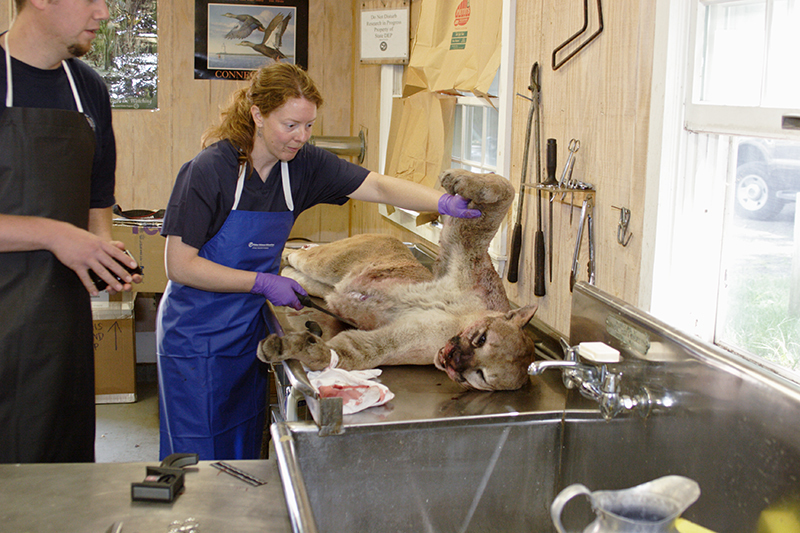
(c) Bobby McCabe, some rights reserved (CC BY) · licence
Family: Felidae · Class: Mammalia · Order: Carnivora
Conservation status: SC
Puma concolor (Mountain lion (Southern California/Central Coast ESU)) is a California animal in the Felidae family.
The mountain lion is the largest wild felid in North America, with adults measuring 1.5 to 2.75 meters (5 to 9 feet) in total length, including a tail that comprises approximately one-third of body length. Males typically weigh 53 to 90 kilograms (117 to 200 pounds), while females range from 29 to 64 kilograms (64 to 141 pounds). The species exhibits uniform tawny to grayish coloration across most of the body, with lighter cream or white fur on the chest, throat, and inner legs. The tail tip, backs of ears, and sides of muzzle display black markings. Kittens are born with dark spots that fade by approximately 6 months of age. The Southern California/Central Coast Evolutionarily Significant Unit encompasses mountain lions from the Transverse and Peninsular mountain ranges in Southern California, extending north along the Central Coast ranges to approximately Monterey County. This population is geographically separated from other California mountain lion populations by major highways, urban development, and agricultural lands. The range includes portions of Los Angeles, Ventura, Santa Barbara, Riverside, San Bernardino, Orange, San Diego, Kern, Tulare, Kings, Fresno, San Luis Obispo, and Monterey counties. Mountain lions occupy diverse habitats within this range, from chaparral and oak woodlands at lower elevations to mixed conifer forests at elevations up to 3,000 meters (10,000 feet). The species requires large territories with adequate prey density and sufficient cover for hunting. Males maintain territories of 100 to 300 square kilometers, while female territories typically range from 25 to 100 square kilometers. Rocky outcrops, dense vegetation, and steep terrain provide essential denning sites and travel corridors. As obligate carnivores, mountain lions primarily hunt ungulates, with mule deer comprising the majority of their diet. They also prey on smaller mammals including rabbits, rodents, and occasionally domestic livestock. Mountain lions are solitary except during mating and kitten-rearing periods. Breeding occurs year-round with a peak from December through March. After a gestation period of approximately 90 days, females give birth to 1 to 6 kittens, typically 2 to 3, in secluded dens. Kittens remain with their mother for 12 to 24 months. The Southern California/Central Coast population faces significant conservation challenges despite the species' California ranking of SC (Species of Concern). Habitat fragmentation from urban development and transportation infrastructure has created isolated subpopulations with limited genetic exchange. Vehicle strikes represent the leading cause of mortality, particularly along Interstate 15 and State Route 101. According to the National Park Service, genetic diversity in some areas has declined to levels comparable to endangered Florida panthers. The California Department of Fish and Wildlife notes that this evolutionarily significant unit is not currently tracked by the California Natural Diversity Database, potentially limiting comprehensive population monitoring. Climate change and increased wildfire frequency further threaten habitat connectivity and prey availability across this fragmented landscape.
Classification
Class: Mammalia · Order: Carnivora · Family: Felidae
Conservation status
SC
Frequently asked questions
How is Puma concolor classified?
Puma concolor belongs to class Mammalia, order Carnivora, family Felidae.
What family does Puma concolor belong to?
Puma concolor is in the Felidae family.
Is Puma concolor protected or of conservation concern?
Puma concolor carries the following status: SC.
What is Puma concolor?
The mountain lion is the largest wild felid in North America, with adults measuring 1.5 to 2.75 meters (5 to 9 feet) in total length, including a tail that comprises approximately one-third of body length.
Is Puma concolor found in California?
Yes. Puma concolor is recorded in California in The California Species Project's catalogue.
Related species
Other California species in the same genus, family, or bioregion.
Data from The California Species Project — 14,000+ California species with verified data from CNPS, CDFW, USFWS, and more.