Pyla fusca
Speckled Black Pyla Moth
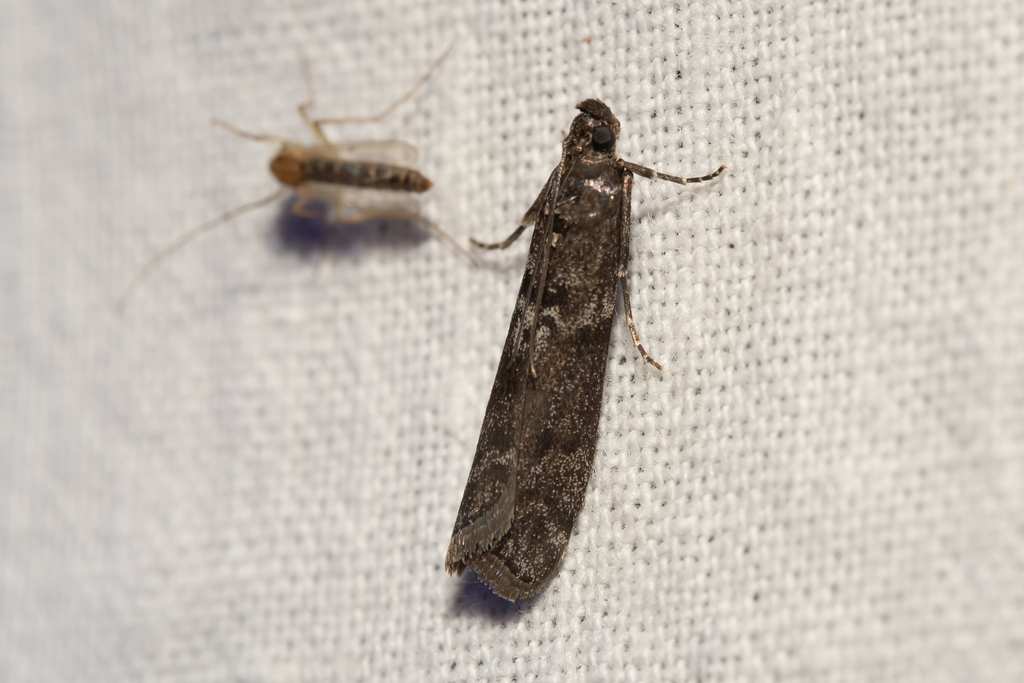
(c) Поляков Александр, some rights reserved (CC BY) · licence
Family: Pyralidae · Class: Insecta · Order: Lepidoptera
Pyla fusca (Speckled Black Pyla Moth) is a California animal in the Pyralidae family.
Pyla fusca is a snout moth in the subfamily Phycitinae that inhabits the Holarctic region. This species is taxonomically distinct from other members of the genus Pyla, which are typically restricted to North America, and has been proposed for separation into a monotypic genus Matilella due to its unique characteristics and biogeographic distribution (Wikipedia). The common name "Speckled Black Pyla Moth" refers to the species' distinctive wing patterning, though detailed morphological descriptions remain limited in the scientific literature. The species exhibits a broad Holarctic distribution, occurring across both North American and Eurasian regions. In North America, Pyla fusca has been documented from various locations including California, where it appears in lepidopteran surveys and collecting reports. The species' presence extends northward into Canada, where it maintains stable populations and is considered secure (N5 ranking). This wide distribution pattern distinguishes it from its congeners and supports the taxonomic proposals for generic reassignment. Habitat requirements for Pyla fusca have not been extensively documented in the available literature. Like other members of the Pyralidae family, this species likely utilizes a variety of environments that support its larval development and adult activity patterns. The broad geographic range suggests adaptability to different climatic conditions across the Holarctic, from temperate North American regions to corresponding latitudes in Eurasia. Specific elevation preferences, vegetation associations, and microhabitat requirements remain poorly documented. Ecological information regarding Pyla fusca remains limited, reflecting the generally insufficient knowledge of Phycitinae biology noted by taxonomic authorities. Larval host plants, feeding behaviors, reproductive cycles, and seasonal activity patterns have not been well documented in the scientific literature. The species' flight period, mating behaviors, and overwintering strategies require further research to provide comprehensive ecological understanding. Adult moths presumably follow typical pyralid patterns of nocturnal activity and attraction to artificial lights, but specific behavioral observations are lacking. Pyla fusca currently holds no formal global conservation ranking (GNR), indicating insufficient data for comprehensive status assessment. However, regional evaluations suggest the species maintains stable populations in portions of its range, particularly in Canada where it receives an N5 (secure) ranking. The species' broad Holarctic distribution likely provides some resilience against localized threats, though specific population trends and conservation needs have not been systematically evaluated. Given the general lack of detailed biological information available for many Phycitinae species, Pyla fusca represents a taxon requiring additional research to fully understand its ecological role and conservation requirements. The proposed taxonomic revisions, if implemented, would place this species in its own genus, potentially highlighting its unique evolutionary position within the snout moth fauna. Scientific documentation for this species remains limited, and additional verified information about its biology, distribution, or ecology would help improve understanding of this Holarctic moth species.
Classification
Class: Insecta · Order: Lepidoptera · Family: Pyralidae
Frequently asked questions
How is Pyla fusca classified?
Pyla fusca belongs to class Insecta, order Lepidoptera, family Pyralidae.
What family does Pyla fusca belong to?
Pyla fusca is in the Pyralidae family.
What is Pyla fusca?
Pyla fusca is a snout moth in the subfamily Phycitinae that inhabits the Holarctic region.
Is Pyla fusca found in California?
Yes. Pyla fusca is recorded in California in The California Species Project's catalogue.
Related species
Other California species in the same genus, family, or bioregion.
Data from The California Species Project — 14,000+ California species with verified data from CNPS, CDFW, USFWS, and more.