Pyralis farinalis
Meal Moth
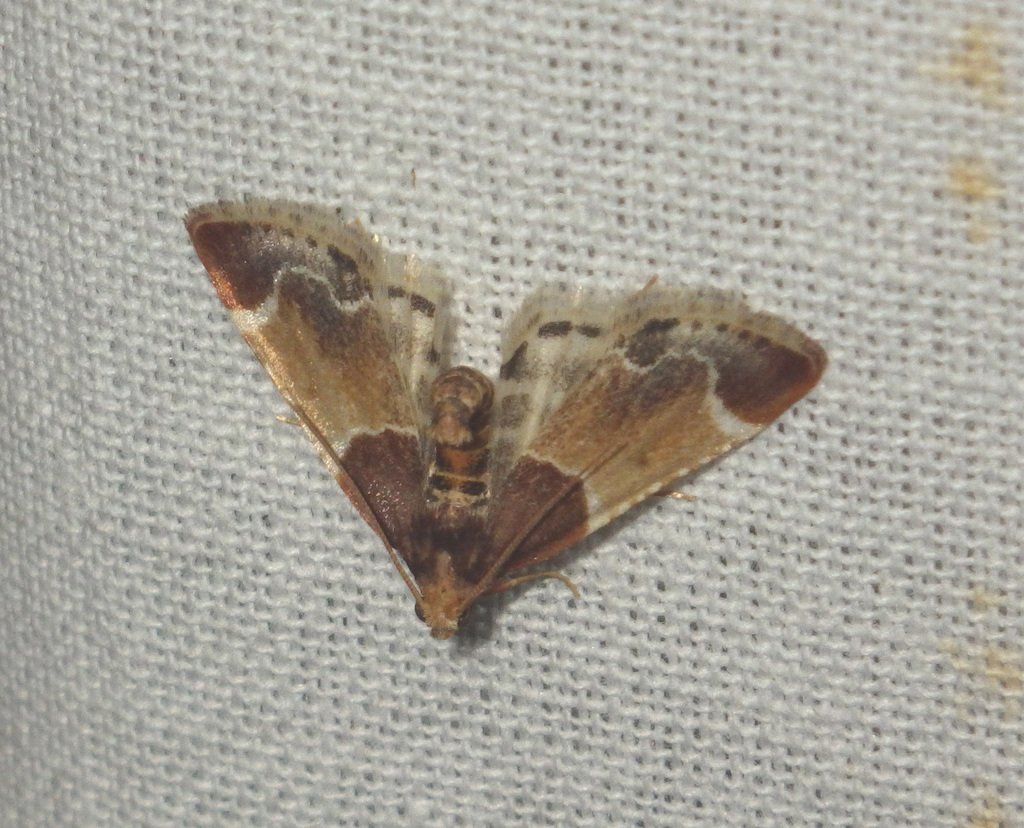
no rights reserved · CC0
Family: Pyralidae · Class: Insecta · Order: Lepidoptera
Pyralis farinalis (Meal Moth) is a California animal in the Pyralidae family.
The meal moth (Pyralis farinalis) is a small pyralid moth in the family Pyralidae, characterized by distinctive wing patterns and coloration. Adults have a wingspan of 18-30 mm (0.7-1.2 inches), with forewings displaying a complex pattern of reddish-brown, purple-brown, and yellowish markings. The forewings feature two prominent transverse lines - a basal line and a postmedial line - with a distinctive pale yellow or cream-colored band between them. The hindwings are typically pale gray to whitish with darker margins. At rest, the wings are held horizontally, giving the moth a triangular profile when viewed from above. Pyralis farinalis has a cosmopolitan distribution, occurring across North America, Europe, Asia, and other regions where suitable conditions exist. In California, the species is found throughout the state from sea level to moderate elevations, particularly in association with human habitation and stored grain facilities. The moth occurs in both urban and rural environments, with populations closely tied to food storage areas, mills, granaries, and similar structures. The species inhabits a wide range of environments but shows a strong preference for areas containing stored organic materials. Primary habitats include grain storage facilities, flour mills, bakeries, pet food manufacturing plants, and residential areas where cereals and grain products are stored. The moth also occurs in natural settings where organic debris accumulates, including bird nests, mammal burrows, and areas with decomposing plant material. Adults are commonly found near artificial lights during nocturnal activity periods. Meal moths are primarily nocturnal, with adults most active during evening and nighttime hours. The species exhibits multiple generations per year, with development time varying based on temperature and food availability. Females lay eggs directly on or near suitable food sources, with larvae developing within stored grain products, flour, cereals, and other organic materials. The larval stage is the most economically significant, as caterpillars feed on a wide variety of stored food products, creating webbing and contaminating materials with frass and silk. Larvae construct silk tubes or galleries within food sources, pupating in cocoons spun in crevices or among food debris. Adults primarily feed on nectar and other liquid food sources. Pyralis farinalis is not listed under any federal or state conservation programs and is not considered a species of conservation concern. The moth is actually regarded as a significant stored product pest in many regions, including California. Populations appear stable and may be expanding in association with global food storage and transport systems. The species' adaptability to human-modified environments and ability to utilize a wide range of stored organic materials have contributed to its successful establishment across diverse geographic regions. Management efforts typically focus on pest control rather than conservation, with integrated pest management strategies employed in commercial food storage facilities to reduce economic impacts.
Classification
Class: Insecta · Order: Lepidoptera · Family: Pyralidae
Frequently asked questions
How is Pyralis farinalis classified?
Pyralis farinalis belongs to class Insecta, order Lepidoptera, family Pyralidae.
What family does Pyralis farinalis belong to?
Pyralis farinalis is in the Pyralidae family.
What is Pyralis farinalis?
The meal moth (Pyralis farinalis) is a small pyralid moth in the family Pyralidae, characterized by distinctive wing patterns and coloration.
Is Pyralis farinalis found in California?
Yes. Pyralis farinalis is recorded in California in The California Species Project's catalogue.
Related species
Other California species in the same genus, family, or bioregion.
Data from The California Species Project — 14,000+ California species with verified data from CNPS, CDFW, USFWS, and more.