Pyramidobela quinquecristata
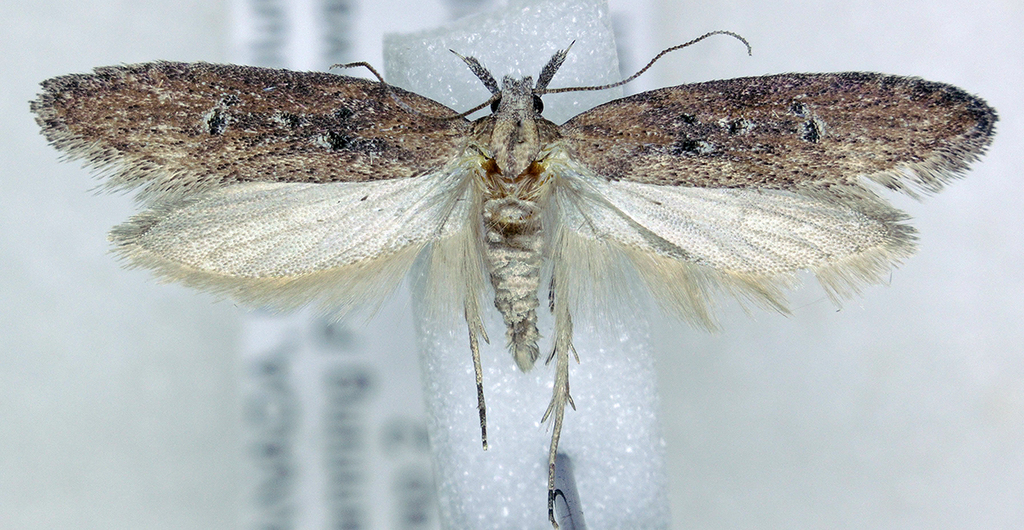
(c) Dave, some rights reserved (CC BY) · licence
Family: Depressariidae · Class: Insecta · Order: Lepidoptera
Pyramidobela quinquecristata is a California animal in the Depressariidae family.
Pyramidobela quinquecristata is a small moth species in the family Depressariidae, distinguished by five distinct crests or ridges on its forewings that give rise to its scientific name. This micro-moth exhibits the typical narrow-winged body plan characteristic of the Depressariidae family, with forewings measuring approximately 3-4 mm in length and a wingspan of 8-10 mm. The forewings display a mottled brown and cream coloration with darker transverse bands, while the hindwings are typically pale gray with reduced venation and long marginal fringes that extend beyond the wing membrane. The species' distribution appears to be restricted to western North America, with documented occurrences in California. Specific distributional records are limited in the literature, reflecting the challenges of studying micro-Lepidoptera and the specialized taxonomic expertise required for accurate identification. The species was described from specimens collected in California, though comprehensive range mapping remains incomplete due to limited survey efforts targeting this group of small moths. Pyramidobela quinquecristata inhabits areas with appropriate host plant communities, likely in chaparral, oak woodland, or mixed coniferous forest environments typical of California's Mediterranean climate zones. Members of the Depressariidae family typically prefer habitats with diverse herbaceous plant communities, as many species have narrow host plant associations. The elevation range and specific microhabitat preferences for this species require further documentation through targeted field surveys. Like other Depressariidae species, P. quinquecristata likely exhibits a specialized feeding ecology during its larval stage. Most members of this family are leaf miners or stem borers as larvae, creating characteristic feeding patterns within host plant tissues. The adult flight period and seasonal activity patterns have not been well documented, though many California Depressariidae species are active during spring and early summer months when host plants are producing new growth. Adults are typically nocturnal and may be attracted to ultraviolet light sources used in moth surveys. The conservation status of Pyramidobela quinquecristata remains poorly understood due to limited research on this micro-moth fauna. The species lacks federal or state conservation listing status, which is common for many small moth species that have received minimal study. Primary potential threats likely include habitat loss from urban development, altered fire regimes, and climate change effects on host plant communities. The narrow host plant associations typical of Depressariidae species may make them particularly vulnerable to environmental changes that affect their larval food sources. Comprehensive surveys using modern molecular techniques and light trapping methods would be needed to better assess the species' current distribution, population status, and conservation needs. The taxonomic stability of the species also requires verification through modern systematic approaches, as historical micro-Lepidoptera taxonomy was based on limited character sets and may require revision with contemporary morphological and molecular data.
Classification
Class: Insecta · Order: Lepidoptera · Family: Depressariidae
Frequently asked questions
How is Pyramidobela quinquecristata classified?
Pyramidobela quinquecristata belongs to class Insecta, order Lepidoptera, family Depressariidae.
What family does Pyramidobela quinquecristata belong to?
Pyramidobela quinquecristata is in the Depressariidae family.
What is Pyramidobela quinquecristata?
Pyramidobela quinquecristata is a small moth species in the family Depressariidae, distinguished by five distinct crests or ridges on its forewings that give rise to its scientific name.
Is Pyramidobela quinquecristata found in California?
Yes. Pyramidobela quinquecristata is recorded in California in The California Species Project's catalogue.
Related species
Other California species in the same genus, family, or bioregion.
Data from The California Species Project — 14,000+ California species with verified data from CNPS, CDFW, USFWS, and more.