Pyrausta orphisalis
Orange Mint Moth
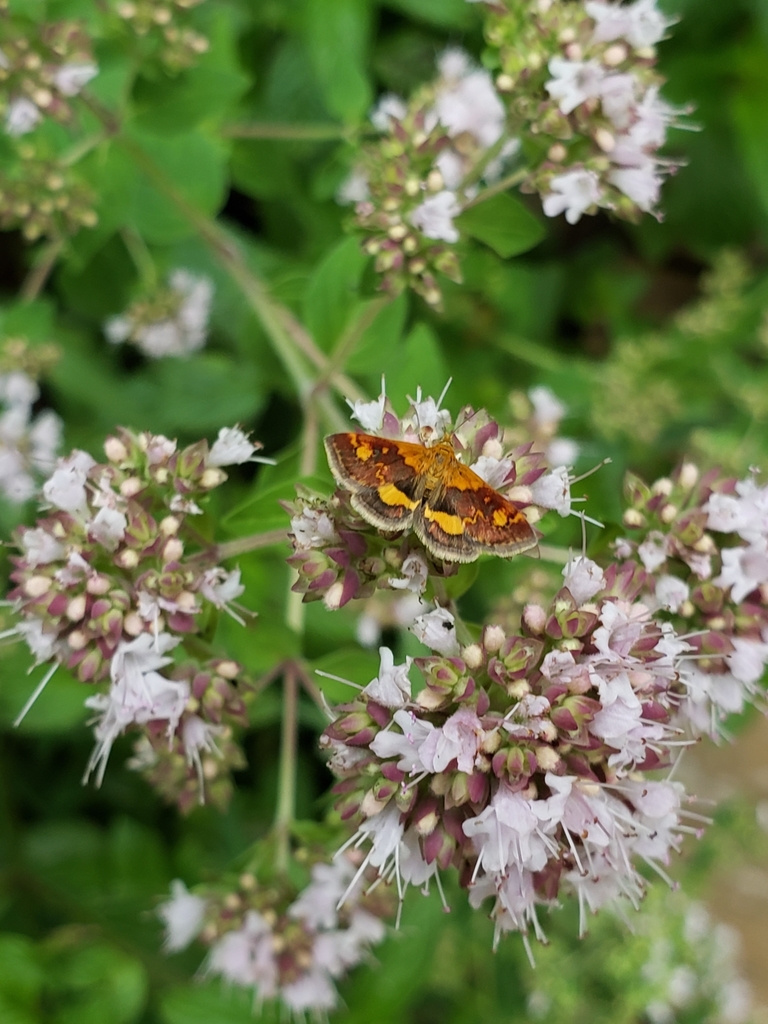
(c) Andy Deans, some rights reserved (CC BY) · licence
Family: Crambidae · Class: Insecta · Order: Lepidoptera
Pyrausta orphisalis (Orange Mint Moth) is a California animal in the Crambidae family.
The Orange Mint Moth (Pyrausta orphisalis) is a small crambid moth in the family Crambidae, subfamily Pyraustinae. Adults typically measure 10-15 mm (0.4-0.6 inches) in wingspan. The forewings display a distinctive orange-brown base color with darker brown or blackish markings, including irregular transverse lines and spots. The hindwings are generally paler, ranging from cream to light brown with faint markings. The moth's thorax and abdomen are orange-brown, matching the forewings. When at rest, the wings are held in a triangular position over the body, characteristic of many pyraustine moths. Pyrausta orphisalis occurs throughout eastern North America, with records extending from southeastern Canada south to Florida and west to the Great Plains. The species has been documented in states from Maine to Georgia along the Atlantic coast and westward through the Ohio Valley and Great Lakes region. While primarily an eastern species, scattered populations may occur in suitable habitat across the continental range. The species inhabits areas where its host plants occur, including woodland edges, meadows, gardens, and disturbed sites. Orange Mint Moths are associated with plants in the mint family (Lamiaceae), specifically savory (Satureja species) and wild bergamot or bee balm (Monarda species). These host plants typically grow in well-drained soils in partial to full sun exposure. The moths can be found from sea level to moderate elevations throughout their range, wherever suitable host vegetation is present. Adult Orange Mint Moths are primarily nocturnal and are attracted to artificial lights. The species is multivoltine in most of its range, producing two to three generations annually depending on latitude and local climate conditions. Adults are active from late spring through early fall, with peak flight periods varying by generation. Larvae feed on the leaves and flowers of host plants, creating small irregular holes or skeletonizing leaf surfaces. Pupation typically occurs in silk cocoons attached to plant debris or in soil litter near the base of host plants. The final generation overwinters as pupae in northern portions of the range. The Orange Mint Moth does not currently hold any federal or state conservation listing status. The species appears to be relatively stable throughout much of its range, likely benefiting from the widespread cultivation of mint family plants in gardens and landscapes. However, like many lepidopteran species, local populations may be affected by habitat loss, pesticide use, and changes in land management practices. The moth's association with commonly cultivated plants such as garden savory and bee balm may provide some buffer against habitat loss in agricultural and suburban areas. Climate change could potentially affect the species' distribution, particularly at the northern and southern limits of its range, though specific impacts have not been thoroughly studied. Conservation of native mint family plants and reduced pesticide use in areas where the species occurs would benefit local populations.
Classification
Class: Insecta · Order: Lepidoptera · Family: Crambidae
Frequently asked questions
How is Pyrausta orphisalis classified?
Pyrausta orphisalis belongs to class Insecta, order Lepidoptera, family Crambidae.
What family does Pyrausta orphisalis belong to?
Pyrausta orphisalis is in the Crambidae family.
What is Pyrausta orphisalis?
The Orange Mint Moth (Pyrausta orphisalis) is a small crambid moth in the family Crambidae, subfamily Pyraustinae.
Is Pyrausta orphisalis found in California?
Yes. Pyrausta orphisalis is recorded in California in The California Species Project's catalogue.
Related species
Other California species in the same genus, family, or bioregion.
Data from The California Species Project — 14,000+ California species with verified data from CNPS, CDFW, USFWS, and more.