Pyrausta perrubralis
Shasta Pyrausta Moth
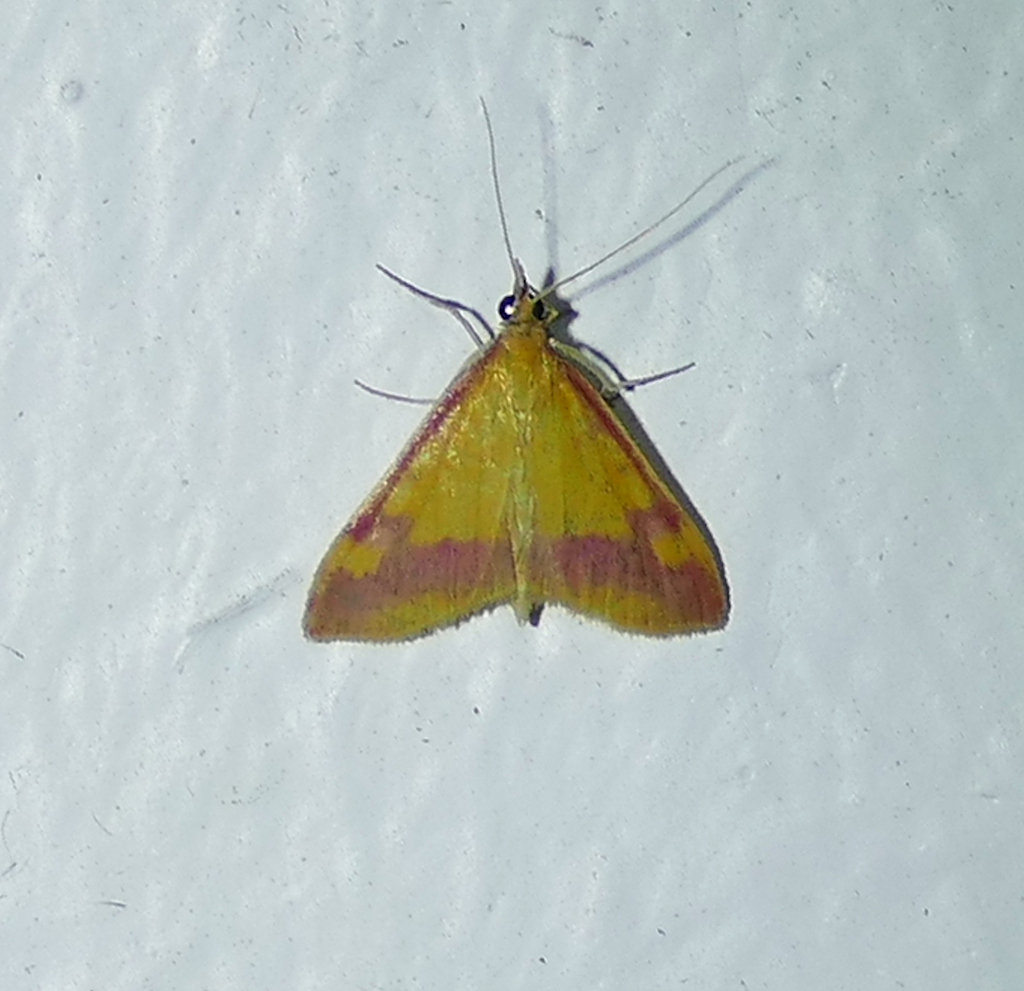
(c) Wendy McCrady, some rights reserved (CC BY) · licence
Family: Crambidae · Class: Insecta · Order: Lepidoptera
Pyrausta perrubralis (Shasta Pyrausta Moth) is a California animal in the Crambidae family.
Pyrausta perrubralis, commonly known as the Shasta Pyrausta Moth, is a small moth in the family Crambidae. This species was first described by Packard in 1873 and represents one of several Pyrausta species found in western North America. The moth displays typical crambid characteristics with relatively narrow forewings and a compact body structure, though detailed morphological descriptions remain limited in the scientific literature. The species occurs across western North America, with documented records from British Columbia south through California, and extending east to New Mexico (iNaturalist). Within California, the moth has been recorded in various counties, though specific distributional data within the state remains sparse. The common name "Shasta Pyrausta Moth" suggests a historical association with the Shasta region of northern California, though the species' range extends well beyond this area. Habitat preferences for P. perrubralis have not been comprehensively documented, though larval host plant associations provide some insight into ecological requirements. Research from the San Bruno Mountains documented larvae feeding on Monardella villosa (coyote mint), marking the first recorded rearing of this species and establishing this native mint as a host plant (Yale University Peabody Museum). This host plant association suggests the moth likely inhabits areas where Monardella species occur, including chaparral, coastal scrub, and montane habitats where these aromatic shrubs are common. Lifecycle and behavioral information for P. perrubralis remains poorly documented in the scientific literature. The successful rearing from larvae found on Monardella villosa indicates that females oviposit on or near host plants, and larvae develop by feeding on the foliage. Adult emergence was recorded in July in the San Bruno Mountains study, suggesting summer flight periods, though seasonal activity patterns across the species' range have not been systematically studied. Like other Pyrausta species, adults are likely active during evening and nighttime hours and attracted to artificial lights. The species exhibits taxonomic complexity, with multiple subspecies recognized including P. p. perrubralis, P. p. shastanalis, and P. p. saanichalis (iNaturalist). This subspecific variation may reflect geographic isolation and local adaptation across the species' broad western North American range. Conservation status for P. perrubralis has not been formally assessed at federal or state levels. The species lacks formal conservation rankings, and population trends remain unknown. The limited ecological research on this moth reflects a broader knowledge gap affecting many western North American microlepidoptera. The discovery of host plant relationships and successful rearing as recently as the 1980s indicates that basic biological information continues to emerge for this species. Scientific documentation for this species remains limited despite its wide distribution. The information presented here is based on available taxonomic databases and the few published ecological observations. Research needs include systematic surveys to better define habitat requirements, host plant relationships, and population status across the species' range.
Classification
Class: Insecta · Order: Lepidoptera · Family: Crambidae
Frequently asked questions
How is Pyrausta perrubralis classified?
Pyrausta perrubralis belongs to class Insecta, order Lepidoptera, family Crambidae.
What family does Pyrausta perrubralis belong to?
Pyrausta perrubralis is in the Crambidae family.
What is Pyrausta perrubralis?
Pyrausta perrubralis, commonly known as the Shasta Pyrausta Moth, is a small moth in the family Crambidae.
Is Pyrausta perrubralis found in California?
Yes. Pyrausta perrubralis is recorded in California in The California Species Project's catalogue.
Related species
Other California species in the same genus, family, or bioregion.
Data from The California Species Project — 14,000+ California species with verified data from CNPS, CDFW, USFWS, and more.