Pyrausta unifascialis
One-banded Pyrausta
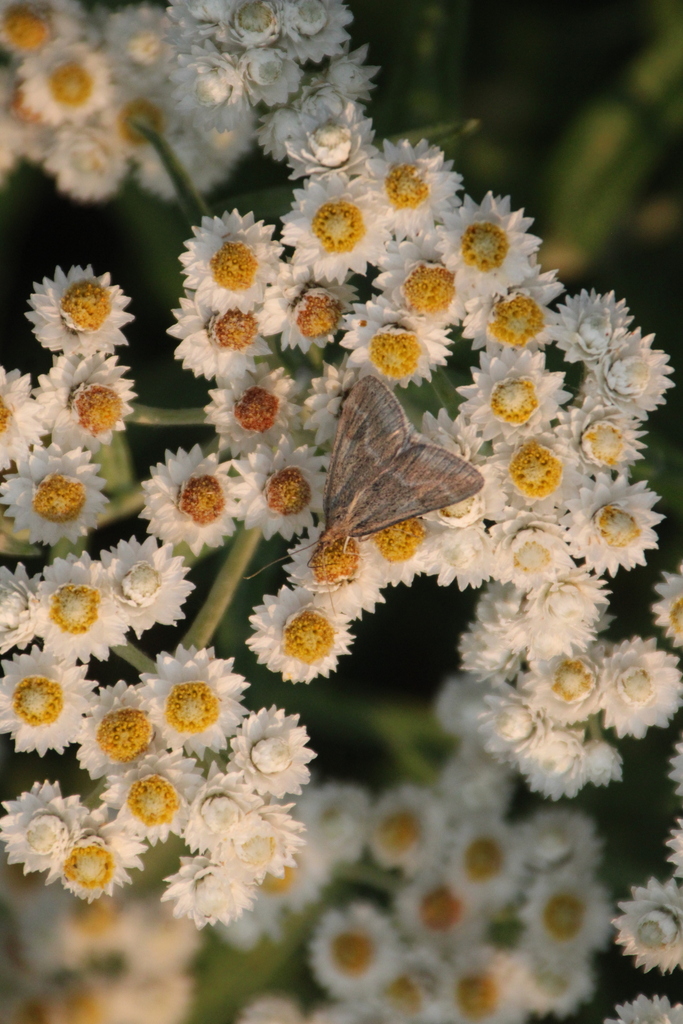
(c) Therese Phillips, some rights reserved (CC BY) · licence
Family: Crambidae · Class: Insecta · Order: Lepidoptera
Pyrausta unifascialis (One-banded Pyrausta) is a California animal in the Crambidae family.
The one-banded pyrausta (Pyrausta unifascialis) is a small moth in the family Crambidae, subfamily Pyraustinae. Adults have a wingspan of approximately 15-20 mm (0.6-0.8 inches), with forewings displaying a distinctive pattern that gives the species its common name. The forewings are typically brownish or grayish-brown with a prominent white or pale yellow band crossing the wing, creating the characteristic single band marking. The hindwings are generally paler, often whitish or light brown with darker margins. The thorax and head are covered in scales that match the forewing coloration, while the antennae are simple and thread-like. The distribution of Pyrausta unifascialis in North America includes several western states, with documented populations in California. The species' range extends from the Pacific Coast inland to various mountainous regions, though specific distribution data for California counties remains limited in published literature. Historical records suggest the species may have a broader distribution than currently documented, potentially due to limited survey efforts for this small moth species. One-banded pyrausta inhabits areas where its larval host plants occur, typically in open woodlands, meadows, and disturbed sites. The species is associated with plants in the mint family (Lamiaceae), with larvae feeding on various herbaceous species within this plant family. Adults are found from late spring through early fall, with peak flight periods varying by elevation and local climate conditions. The species appears to prefer areas with moderate moisture levels and partial shade, often in riparian zones or forest edges where suitable host plants are abundant. Larvae of Pyrausta unifascialis develop as leaf feeders on their Lamiaceae host plants, creating small feeding tunnels or surface feeding damage. The species likely completes one to two generations per year, depending on local climate conditions and elevation. Adults are primarily nocturnal and are attracted to artificial lights. Mating behavior follows typical crambid patterns, with males locating females through pheromone detection. Females deposit eggs singly or in small clusters on or near host plant foliage. Overwintering likely occurs in the larval or pupal stage, though specific life history details remain poorly documented for this species. Pyrausta unifascialis does not appear on federal or California state endangered species lists as of December 2025. The species' conservation status is not well-documented, reflecting the general lack of comprehensive survey data for many small moth species. Potential threats may include habitat loss due to development, changes in plant communities affecting host plant availability, and the use of broad-spectrum insecticides in agricultural and urban areas. Climate change may also impact the species through alterations to host plant phenology and distribution. The species would benefit from targeted surveys to better understand its current distribution, population status, and habitat requirements in California.
Classification
Class: Insecta · Order: Lepidoptera · Family: Crambidae
Frequently asked questions
How is Pyrausta unifascialis classified?
Pyrausta unifascialis belongs to class Insecta, order Lepidoptera, family Crambidae.
What family does Pyrausta unifascialis belong to?
Pyrausta unifascialis is in the Crambidae family.
What is Pyrausta unifascialis?
The one-banded pyrausta (Pyrausta unifascialis) is a small moth in the family Crambidae, subfamily Pyraustinae.
Is Pyrausta unifascialis found in California?
Yes. Pyrausta unifascialis is recorded in California in The California Species Project's catalogue.
Related species
Other California species in the same genus, family, or bioregion.
Data from The California Species Project — 14,000+ California species with verified data from CNPS, CDFW, USFWS, and more.