Pyrgus scriptura
Small Checkered-Skipper
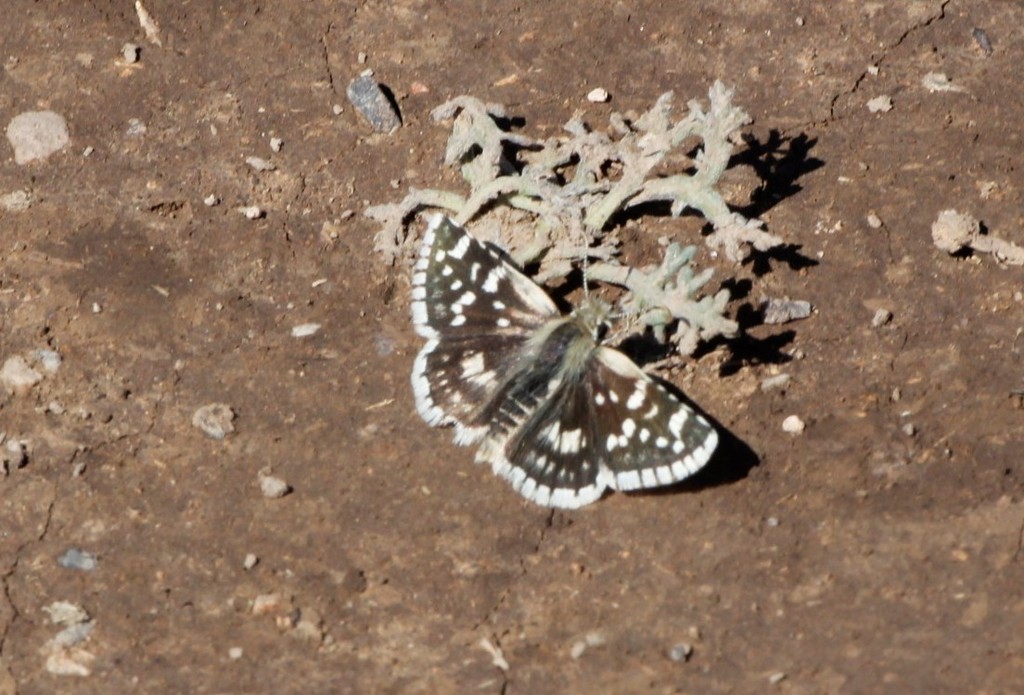
(c) Juan Cruzado Cortés, some rights reserved (CC BY-SA) · licence
Family: Hesperiidae · Class: Insecta · Order: Lepidoptera
Pyrgus scriptura (Small Checkered-Skipper) is a California animal in the Hesperiidae family.
The Small Checkered-Skipper is a compact butterfly with a wingspan ranging from 19 to 25 mm (0.75 to 1.0 inch). The dorsal wing surfaces display a distinctive checkered pattern of white spots on a dark brown to blackish background, giving the species its common name. Males exhibit more prominent white spotting than females, with a characteristic row of white spots across the forewings and smaller scattered spots on the hindwings. The ventral surfaces are lighter, with pale gray-brown coloration and reduced spotting. The antennae are relatively short with curved clubs, and the body is robust and hairy, typical of skipper butterflies. The Small Checkered-Skipper has an extensive range across western North America, from Montana and eastern Wyoming south through Colorado and New Mexico to Mexico. The distribution extends westward through Utah, Nevada, and Arizona to southern California and Baja California Norte. In California, the species occurs primarily in desert and semi-desert regions of the southeastern counties, including Imperial, Riverside, San Bernardino, and Inyo counties. The species is most commonly encountered in the Mojave and Sonoran desert regions at elevations typically below 1,200 meters (4,000 feet). This skipper inhabits open, arid environments including desert flats, washes, disturbed areas, and alkaline soils where host plants thrive. The species shows particular association with areas containing sparse vegetation and exposed ground, often near desert springs, agricultural margins, and disturbed habitats along roadsides. The butterfly requires proximity to its host plants and nectar sources, typically favoring areas with some moisture availability in otherwise xeric conditions. Small Checkered-Skippers are obligate herbivores in their larval stage, feeding exclusively on plants in the mallow family (Malvaceae). Primary host plants include alkali mallow (Sida hederacea), scarlet globemallow (Sphaeralcea coccinea), and desert globemallow (Sphaeralcea ambigua). Females deposit single eggs on host plant leaves, and larvae feed within rolled leaf shelters. The species is multivoltine in warmer regions, producing multiple generations per year when conditions permit. Adults are active fliers, feeding on nectar from various flowers including desert willow, chuparosa, and cultivated plants in urban areas. Males exhibit territorial behavior, perching on low vegetation and pursuing potential mates or intruders. The Small Checkered-Skipper is not federally or state listed, and populations appear stable across much of its range. The species demonstrates adaptability to disturbed habitats and can persist in areas with moderate human activity. However, localized threats include habitat loss due to urban development, agricultural conversion, and invasive plant species that displace native host plants. Water diversions and groundwater depletion may impact populations in desert springs and riparian areas where the species concentrates. Climate change poses potential long-term risks through altered precipitation patterns and increased temperatures in desert ecosystems. The species benefits from conservation of native desert vegetation communities and maintenance of natural hydrological processes in arid landscapes.
Classification
Class: Insecta · Order: Lepidoptera · Family: Hesperiidae
Frequently asked questions
How is Pyrgus scriptura classified?
Pyrgus scriptura belongs to class Insecta, order Lepidoptera, family Hesperiidae.
What family does Pyrgus scriptura belong to?
Pyrgus scriptura is in the Hesperiidae family.
What is Pyrgus scriptura?
The Small Checkered-Skipper is a compact butterfly with a wingspan ranging from 19 to 25 mm (0.75 to 1.0 inch).
Is Pyrgus scriptura found in California?
Yes. Pyrgus scriptura is recorded in California in The California Species Project's catalogue.
Related species
Other California species in the same genus, family, or bioregion.
Data from The California Species Project — 14,000+ California species with verified data from CNPS, CDFW, USFWS, and more.