Pyrisitia nise
Mimosa Yellow
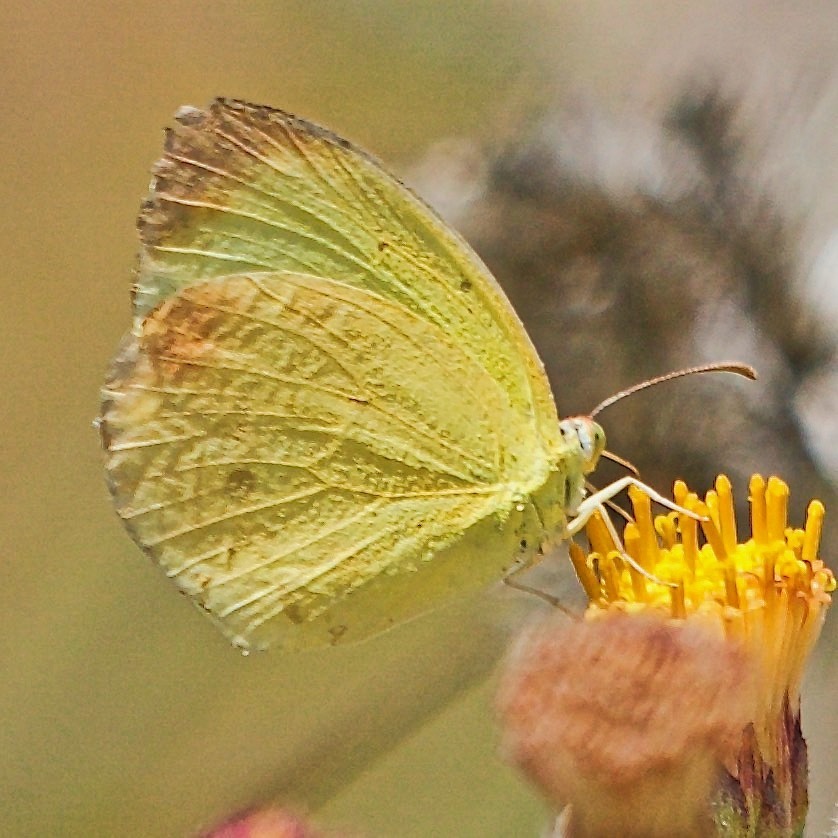
(c) Bill Levine, some rights reserved (CC BY) · licence
Family: Pieridae · Class: Insecta · Order: Lepidoptera
Pyrisitia nise (Mimosa Yellow) is a California animal in the Pieridae family.
The Mimosa Yellow (Pyrisitia nise) is a small butterfly in the family Pieridae, characterized by bright yellow wings with distinctive black markings. Males display vibrant sulfur-yellow dorsal surfaces with black borders along the wing margins, while females are typically paler yellow with more extensive black markings. The wingspan ranges from 32 to 44 millimeters (1.3 to 1.7 inches). The undersides of the hindwings are pale yellow with scattered black spots, and the forewings show faint orange patches near the tips. This species exhibits sexual dimorphism typical of many pierids, with males being more intensely colored than females. The Mimosa Yellow is primarily a resident species ranging from Argentina northward through Central America and Mexico to the Texas Gulf Coast and southern Florida. The species occurs as an occasional stray in central Texas and southeastern Arizona, with rare appearances documented in southern California, southern Colorado, and Kansas. In its core range, populations are stable and the species is considered common in suitable habitat. The butterfly's distribution closely follows that of its primary host plant, limiting its establishment in areas where the host is absent. This species inhabits disturbed areas, roadsides, vacant lots, garden edges, and other open habitats where its host plant thrives. The Mimosa Yellow shows a strong preference for sunny, warm locations at elevations typically below 1,000 meters (3,280 feet). Adults are most commonly observed in areas with abundant flowering plants that provide nectar sources, including lantana, pentas, and various composite flowers. The species tolerates urban environments well, often colonizing disturbed sites where sensitive plant becomes established. Mimosa Yellow caterpillars feed exclusively on sensitive plant (Mimosa pudica) in the pea family (Fabaceae). This host plant, also known as the touch-me-not, is characterized by compound leaves that fold when touched and small pink globular flowers. Females deposit single white eggs on young leaves and flower buds of the host plant. The larvae are pale green with darker dorsal stripes and feed on leaves, buds, and seed pods. Development from egg to adult takes approximately 25 to 30 days under optimal conditions. Multiple broods occur throughout the year in warm climates, with continuous breeding where temperatures permit year-round activity. The Mimosa Yellow is not federally or state listed, and populations within its native range appear stable. However, the species' dependence on a single host plant makes local populations vulnerable to habitat destruction and herbicide use. In areas where it appears as a stray, the butterfly cannot establish permanent populations due to the absence of suitable host plants or climatic conditions. Climate change may potentially expand the northern limits of this species' range as temperatures warm, though establishment would still require the presence of sensitive plant populations.
Classification
Class: Insecta · Order: Lepidoptera · Family: Pieridae
Frequently asked questions
How is Pyrisitia nise classified?
Pyrisitia nise belongs to class Insecta, order Lepidoptera, family Pieridae.
What family does Pyrisitia nise belong to?
Pyrisitia nise is in the Pieridae family.
What is Pyrisitia nise?
The Mimosa Yellow (Pyrisitia nise) is a small butterfly in the family Pieridae, characterized by bright yellow wings with distinctive black markings.
Is Pyrisitia nise found in California?
Yes. Pyrisitia nise is recorded in California in The California Species Project's catalogue.
Related species
Other California species in the same genus, family, or bioregion.
Data from The California Species Project — 14,000+ California species with verified data from CNPS, CDFW, USFWS, and more.