Pyrocephalus rubinus
Vermilion Flycatcher
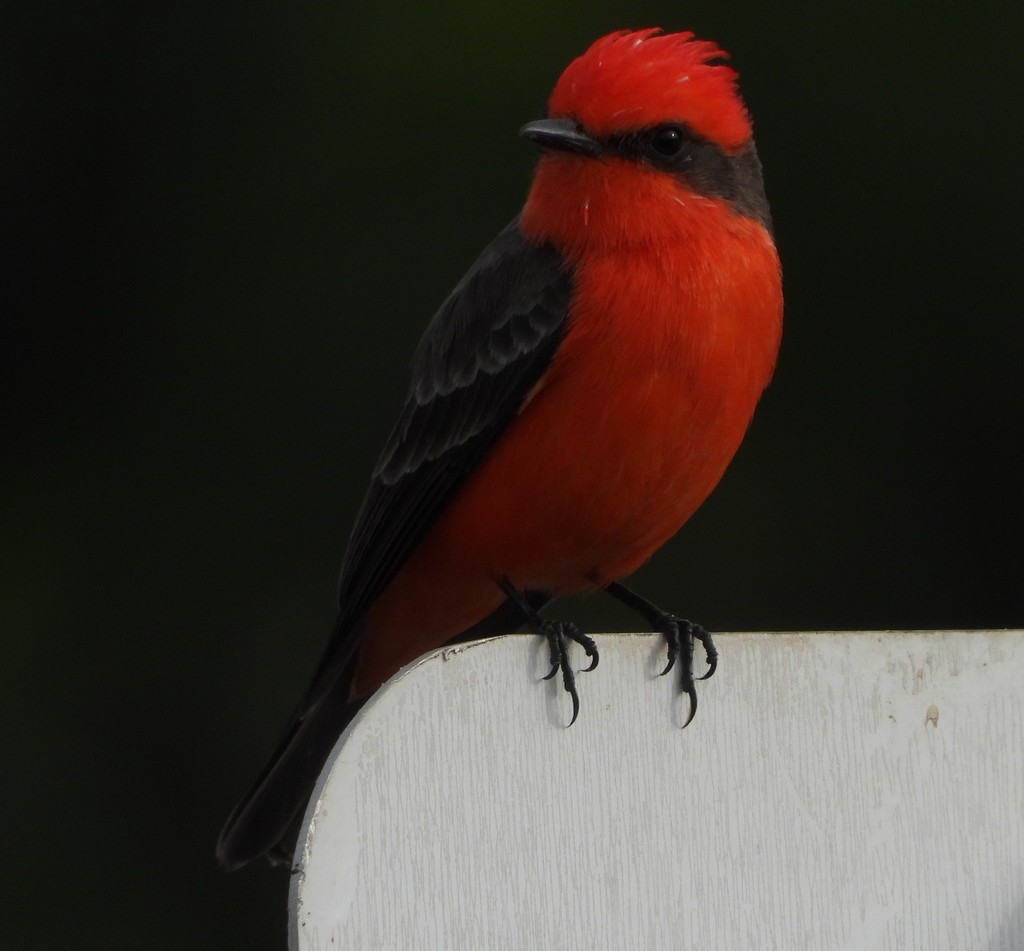
(c) Jared Shorma, some rights reserved (CC BY) · licence
Family: Tyrannidae · Class: Aves · Order: Passeriformes
Conservation status: G5 S2S3
Pyrocephalus rubinus (Vermilion Flycatcher) is a California animal in the Tyrannidae family.
The Vermilion Flycatcher is a small, sexually dimorphic passerine measuring 13 to 14 cm (5.1 to 5.5 inches) in length with a wingspan of approximately 24 cm (9.4 inches). Adult males display brilliant red plumage on the head, throat, breast, and belly, contrasting sharply with dark brown to black upperparts, wings, and tail. A distinctive black mask extends through the eye. Adult females and juveniles are brown above with pale underparts, featuring a peach-colored wash on the lower belly and undertail coverts, and subtle streaking on the breast. Historically, Vermilion Flycatchers bred throughout much of California's Central Valley, from Shasta County south to Kern County, and in desert regions of southeastern California. The species also occurred along the Colorado River and in scattered locations in southern California. Current breeding populations in California are extremely limited, with recent confirmed nesting restricted primarily to desert areas near the Salton Sea and along the lower Colorado River. Small populations may persist in isolated riparian areas, but the species has been extirpated from most of its former California range. Vermilion Flycatchers inhabit open woodlands, riparian corridors, desert oases, and agricultural areas with scattered trees. They prefer areas with prominent perches for hunting, including dead snags, fence posts, and utility wires, typically near water sources. Elevation ranges from below sea level near the Salton Sea to approximately 1,200 meters (4,000 feet) in desert mountain ranges. Critical habitat features include large trees for nesting, particularly cottonwoods, willows, and mesquites, along with open areas for foraging. This species employs typical flycatcher feeding behavior, making aerial sallies from exposed perches to capture flying insects including flies, beetles, moths, and flying ants. Males perform elaborate courtship displays, rising 15 to 30 meters above their territory while singing and fluttering their wings before diving back to perches. Breeding occurs from March through August, with peak activity from April to June. Females construct cup-shaped nests in tree forks, typically 3 to 6 meters above ground, laying 2 to 4 cream-colored eggs with brown spotting. Incubation lasts 14 to 16 days, with fledging occurring 14 to 18 days after hatching. While not federally listed, the Vermilion Flycatcher's California populations have declined precipitously since the mid-20th century. The species is considered a California Bird Species of Special Concern due to significant range contraction and population reduction. Primary threats include habitat loss through agricultural conversion, urban development, and water diversions that eliminate riparian vegetation. Cowbird parasitism and pesticide use in agricultural areas pose additional challenges. The species' global rank of G5 indicates overall stability across its range, which extends through Mexico and Central America, but California's S2S3 ranking reflects the precarious status of peripheral populations. Conservation efforts focus on riparian habitat restoration and protection of remaining breeding sites in desert regions.
Classification
Class: Aves · Order: Passeriformes · Family: Tyrannidae
Conservation status
G5 S2S3
Frequently asked questions
How is Pyrocephalus rubinus classified?
Pyrocephalus rubinus belongs to class Aves, order Passeriformes, family Tyrannidae.
What family does Pyrocephalus rubinus belong to?
Pyrocephalus rubinus is in the Tyrannidae family.
Is Pyrocephalus rubinus protected or of conservation concern?
Pyrocephalus rubinus carries the following status: G5 S2S3.
What is Pyrocephalus rubinus?
The Vermilion Flycatcher is a small, sexually dimorphic passerine measuring 13 to 14 cm (5.1 to 5.5 inches) in length with a wingspan of approximately 24 cm (9.4 inches).
Is Pyrocephalus rubinus found in California?
Yes. Pyrocephalus rubinus is recorded in California in The California Species Project's catalogue.
Related species
Other California species in the same genus, family, or bioregion.
Data from The California Species Project — 14,000+ California species with verified data from CNPS, CDFW, USFWS, and more.