Pyroderces badia
Florida Pink Scavenger Moth
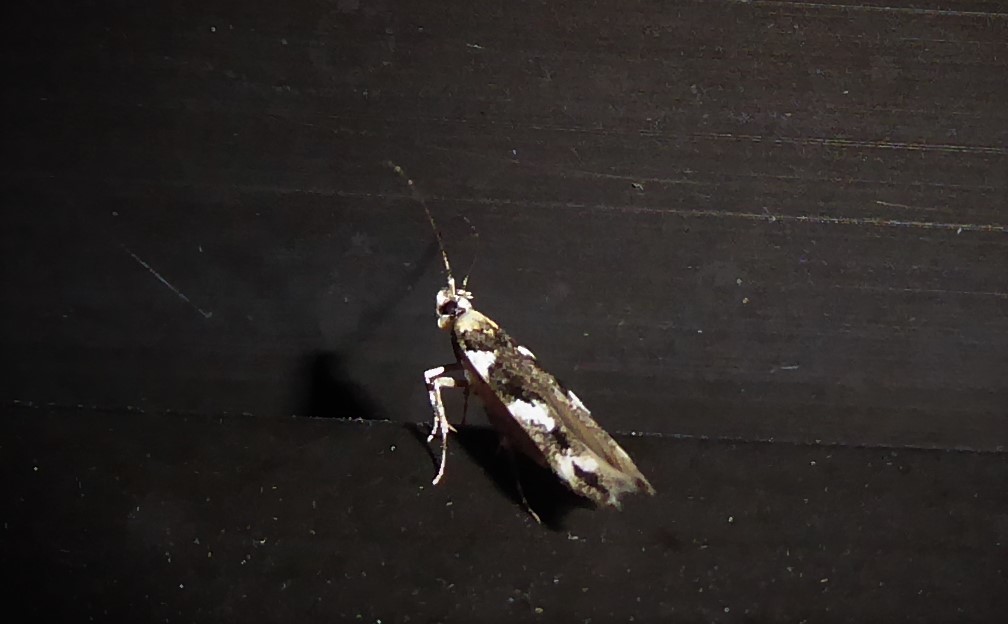
(c) Aalbert Rebergen, some rights reserved (CC BY) · licence
Family: Cosmopterigidae · Class: Insecta · Order: Lepidoptera
Pyroderces badia (Florida Pink Scavenger Moth) is a California animal in the Cosmopterigidae family.
The Florida Pink Scavenger Moth (Pyroderces badia) is a small moth in the family Cosmopterigidae, formerly classified in the genus Anatrachyntis but reclassified following Koster & Sinev (2003). This species represents one of the more widely distributed cosmopterigid moths in North America, with populations established across multiple regions through both natural dispersal and human-mediated transport. Adults are small moths with narrow forewings typical of the Cosmopterigidae family. The species displays the characteristic pink and brown coloration that gives it its common name, though detailed morphological descriptions of wing patterns and size measurements have not been extensively documented in available literature. The Florida Pink Scavenger Moth occurs throughout the southern United States from Florida to California, with its range extending as far north as Maryland (iNaturalist). The species has established populations across this broad geographic area and has been documented in California, where it appears to be well-established. Beyond its native North American range, this moth has become an introduced species in Europe, recorded from Italy, Greece, Spain, Malta, and the United Kingdom through accidental importation, typically associated with pomegranate shipments (iNaturalist). The species has also been documented from Hawaii. Habitat preferences for this species have not been comprehensively documented, though its widespread distribution suggests adaptability to various environments. The moth's association with stored products and its history of accidental transport in agricultural commodities indicates a preference for areas where suitable larval food sources are available. The larval stage functions as a scavenger, feeding on various organic materials, which contributes to the species' ecological role and common name. Detailed studies of the immature stages have been conducted, including work documenting new host records from Louisiana, though specific host plant relationships remain incompletely documented in available sources. The species' scavenging behavior allows it to exploit diverse food resources, contributing to its successful establishment across varied geographic regions. The Florida Pink Scavenger Moth appears to have no special conservation status and is not listed under state or federal protection programs. Its widespread distribution and apparent ecological adaptability suggest stable populations throughout its range. The species' ability to establish in new regions through human-mediated dispersal, as evidenced by its presence in Europe and Hawaii, indicates robust dispersal capabilities and ecological flexibility. However, comprehensive population studies and trend analyses have not been extensively documented for this species. The moth's role as a scavenger may provide certain ecological services in decomposition processes, though its overall ecological impact has not been thoroughly studied.
Classification
Class: Insecta · Order: Lepidoptera · Family: Cosmopterigidae
Frequently asked questions
How is Pyroderces badia classified?
Pyroderces badia belongs to class Insecta, order Lepidoptera, family Cosmopterigidae.
What family does Pyroderces badia belong to?
Pyroderces badia is in the Cosmopterigidae family.
What is Pyroderces badia?
The Florida Pink Scavenger Moth (Pyroderces badia) is a small moth in the family Cosmopterigidae, formerly classified in the genus Anatrachyntis but reclassified following Koster & Sinev (2003).
Is Pyroderces badia found in California?
Yes. Pyroderces badia is recorded in California in The California Species Project's catalogue.
Related species
Other California species in the same genus, family, or bioregion.
Data from The California Species Project — 14,000+ California species with verified data from CNPS, CDFW, USFWS, and more.