Quiscalus mexicanus
Great-tailed Grackle
no rights reserved · CC0
Family: Icteridae · Class: Aves · Order: Passeriformes
Quiscalus mexicanus (Great-tailed Grackle) is a California animal in the Icteridae family.
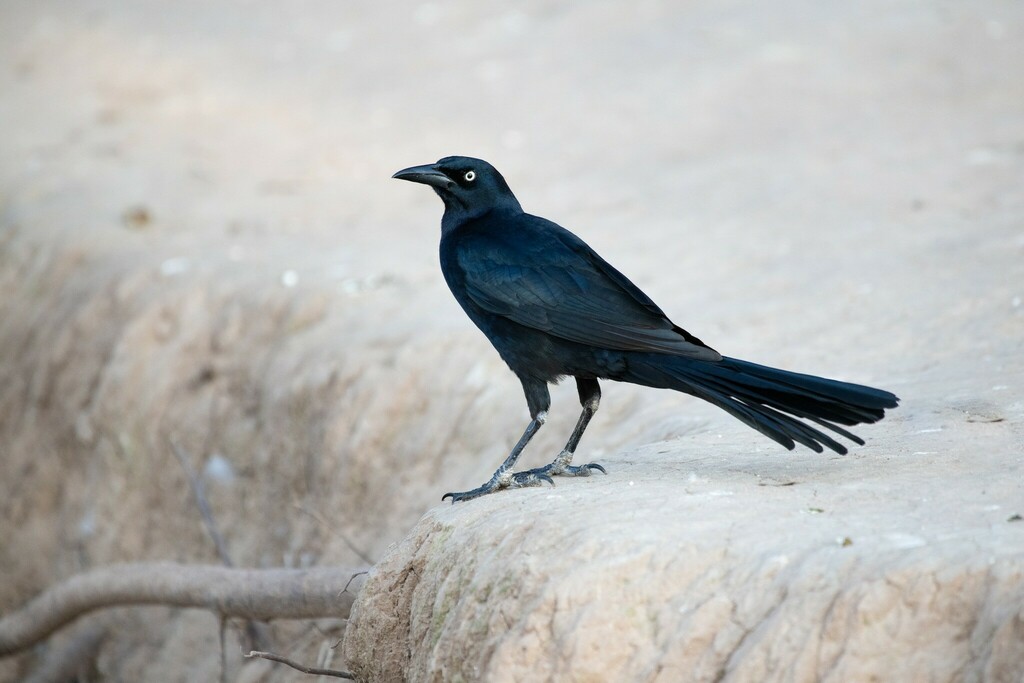
The Great-tailed Grackle is a large, sexually dimorphic blackbird native to Central America and Mexico that has expanded its range northward into California since the 1960s. Males are significantly larger than females, measuring 43-46 cm (17-18 inches) in length with a wingspan reaching 58 cm (23 inches), while females are smaller at 33-38 cm (13-15 inches). Adult males display iridescent black plumage with purple, blue, and green sheens, particularly visible on the head and neck. Their most distinctive feature is the elongated, keel-shaped tail that extends well beyond the wingtips when folded. Females are brown above with lighter, streaked underparts and have proportionally shorter tails. Both sexes have bright yellow eyes and long, pointed bills adapted for their omnivorous diet. Historically absent from California, Great-tailed Grackles began colonizing the state in the 1960s, first appearing in the Imperial Valley. The species has since expanded throughout the Central Valley, Southern California, and coastal areas, reaching as far north as the San Francisco Bay Area. Current populations are established in urban and agricultural areas across much of lowland California, with the highest densities in the Central Valley and Southern California metropolitan areas. Great-tailed Grackles inhabit open and semi-open environments including agricultural fields, urban parks, shopping centers, residential areas, and wetland edges. They show strong affinity for human-modified landscapes and are commonly found near water sources such as irrigation canals, retention ponds, and suburban water features. The species typically occurs from sea level to approximately 1,500 meters (4,900 feet) elevation in California. These highly social birds form large communal roosts, particularly during non-breeding seasons, with gatherings sometimes numbering in the thousands. Their diet is exceptionally varied, including insects, small vertebrates, eggs, nestlings, fruits, seeds, and human food scraps. Great-tailed Grackles are opportunistic foragers that walk on the ground, wade in shallow water, and glean insects from vegetation. Breeding occurs from March through July, with females constructing cup-shaped nests in trees, shrubs, or human structures. Clutch size ranges from 3-5 eggs, with an incubation period of 13-14 days. Females provide all parental care while males may mate with multiple partners. The Great-tailed Grackle is not federally or state listed and is considered a species of least concern. Populations in California continue to expand both geographically and numerically, representing one of the most successful avian colonizations of the state in recent decades. The species' adaptability to urban environments and tolerance of human activity have facilitated this rapid expansion. In some areas, large roosts have created nuisance concerns due to noise and droppings, leading to management efforts at specific sites. Unlike many bird species, the Great-tailed Grackle benefits from agricultural and urban development, utilizing irrigation systems, landscaping, and food sources associated with human habitation.
Classification
Class: Aves · Order: Passeriformes · Family: Icteridae
Frequently asked questions
How is Quiscalus mexicanus classified?
Quiscalus mexicanus belongs to class Aves, order Passeriformes, family Icteridae.
What family does Quiscalus mexicanus belong to?
Quiscalus mexicanus is in the Icteridae family.
What is Quiscalus mexicanus?
The Great-tailed Grackle is a large, sexually dimorphic blackbird native to Central America and Mexico that has expanded its range northward into California since the 1960s.
Is Quiscalus mexicanus found in California?
Yes. Quiscalus mexicanus is recorded in California in The California Species Project's catalogue.
Related species
Other California species in the same genus, family, or bioregion.
Data from The California Species Project — 14,000+ California species with verified data from CNPS, CDFW, USFWS, and more.