Quiscalus quiscula
Common Grackle
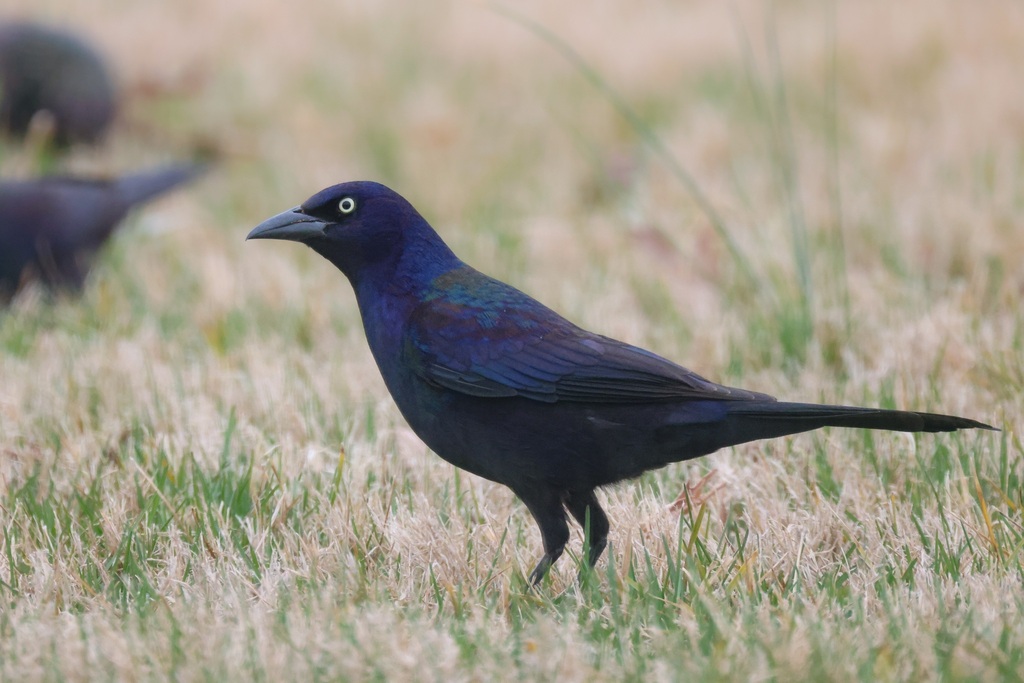
no rights reserved · CC0
Family: Icteridae · Class: Aves · Order: Passeriformes
Quiscalus quiscula (Common Grackle) is a California animal in the Icteridae family.
The Common Grackle is a medium-sized blackbird measuring 28 to 34 cm (11 to 13.4 inches) in length with a wingspan of 36 to 46 cm (14.2 to 18.1 inches). Males are notably larger than females, weighing 110 to 151 grams compared to females at 74 to 142 grams. Adult males display iridescent black plumage with a purple, bronze, or blue-green sheen, particularly on the head and body. The tail is long and keel-shaped, creating a distinctive V-profile during flight. Females are smaller and duller, with less iridescent plumbing that appears brownish-black. Both sexes have bright yellow eyes and long, pointed bills adapted for their omnivorous diet. Historically, Common Grackles were primarily distributed across eastern North America, from southern Canada to the Gulf Coast. The species has expanded its range westward over the past century, now occurring from the Atlantic Coast to the eastern slopes of the Rocky Mountains. In California, Common Grackles are considered vagrant visitors, with sporadic sightings primarily in the northeastern counties and along the Colorado River. Most California records occur during fall and winter months, likely representing birds that have wandered from established populations in neighboring states. Common Grackles inhabit a variety of open and semi-open environments including agricultural areas, urban parks, suburban neighborhoods, and woodland edges. They prefer areas with scattered trees for nesting and roosting, combined with open ground for foraging. The species adapts readily to human-modified landscapes and is commonly found near parking lots, golf courses, and residential areas with mature trees. They typically occur at elevations below 600 meters (2,000 feet) but can be found at higher elevations during dispersal. These highly social birds form large flocks outside the breeding season, sometimes numbering in the thousands. Common Grackles are opportunistic omnivores with a diverse diet including insects, earthworms, small vertebrates, grains, fruits, and human food scraps. They employ various foraging techniques, including ground gleaning, probing in soil, and occasionally catching small fish in shallow water. Breeding occurs from March through July, with pairs constructing bulky nests of twigs, grasses, and mud in tree branches 1 to 30 meters above ground. Females lay 3 to 7 pale blue to brown eggs with dark markings, incubating them for 11 to 15 days. Young fledge after 12 to 16 days but continue to receive parental care for several weeks. The Common Grackle is not federally listed and is considered a species of least concern globally. Continental populations remain stable to increasing, with Breeding Bird Survey data indicating relatively stable trends across most of the species' range. In California, the species remains a rare vagrant with no established breeding populations. Climate change may facilitate further westward range expansion, potentially leading to more frequent occurrences in California. The species' adaptability to human environments and diverse diet contribute to its overall population stability.
Classification
Class: Aves · Order: Passeriformes · Family: Icteridae
Frequently asked questions
How is Quiscalus quiscula classified?
Quiscalus quiscula belongs to class Aves, order Passeriformes, family Icteridae.
What family does Quiscalus quiscula belong to?
Quiscalus quiscula is in the Icteridae family.
What is Quiscalus quiscula?
The Common Grackle is a medium-sized blackbird measuring 28 to 34 cm (11 to 13.4 inches) in length with a wingspan of 36 to 46 cm (14.2 to 18.1 inches).
Is Quiscalus quiscula found in California?
Yes. Quiscalus quiscula is recorded in California in The California Species Project's catalogue.
Related species
Other California species in the same genus, family, or bioregion.
Data from The California Species Project — 14,000+ California species with verified data from CNPS, CDFW, USFWS, and more.