Radiocentrum avalonense
Catalina Mountainsnail
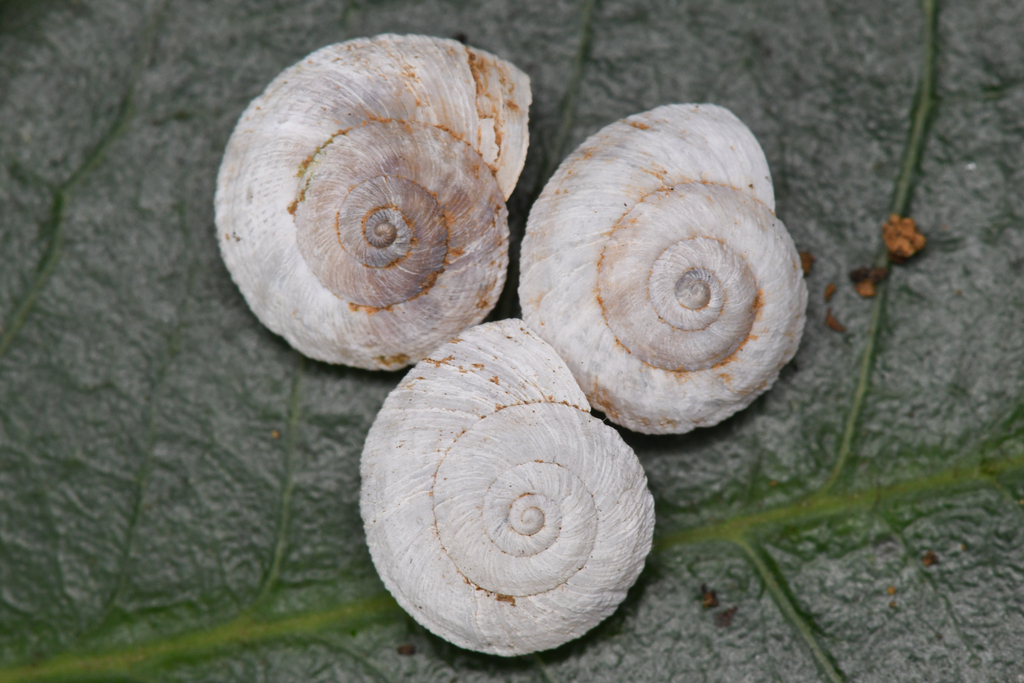
(c) Trevor Van Loon, some rights reserved (CC BY) · licence
Family: Oreohelicidae · Class: Gastropoda · Order: Stylommatophora
Conservation status: G1 S1
Radiocentrum avalonense (Catalina Mountainsnail) is a California animal in the Oreohelicidae family.
The Catalina mountainsnail (Radiocentrum avalonense) is a terrestrial gastropod mollusk endemic to Santa Catalina Island, California. This species belongs to a group of land snails that are geographically isolated on California's Channel Islands, representing relict populations from past geological periods when sea levels and climate conditions differed significantly from today. The physical characteristics of R. avalonense follow the general morphology of the genus Radiocentrum, with a relatively small, coiled shell typical of terrestrial snails. Detailed morphological descriptions of this species remain limited in the scientific literature, reflecting the challenges of studying small, endemic invertebrates on isolated islands. Like other members of its genus, the shell likely exhibits the characteristic spiral structure with multiple whorls, though specific measurements and coloration patterns have not been comprehensively documented. Radiocentrum avalonense is restricted entirely to Santa Catalina Island, located approximately 35 kilometers southwest of Los Angeles in the Pacific Ocean. This island, covering roughly 194 square kilometers, represents the species' entire known range. The snail's distribution on the island appears to be further limited to specific microhabitats that provide suitable conditions for survival and reproduction. The habitat requirements of the Catalina mountainsnail likely include areas with adequate moisture retention, organic matter for feeding, and shelter from extreme weather conditions. Island ecosystems typically support land snails in areas with native vegetation that provides leaf litter, fallen logs, and rock crevices. Santa Catalina Island's mediterranean climate, with its dry summers and mild, wet winters, creates challenging conditions for moisture-dependent invertebrates like terrestrial snails. Like other land snails, R. avalonense is presumed to be a detritivore, feeding on decomposing organic matter, fungi, and possibly algae growing on surfaces. Reproduction likely follows the hermaphroditic pattern typical of terrestrial gastropods, where individuals possess both male and female reproductive organs. Specific details about breeding behavior, seasonal activity patterns, and life cycle duration remain undocumented for this species. The conservation status of Radiocentrum avalonense reflects its extreme vulnerability as an island endemic. With a Global/State Rank of G1 S1, the species is considered critically imperiled both globally and within California (NatureServe 2024). This ranking indicates an extremely high risk of extinction due to the species' restricted range, small population size, and limited habitat availability. Island endemics face particular conservation challenges, including habitat modification, introduction of non-native species, altered fire regimes, and climate change impacts. The isolation that initially promoted speciation now increases extinction risk, as populations cannot be supplemented from other locations. No federal or state listing status has been assigned to this species as of December 2025, despite its critical conservation ranking. The lack of detailed biological and ecological studies hampers conservation planning efforts. Continued monitoring of population status and habitat conditions on Santa Catalina Island is essential for the long-term persistence of this endemic species.
Classification
Class: Gastropoda · Order: Stylommatophora · Family: Oreohelicidae
Conservation status
G1 S1
Frequently asked questions
How is Radiocentrum avalonense classified?
Radiocentrum avalonense belongs to class Gastropoda, order Stylommatophora, family Oreohelicidae.
What family does Radiocentrum avalonense belong to?
Radiocentrum avalonense is in the Oreohelicidae family.
Is Radiocentrum avalonense protected or of conservation concern?
Radiocentrum avalonense carries the following status: G1 S1.
What is Radiocentrum avalonense?
The Catalina mountainsnail (Radiocentrum avalonense) is a terrestrial gastropod mollusk endemic to Santa Catalina Island, California.
Is Radiocentrum avalonense found in California?
Yes. Radiocentrum avalonense is recorded in California in The California Species Project's catalogue.
More California species
This species has no close relatives in our California data — here are other species to explore.
Data from The California Species Project — 14,000+ California species with verified data from CNPS, CDFW, USFWS, and more.