Rallus crepitans
Clapper Rail
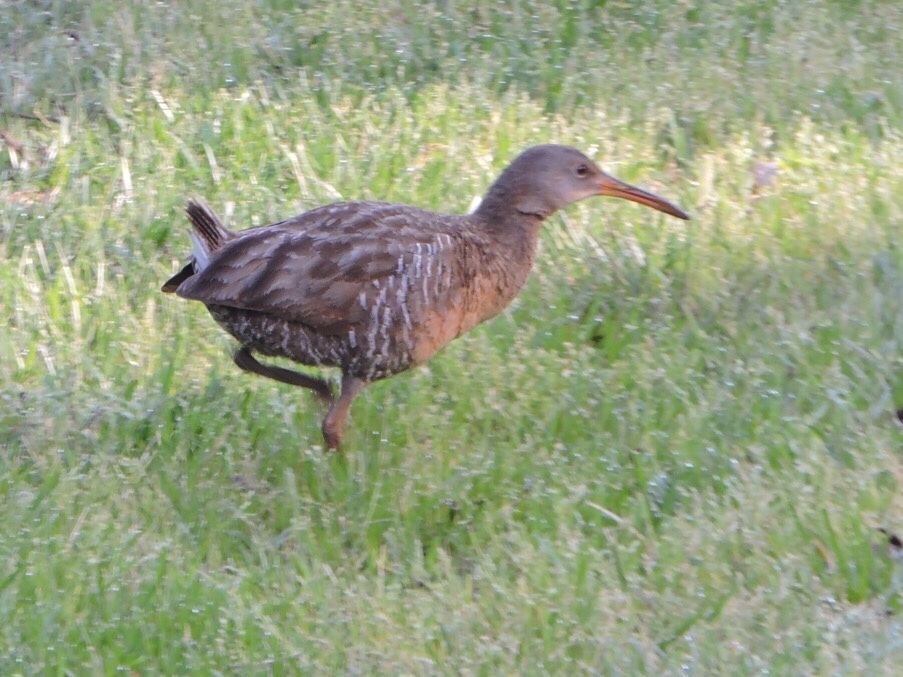
(c) Nick Newberry, some rights reserved (CC BY) · licence
Family: Rallidae · Class: Aves · Order: Gruiformes
Rallus crepitans (Clapper Rail) is a California animal in the Rallidae family.
The Clapper Rail is a medium-sized marsh bird measuring 32 to 41 cm (12.6 to 16.1 inches) in length with a wingspan of 43 to 50 cm (17 to 20 inches). Adults weigh between 180 to 340 grams (6.3 to 12 ounces). The species displays grayish-brown upperparts with darker streaking and barring, while the underparts are cinnamon-buff to rufous on the breast, fading to white on the belly. The flanks show distinctive black and white barring. A long, slightly decurved orange-yellow bill and orange-red legs distinguish this species from other rails. Females are typically larger than males, and juveniles appear duller with less distinct markings. Historically, Clapper Rails inhabited salt marshes along both the Atlantic and Pacific coasts of North America. In California, the species was found in San Francisco Bay salt marshes, with populations documented in San Mateo, Santa Clara, Alameda, Contra Costa, Solano, Napa, Sonoma, and Marin counties. However, genetic and morphological studies have led to taxonomic revisions. According to the American Ornithological Society, what was formerly considered the California Clapper Rail (Rallus longirostris obsoletus) is now classified as the Ridgway's Rail (Rallus obsoletus), recognized as a separate species as of 2014. Clapper Rails require salt marsh habitats with specific tidal characteristics and vegetation structure. They inhabit areas dominated by cordgrass (Spartina) and pickleweed (Salicornia), typically in zones that experience regular tidal flooding. The species requires a complex mosaic of tidal channels, mudflats, and vegetated areas for foraging and nesting. Optimal habitat includes areas with water depths of 5 to 25 cm (2 to 10 inches) during high tides and exposed mudflats during low tides. Clapper Rails are primarily crepuscular, with peak activity during dawn and dusk hours. Their diet consists of crabs, particularly fiddler crabs and mud crabs, supplemented by marine worms, mollusks, small fish, and occasionally plant material. The species exhibits strong territorial behavior during breeding season, which extends from March through August. Females construct platform nests of marsh vegetation, typically 15 to 46 cm (6 to 18 inches) above mean high tide level. Clutch size ranges from 6 to 14 eggs, with an average of 9 eggs. Incubation lasts 20 to 23 days, and chicks fledge after 35 to 42 days. The taxonomic status of Clapper Rail populations has significant conservation implications. While the species Rallus crepitans maintains stable populations in Atlantic coast marshes, the former California populations now recognized as Ridgway's Rail face severe conservation challenges. The U.S. Fish and Wildlife Service listed the California Clapper Rail (now Ridgway's Rail) as federally endangered in 1970. Current population estimates for Ridgway's Rail indicate fewer than 4,000 individuals remain in San Francisco Bay. Primary threats include habitat loss from development, invasive Spartina alterniflora hybridization, sea level rise, pollution, and predation by introduced mammals.
Classification
Class: Aves · Order: Gruiformes · Family: Rallidae
Frequently asked questions
How is Rallus crepitans classified?
Rallus crepitans belongs to class Aves, order Gruiformes, family Rallidae.
What family does Rallus crepitans belong to?
Rallus crepitans is in the Rallidae family.
What is Rallus crepitans?
The Clapper Rail is a medium-sized marsh bird measuring 32 to 41 cm (12.6 to 16.1 inches) in length with a wingspan of 43 to 50 cm (17 to 20 inches).
Is Rallus crepitans found in California?
Yes. Rallus crepitans is recorded in California in The California Species Project's catalogue.
Related species
Other California species in the same genus, family, or bioregion.
Data from The California Species Project — 14,000+ California species with verified data from CNPS, CDFW, USFWS, and more.