Rallus obsoletus
Ridgway's Rail
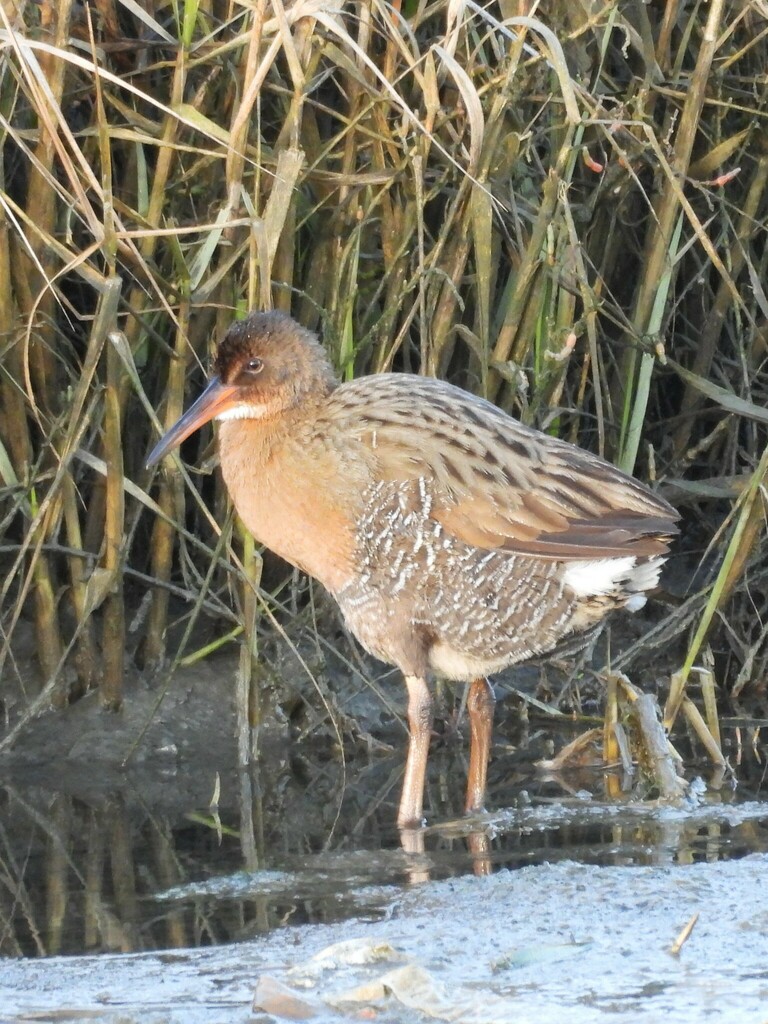
(c) P Holroyd, some rights reserved (CC BY) · licence
Family: Rallidae · Class: Aves · Order: Gruiformes
Rallus obsoletus (Ridgway's Rail) is a California animal in the Rallidae family.
Ridgway's Rail is a large, secretive marsh bird that ranges from 13 to 19 inches in length from bill to tail. This species exhibits the characteristic long legs, long toes, and short tail typical of rails, with a relatively long bill adapted for probing in mud and vegetation. The bird displays brown and gray plumage with darker barring on the back and flanks, providing effective camouflage in marsh environments. The species occurs along the Pacific Coast from San Francisco Bay south to Baja California, Mexico, and in freshwater and brackish marshes of the Colorado River system in southeastern California and southwestern Arizona. Three subspecies are recognized: the California Ridgway's Rail (R. o. obsoletus) found in San Francisco Bay and surrounding marshes, the Light-footed Ridgway's Rail (R. o. levipes) inhabiting coastal Southern California marshes, and the Yuma Ridgway's Rail (R. o. yumanensis) occurring in freshwater and brackish marshes of the Colorado River valley extending into northwestern Sonora, Mexico. Ridgway's Rail inhabits tidal salt marshes, brackish marshes, and freshwater wetlands with dense emergent vegetation. In San Francisco Bay, nesting habitat is characterized by the presence of tidal sloughs, abundant invertebrate populations, and extensive pickleweed (Salicornia) coverage. The species requires areas with adequate water depth for foraging and dense vegetation for cover and nesting. At Upper Newport Bay, studies have documented specific home range requirements tied to marsh structure and tidal patterns (NatureServe Explorer). The species is omnivorous with a broad feeding niche, though animal matter consistently comprises a major component of the diet. Rails probe in mud and among vegetation for invertebrates, small crustaceans, worms, and occasionally consume plant material. Most eggs are laid from early April to early May, with nests constructed in dense marsh vegetation above high tide lines. The breeding system involves territorial males establishing and defending marsh territories during the breeding season. All three subspecies of Ridgway's Rail face significant conservation challenges. The California subspecies (R. o. obsoletus) and Light-footed subspecies (R. o. levipes) are federally listed as endangered, while the Yuma subspecies (R. o. yumanensis) is also listed as endangered under the Endangered Species Act (USFWS ECOS). Primary threats include habitat loss and degradation due to urban development, water diversions, invasive species, and sea level rise in coastal areas. The species has experienced severe population declines, particularly in San Francisco Bay where habitat loss has exceeded 85% since the 1800s. Conservation efforts focus on habitat restoration, invasive species control, and protection of remaining marsh systems. Climate change poses additional threats through altered precipitation patterns, increased storm intensity, and accelerated sea level rise affecting coastal marsh habitats.
Classification
Class: Aves · Order: Gruiformes · Family: Rallidae
Frequently asked questions
How is Rallus obsoletus classified?
Rallus obsoletus belongs to class Aves, order Gruiformes, family Rallidae.
What family does Rallus obsoletus belong to?
Rallus obsoletus is in the Rallidae family.
What is Rallus obsoletus?
Ridgway's Rail is a large, secretive marsh bird that ranges from 13 to 19 inches in length from bill to tail.
Is Rallus obsoletus found in California?
Yes. Rallus obsoletus is recorded in California in The California Species Project's catalogue.
Related species
Other California species in the same genus, family, or bioregion.
Data from The California Species Project — 14,000+ California species with verified data from CNPS, CDFW, USFWS, and more.