Rallus obsoletus obsoletus
California Ridgway's rail
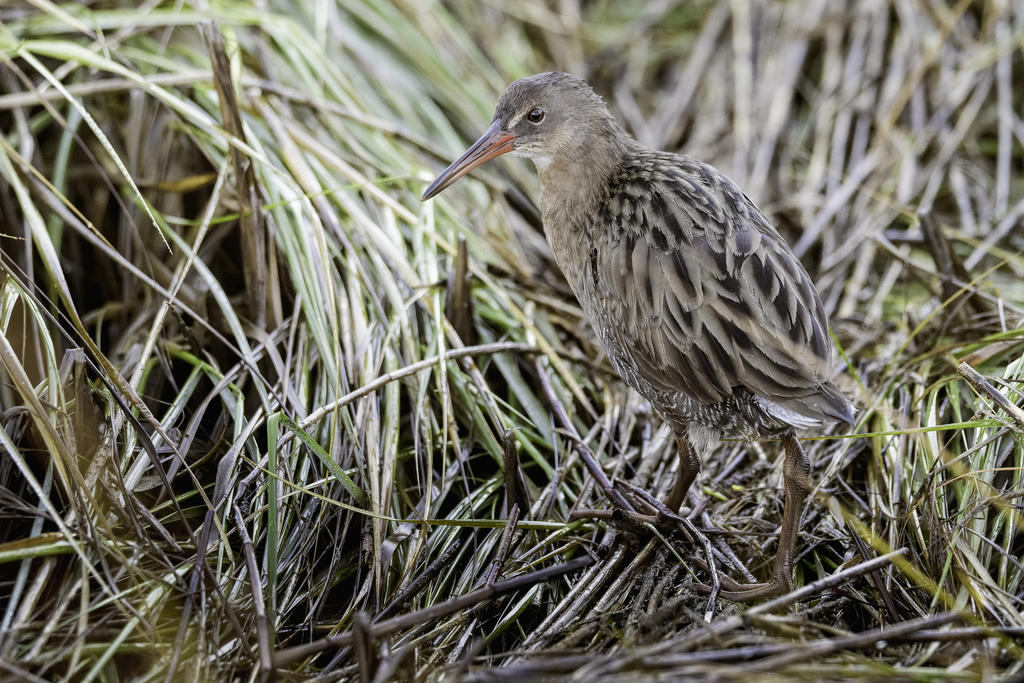
(c) cello caruso-turiello, some rights reserved (CC BY) · licence
Family: Rallidae · Class: Aves · Order: Gruiformes
Conservation status: FP · Endangered · G3T1 S2
Rallus obsoletus obsoletus (California Ridgway's rail) is a California animal in the Rallidae family.
The California Ridgway's rail is a medium-sized marsh bird with a hen-like appearance, measuring approximately 33-46 cm (13-18 inches) in length. It exhibits a long, slightly downward-curving orange-brown bill, olive-brown upper parts, and a cinnamon-buff colored breast. The flanks are dark with distinctive black and white barring, while the cheeks and flanks appear brownish-gray. Adults possess a laterally compressed body with relatively long legs and toes adapted for navigating marsh environments. The species displays sexual dimorphism, with females typically larger than males. Historically, the California Ridgway's rail was distributed throughout the San Francisco Bay salt marsh system. Currently, the subspecies is restricted to remnant tidal salt marshes around San Francisco Bay, with populations concentrated in the South Bay, North Bay, and East Bay regions. The species has experienced severe range contraction, now occupying less than 5% of its historical habitat due to extensive wetland loss and degradation. This subspecies inhabits tidal salt marshes dominated by cordgrass (Spartina foliosa) and pickleweed (Salicornia pacifica). The birds require areas with appropriate tidal flow, sufficient high tide refugia, and mudflat foraging areas. They utilize the lower littoral zone for nesting, constructing platform nests 15-60 cm above mean high water in dense vegetation that provides concealment and protection from predation. California Ridgway's rails are secretive birds that exhibit strong territorial behavior, particularly during late winter and the breeding season (Williams 1929, Albertson 1995, Garcia 1995). Territoriality diminishes during extreme high tides when cover is limited and during the post-breeding season. The species demonstrates strong site fidelity, with individuals returning to the same territories annually. They are primarily active during dawn and dusk, foraging for crabs, clams, worms, and other invertebrates in mudflats and marsh channels. Breeding occurs from March through August, with peak activity in April and May. Females typically lay 6-10 buff-colored eggs with brown markings in a cup-shaped nest. The California Ridgway's rail has been federally listed as endangered since 1970 and is classified as endangered by the State of California. According to California Department of Fish and Wildlife, the subspecies was formerly known as the California clapper rail (Rallus longirostris obsoletus) until taxonomic revisions by the American Ornithological Union in 2014 recognized it as Rallus obsoletus obsoletus. Current population estimates suggest fewer than 3,000 individuals remain. Primary threats include habitat loss from urban development, altered hydrology, sea level rise, pollution, and predation by introduced species such as Norway rats and feral cats. Conservation efforts focus on habitat restoration, predator control, and water management to maintain appropriate salinity and tidal flow patterns essential for the species' survival.
Classification
Class: Aves · Order: Gruiformes · Family: Rallidae
Conservation status
FP · Endangered · G3T1 S2
Frequently asked questions
How is Rallus obsoletus obsoletus classified?
Rallus obsoletus obsoletus belongs to class Aves, order Gruiformes, family Rallidae.
What family does Rallus obsoletus obsoletus belong to?
Rallus obsoletus obsoletus is in the Rallidae family.
Is Rallus obsoletus obsoletus protected or of conservation concern?
Rallus obsoletus obsoletus carries the following status: FP · Endangered · G3T1 S2.
What is Rallus obsoletus obsoletus?
The California Ridgway's rail is a medium-sized marsh bird with a hen-like appearance, measuring approximately 33-46 cm (13-18 inches) in length.
Is Rallus obsoletus obsoletus found in California?
Yes. Rallus obsoletus obsoletus is recorded in California in The California Species Project's catalogue.
Related species
Other California species in the same genus, family, or bioregion.
Data from The California Species Project — 14,000+ California species with verified data from CNPS, CDFW, USFWS, and more.