Rallus obsoletus yumanensis
Yuma Ridgway's rail
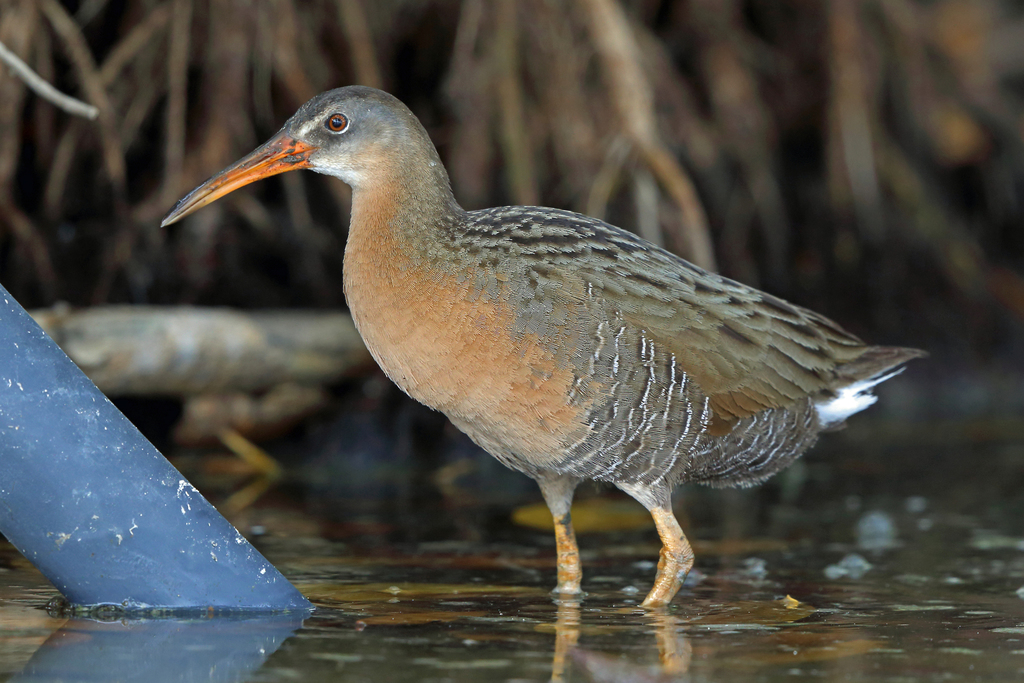
(c) Nigel Voaden, some rights reserved (CC BY) · licence
Family: Rallidae · Class: Aves · Order: Gruiformes
Conservation status: FP · Endangered · G3T3 S1
Rallus obsoletus yumanensis (Yuma Ridgway's rail) is a California animal in the Rallidae family.
The Yuma Ridgway's rail is a marsh bird approximately the size of a chicken, measuring up to 38 cm (15 inches) in length. Adults display gray-brown coloration on the dorsal surface and buffy-cinnamon below, with mottled brown or gray on the rump. The species exhibits brownish-gray cheeks and flanks distinctly barred with black and white. Adults possess a laterally compressed body structure with relatively long legs and toes compared to body size. The bill is long, somewhat orange in coloration, and slightly decurved (USFWS Species Profile). The subspecies occurs in southeastern California, southwestern Arizona, and northwestern Sonora, Mexico. In California, populations are primarily found in the Imperial Valley and Colorado River regions. The species' range extends south through the Colorado River Delta into Mexico. According to California Department of Fish and Wildlife, this subspecies was formerly known as the Yuma clapper rail (Rallus longirostris yumanensis) before taxonomic revision placed it within Rallus obsoletus. Yuma Ridgway's rails inhabit freshwater, brackish, and salt marshes throughout their range (Birds of the World). Unlike their coastal relatives, this subspecies demonstrates adaptability to diverse wetland salinity levels. The species typically occupies dense emergent vegetation including cattails, bulrushes, and other marsh plants that provide cover and nesting sites. Suitable habitat requires permanent water with adjacent mudflats or shallow areas for foraging. The Sonny Bono Salton Sea National Wildlife Refuge provides critical habitat, with wetlands maintained using irrigation water free of fertilizers and toxic pesticides (USFWS Refuge Information). This secretive rail forages primarily during dawn and dusk periods, feeding on aquatic invertebrates, small fish, and crustaceans found in shallow water and mud. The species exhibits strong territorial behavior during breeding season, with males producing distinctive clacking calls. Nesting occurs in dense marsh vegetation, with females constructing platform nests above water level. The species demonstrates strong site fidelity, often returning to the same territories annually. The U.S. Fish and Wildlife Service lists the Yuma Ridgway's rail as endangered wherever found, while California designates it as Fully Protected with threatened status. The subspecies faces significant conservation challenges from habitat loss due to water diversions, agricultural conversion, and urban development. The Colorado River's altered hydrology has substantially reduced available marsh habitat. Additional threats include invasive plant species such as salt cedar (Tamarix pentandra) that alter habitat structure, water quality degradation, and predation by introduced species. Climate change poses emerging challenges through altered precipitation patterns and increased temperatures affecting wetland stability. In 2022, USFWS initiated a five-year status review to assess current population trends and conservation needs (NatureServe 2022). Conservation efforts focus on habitat restoration, water management coordination, and invasive species control to maintain viable populations across the subspecies' limited range.
Classification
Class: Aves · Order: Gruiformes · Family: Rallidae
Conservation status
FP · Endangered · G3T3 S1
Frequently asked questions
How is Rallus obsoletus yumanensis classified?
Rallus obsoletus yumanensis belongs to class Aves, order Gruiformes, family Rallidae.
What family does Rallus obsoletus yumanensis belong to?
Rallus obsoletus yumanensis is in the Rallidae family.
Is Rallus obsoletus yumanensis protected or of conservation concern?
Rallus obsoletus yumanensis carries the following status: FP · Endangered · G3T3 S1.
What is Rallus obsoletus yumanensis?
The Yuma Ridgway's rail is a marsh bird approximately the size of a chicken, measuring up to 38 cm (15 inches) in length.
Is Rallus obsoletus yumanensis found in California?
Yes. Rallus obsoletus yumanensis is recorded in California in The California Species Project's catalogue.
Related species
Other California species in the same genus, family, or bioregion.
Data from The California Species Project — 14,000+ California species with verified data from CNPS, CDFW, USFWS, and more.