Rana aurora
Northern Red-legged Frog
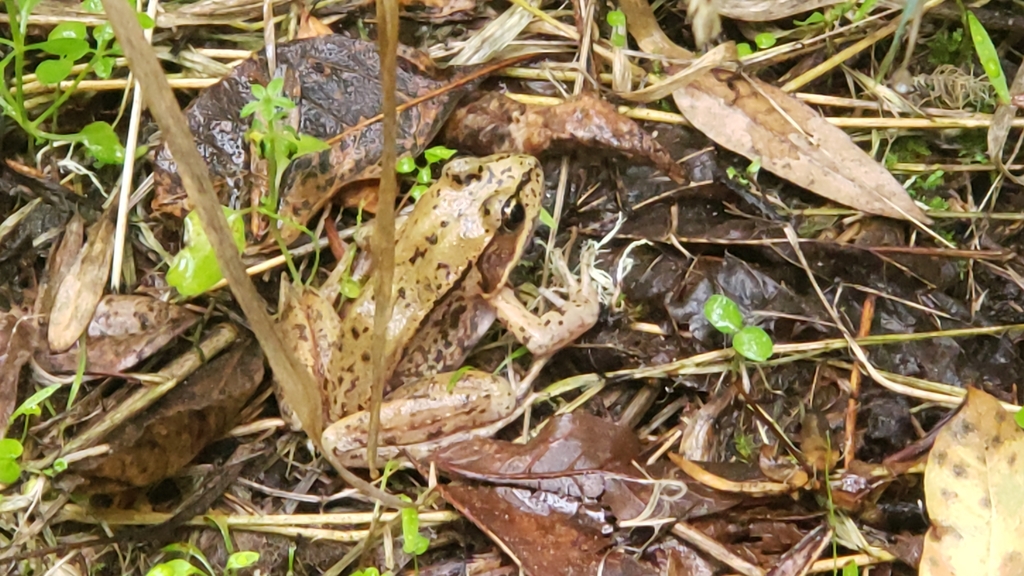
(c) Gavin Slater, some rights reserved (CC BY) · licence
Family: Ranidae · Class: Amphibia · Order: Anura
Conservation status: G4 S3
Rana aurora (Northern Red-legged Frog) is a California animal in the Ranidae family.
The Northern Red-legged Frog (Rana aurora) is a medium-sized ranid amphibian measuring 40 to 100 mm (1.6 to 3.9 inches) in snout-vent length, with females typically larger than males. The dorsal coloration ranges from brown to reddish-brown or olive, often with irregular dark spots or blotches. The species' distinguishing feature is the red or pink coloration on the ventral surfaces of the hind legs and lower abdomen, though this characteristic may be subtle in some individuals. Adults have relatively smooth skin with small tubercles, prominent dorsolateral folds, and large, prominent eyes with horizontal pupils. The toes are partially webbed, with the webbing extending about halfway to the toe tips. Historically, the Northern Red-legged Frog ranged along the Pacific Coast from southwestern British Columbia to Baja California, Mexico. In California, the species occurs in coastal regions and the Sierra Nevada foothills from sea level to approximately 1,370 meters (4,500 feet) elevation. Current populations are documented from Humboldt County south to Santa Barbara County, with isolated populations persisting in the Sierra Nevada foothills of the Central Valley. The species has experienced significant range reduction, particularly in southern California and the Central Valley, where habitat conversion and urbanization have eliminated many historical localities. Northern Red-legged Frogs inhabit a variety of aquatic and terrestrial habitats, showing preference for areas with permanent or semi-permanent water sources. Breeding occurs in shallow, still or slow-moving waters including ponds, lakes, reservoirs, slow streams, and seasonal pools. Adults require riparian vegetation and adjacent upland areas for foraging and shelter, utilizing habitats up to 100 meters from water sources. The species is associated with various plant communities including coastal scrub, grasslands, oak woodlands, and mixed coniferous forests. Larvae develop in aquatic environments with adequate vegetation cover and minimal current. Breeding activity typically occurs from November through April, with peak activity during winter months when temperatures and precipitation are favorable. Females deposit 200 to 1,100 eggs in globular masses attached to submerged vegetation or debris. Embryonic development takes 6 to 14 days depending on water temperature, and tadpoles require 11 to 20 weeks to complete metamorphosis. Adults are primarily nocturnal, feeding on insects, spiders, worms, and other small invertebrates. During dry periods, individuals may estivate under logs, rocks, or in rodent burrows up to several meters from water. The Northern Red-legged Frog is designated as a California Species of Special Concern and receives a global rank of G4 (apparently secure) and state rank of S3 (vulnerable), according to NatureServe. Primary threats include habitat loss and fragmentation from urban development, agricultural conversion, and water diversions. Introduced predators such as bullfrogs and non-native fish species pose significant threats to both larvae and adults. Water pollution from agricultural runoff, urban stormwater, and chemical contamination affects water quality in breeding habitats. Climate change impacts include altered precipitation patterns and increased drought frequency, which can eliminate breeding sites and reduce connectivity between populations.
Classification
Class: Amphibia · Order: Anura · Family: Ranidae
Conservation status
G4 S3
Frequently asked questions
How is Rana aurora classified?
Rana aurora belongs to class Amphibia, order Anura, family Ranidae.
What family does Rana aurora belong to?
Rana aurora is in the Ranidae family.
Is Rana aurora protected or of conservation concern?
Rana aurora carries the following status: G4 S3.
What is Rana aurora?
The Northern Red-legged Frog (Rana aurora) is a medium-sized ranid amphibian measuring 40 to 100 mm (1.6 to 3.9 inches) in snout-vent length, with females typically larger than males.
Is Rana aurora found in California?
Yes. Rana aurora is recorded in California in The California Species Project's catalogue.
Related species
Other California species in the same genus, family, or bioregion.
Data from The California Species Project — 14,000+ California species with verified data from CNPS, CDFW, USFWS, and more.