Rana cascadae
Cascades frog
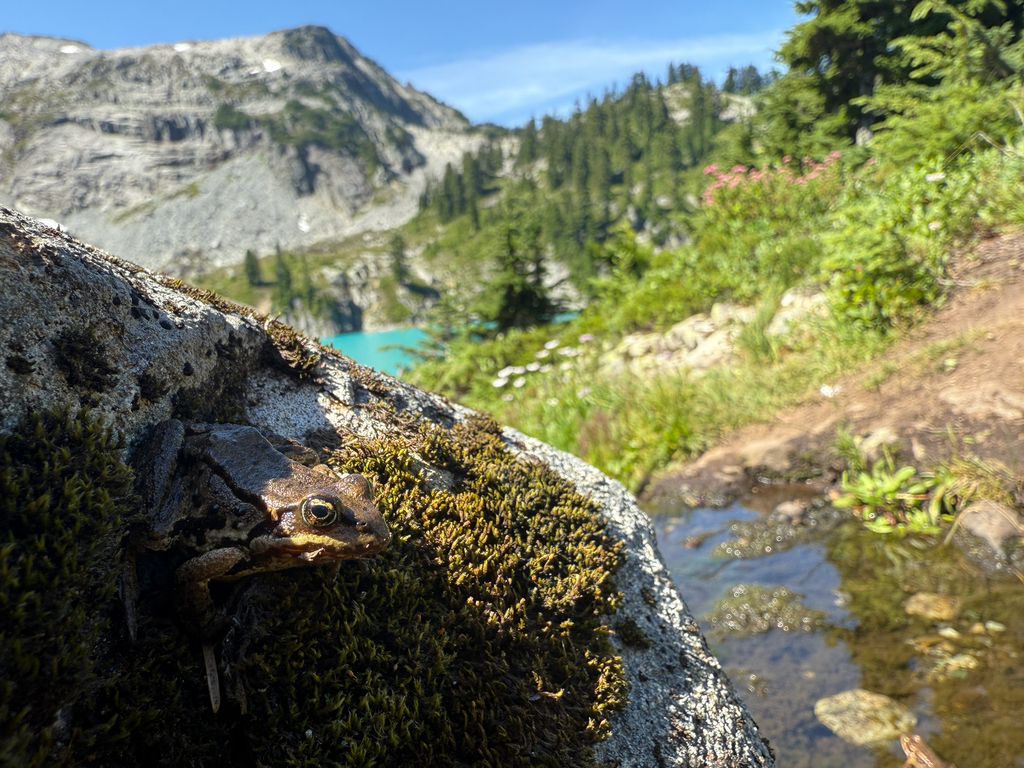
(c) Rajan Rao, some rights reserved (CC BY) · licence
Family: Ranidae · Class: Amphibia · Order: Anura
Conservation status: G3 S3
Rana cascadae (Cascades frog) is a California animal in the Ranidae family.
The Cascades frog (Rana cascadae) is a medium-sized ranid frog endemic to the Cascade Range and associated mountain systems of the Pacific Northwest. Adults typically measure 45 to 75 mm (1.8 to 3.0 inches) in snout-vent length, with females generally larger than males. The dorsal coloration ranges from brown to olive-green with darker irregular blotches and spots. The ventral surface is white to cream-colored, often with faint mottling on the throat and chest. A distinctive dark mask extends from the snout through the eye to behind the tympanum. The legs display prominent dark banding, and the skin has a relatively smooth texture compared to other Pacific Northwest ranids. Historically, Rana cascadae occurred throughout the Cascade Range from southern British Columbia to northern California. In California, populations are found primarily in the northern Sierra Nevada and southern Cascade Range, including areas of Shasta, Lassen, and Plumas counties. The species has experienced significant range contraction, with many historical localities no longer supporting populations. Current distribution is fragmented, with viable populations restricted to higher elevation sites. Cascades frogs inhabit montane and subalpine environments, typically occurring between 1,200 and 2,400 meters (3,900 to 7,900 feet) elevation. The species requires permanent or semi-permanent water bodies for reproduction, including lakes, ponds, slow-moving streams, and beaver ponds. Adults are often found in adjacent riparian and meadow habitats with dense herbaceous vegetation. Breeding sites are characterized by shallow, sun-exposed areas with emergent vegetation and minimal fish presence. The species shows preference for water bodies with neutral to slightly alkaline pH levels. Breeding occurs from late May through August, depending on elevation and snowmelt timing. Females deposit 300 to 1,500 eggs in globular masses attached to submerged vegetation in shallow water. Egg development takes 10 to 14 days, and tadpoles require 2 to 4 years to complete metamorphosis at higher elevations. Adults are primarily nocturnal and feed on a variety of terrestrial and aquatic invertebrates, including beetles, flies, spiders, and aquatic larvae. During winter, adults hibernate terrestrially under logs, rocks, or in burrows below the frost line. The California Fish and Game Commission designated Rana cascadae as a candidate species on October 11, 2017, following documented population declines and range contractions. According to CDFW assessments, the species faces multiple threats including climate change impacts on snowpack and hydroperiod, disease (particularly chytrid fungus), habitat degradation from livestock grazing, and introduced predators such as non-native fish species. UV-B radiation exposure at high elevations may contribute to increased disease susceptibility and developmental abnormalities. The species' dependence on specific hydrological conditions and extended larval development period make populations particularly vulnerable to environmental variability and habitat modification.
Classification
Class: Amphibia · Order: Anura · Family: Ranidae
Conservation status
G3 S3
Frequently asked questions
How is Rana cascadae classified?
Rana cascadae belongs to class Amphibia, order Anura, family Ranidae.
What family does Rana cascadae belong to?
Rana cascadae is in the Ranidae family.
Is Rana cascadae protected or of conservation concern?
Rana cascadae carries the following status: G3 S3.
What is Rana cascadae?
The Cascades frog (Rana cascadae) is a medium-sized ranid frog endemic to the Cascade Range and associated mountain systems of the Pacific Northwest.
Is Rana cascadae found in California?
Yes. Rana cascadae is recorded in California in The California Species Project's catalogue.
Related species
Other California species in the same genus, family, or bioregion.
Data from The California Species Project — 14,000+ California species with verified data from CNPS, CDFW, USFWS, and more.