Rana draytonii
California red- legged frog
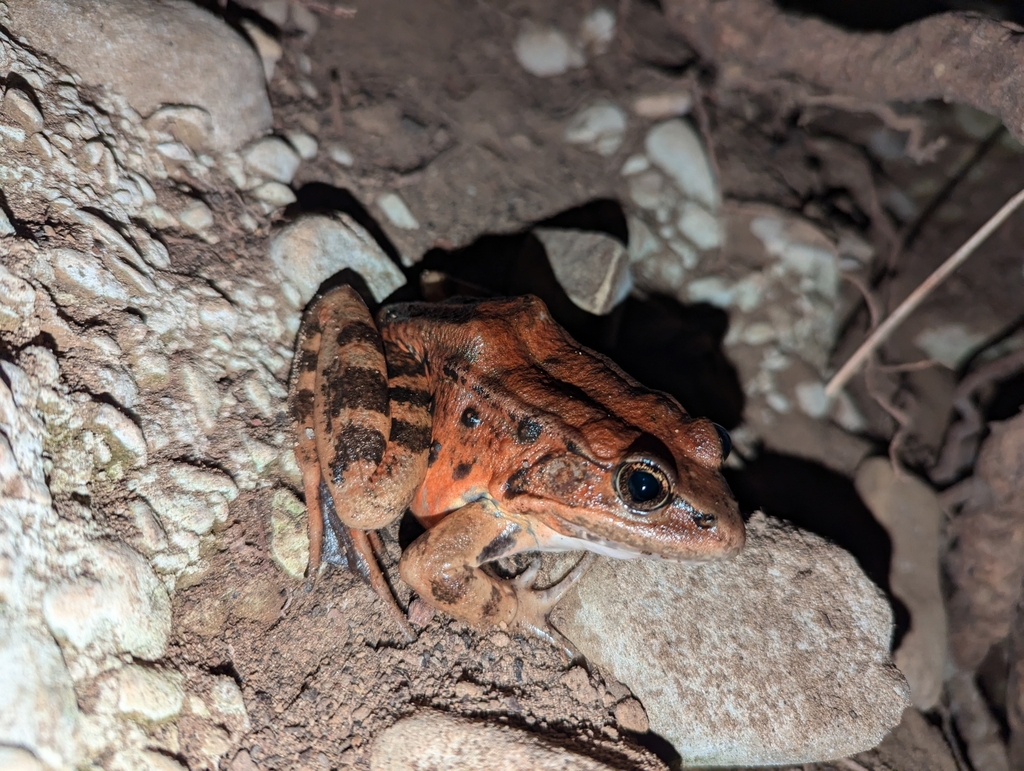
(c) Zack Abbey, some rights reserved (CC BY) · licence
Family: Ranidae · Class: Amphibia · Order: Anura
Conservation status: Threatened · G2G3 S2S3
Rana draytonii (California red- legged frog) is a California animal in the Ranidae family.
The California red-legged frog (Rana draytonii) is the largest native frog in the western United States, reaching 50 to 140 mm (2.0 to 5.5 inches) in snout-vent length. Adults exhibit reddish coloration on the posterior abdomen and hind leg undersurfaces that gives this species its common name. The dorsal surface varies from brown to olive-green with irregular dark spots or blotches. A distinctive pale stripe extends from the upper jaw to the shoulder, bordered below by a dark line. The skin is relatively smooth with small tubercles, and males develop enlarged thumbs during breeding season. Historically, California red-legged frogs ranged from Mendocino County south to Baja California, Mexico, extending inland to the Sierra Nevada foothills. According to the SummitWest Environmental Database, the species currently occurs in California and Mexico, though its range has contracted significantly. The U.S. Fish and Wildlife Service reports that the species has been eliminated from approximately 70% of its former range. Current populations are concentrated in coastal areas from Marin County to Santa Barbara County, with scattered inland populations in the Sierra Nevada foothills and isolated occurrences in Riverside and Imperial counties. California red-legged frogs inhabit aquatic and riparian environments from sea level to 1,500 meters (4,920 feet) elevation. Adults require permanent or nearly permanent water sources including natural ponds, impoundments, slow-moving streams, and marshes. Essential habitat features include emergent vegetation for cover, basking sites such as logs or rocks, and nearby upland areas within 300 feet of water for dispersal and estivation. Breeding sites typically have water depths of 0.7 meters (2.3 feet) or greater with extensive emergent vegetation. This species exhibits a complex life cycle tied to California's Mediterranean climate. Breeding occurs from November through April, peaking in January and February. Females deposit 2,000 to 5,000 eggs in globular masses attached to emergent vegetation. Tadpoles require 3.5 to 7 months to complete metamorphosis, depending on water temperature. Adults are primarily nocturnal, foraging on invertebrates, small fish, and occasionally smaller frogs. During dry periods, individuals may travel up to 2 miles between water sources, using riparian corridors and underground refugia. The California red-legged frog was listed as threatened under the Endangered Species Act in 1996. Population declines result from habitat loss and fragmentation, with an estimated 70% of historical wetland habitat in California eliminated through urban development and agricultural conversion. Additional threats include introduced predators such as bullfrogs and fish, disease including chytrid fungus, and water diversions that alter natural hydrologic cycles. The USFWS designated critical habitat covering 450,288 acres across 27 counties in 2010. Recovery efforts focus on habitat restoration, invasive species control, and establishment of population corridors to facilitate dispersal between breeding sites.
Classification
Class: Amphibia · Order: Anura · Family: Ranidae
Conservation status
Threatened · G2G3 S2S3
Frequently asked questions
How is Rana draytonii classified?
Rana draytonii belongs to class Amphibia, order Anura, family Ranidae.
What family does Rana draytonii belong to?
Rana draytonii is in the Ranidae family.
Is Rana draytonii protected or of conservation concern?
Rana draytonii carries the following status: Threatened · G2G3 S2S3.
What is Rana draytonii?
The California red-legged frog (Rana draytonii) is the largest native frog in the western United States, reaching 50 to 140 mm (2.0 to 5.5 inches) in snout-vent length.
Is Rana draytonii found in California?
Yes. Rana draytonii is recorded in California in The California Species Project's catalogue.
Related species
Other California species in the same genus, family, or bioregion.
Data from The California Species Project — 14,000+ California species with verified data from CNPS, CDFW, USFWS, and more.