Rana luteiventris
Columbia Spotted Frog
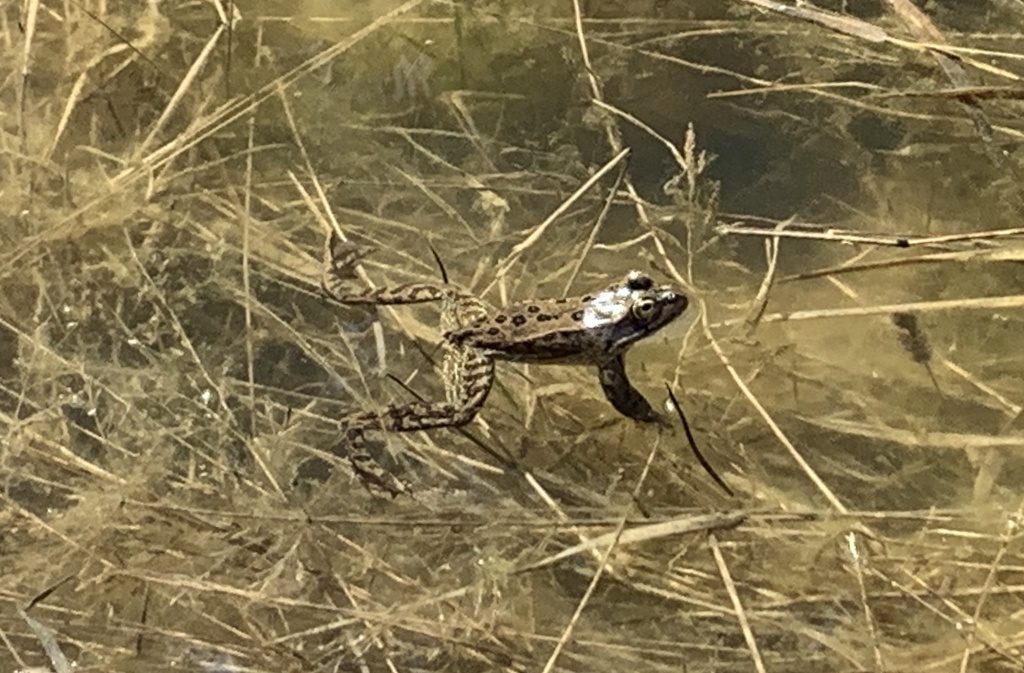
(c) John G. Phillips, some rights reserved (CC BY) · licence
Family: Ranidae · Class: Amphibia · Order: Anura
Rana luteiventris (Columbia Spotted Frog) is a California animal in the Ranidae family.
The Columbia spotted frog is a medium-sized amphibian measuring 44 to 100 mm (1.7 to 3.9 inches) in snout-to-vent length. Adults display highly variable coloration, ranging from tan to reddish-brown or olive-green dorsally, with numerous dark spots scattered across the back and sides. The ventral surface is typically yellow to orange, giving rise to the species' scientific name luteiventris, meaning "yellow belly." A distinctive light-colored jaw stripe extends from the snout to the shoulder, and prominent dorsolateral folds run along each side of the body. The hind legs are long and muscular, adapted for both terrestrial locomotion and aquatic escape. Historically, Columbia spotted frogs occurred across portions of Idaho, Nevada, and Oregon, with populations extending to the southern edge of the range in California (USFWS 2005). The species is currently found in Ada, Canyon, Elmore, Owyhee, and Twin Falls counties in Idaho; Elko, Eureka, and Nye counties in Nevada; and Grant, Harney, Lake, and Malheur counties in Oregon (USFWS 2011). The Great Basin Distinct Population Segment represents the primary conservation concern for this species. Columbia spotted frogs inhabit cool, permanent or semi-permanent water sources in montane and high desert environments. They are typically associated with springs, seeps, slow-moving streams, beaver ponds, and natural lakes at elevations ranging from 1,200 to 2,900 meters (3,900 to 9,500 feet). Suitable habitat includes areas with emergent vegetation for cover and basking sites, along with adjacent upland areas for foraging and overwintering. An estimated 90 percent of known habitat occurs on lands managed by the Forest Service and Bureau of Land Management (USFWS 2011). Adult Columbia spotted frogs are opportunistic invertivores, consuming a wide variety of insects, mollusks, and other small invertebrates (NatureServe). Breeding occurs from March through July, depending on elevation and local climate conditions. Females exhibit communal egg-laying behavior, with 25 or more egg masses often piled together in shallow water areas (AmphibiaWeb). Each female deposits 200 to 1,500 eggs in globular masses attached to submerged vegetation or debris. Tadpoles require one to three years to complete metamorphosis in high-elevation environments. The Columbia spotted frog is currently designated as a candidate species under the Endangered Species Act, indicating that listing is warranted but precluded by higher priority actions (USFWS). The largest known threat is habitat alteration and loss, attributed to drought conditions, spring developments, wetland degradation, water diversions, and road construction. Additional threats include disease, particularly chytrid fungus, non-native species introductions, and climate change impacts on high-elevation aquatic habitats. Conservation efforts focus on habitat protection and restoration throughout the species' historic range, with particular emphasis on maintaining connectivity between breeding sites and preserving critical water sources in arid landscapes.
Classification
Class: Amphibia · Order: Anura · Family: Ranidae
Frequently asked questions
How is Rana luteiventris classified?
Rana luteiventris belongs to class Amphibia, order Anura, family Ranidae.
What family does Rana luteiventris belong to?
Rana luteiventris is in the Ranidae family.
What is Rana luteiventris?
The Columbia spotted frog is a medium-sized amphibian measuring 44 to 100 mm (1.7 to 3.9 inches) in snout-to-vent length.
Is Rana luteiventris found in California?
Yes. Rana luteiventris is recorded in California in The California Species Project's catalogue.
Related species
Other California species in the same genus, family, or bioregion.
Data from The California Species Project — 14,000+ California species with verified data from CNPS, CDFW, USFWS, and more.