Rana sierrae
Sierra Nevada yellow-legged frog
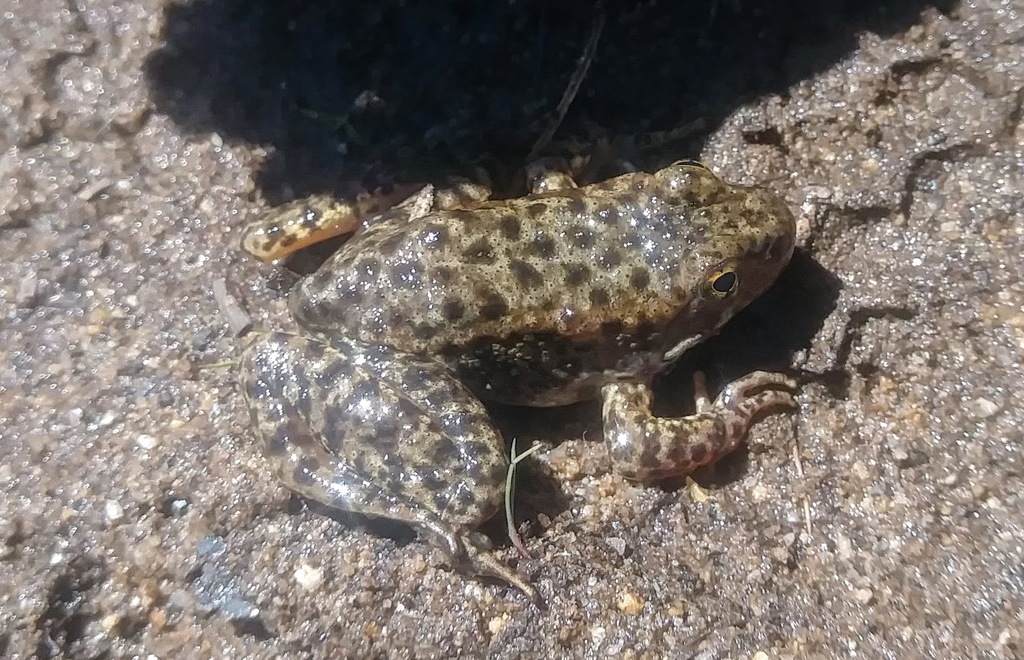
(c) Jonathan Curley, some rights reserved (CC BY) · licence
Family: Ranidae · Class: Amphibia · Order: Anura
Conservation status: ST · Endangered · G2 S2
Rana sierrae (Sierra Nevada yellow-legged frog) is a California animal in the Ranidae family.
The Sierra Nevada yellow-legged frog (Rana sierrae) is a medium-sized ranid frog endemic to the high-elevation lakes and streams of the Sierra Nevada mountain range. Adults measure 42 to 85 mm (1.7 to 3.3 inches) in snout-vent length, with females typically larger than males. The dorsal surface ranges from brown to olive-green with irregular dark spots or blotches. The ventral surface is white to pale yellow, often with a distinct yellow coloration on the underside of the hind legs that gives the species its common name. The skin is relatively smooth with minimal dorsolateral folds, and the toes are extensively webbed for aquatic locomotion. Historically, the Sierra Nevada yellow-legged frog occurred throughout the Sierra Nevada from Fresno County north to Alpine County, California, with populations extending into western Nevada. According to the U.S. Fish and Wildlife Service, the species once occupied over 2,000 water bodies across this range. Current distribution is severely fragmented, with populations persisting primarily in the central and southern Sierra Nevada, including areas within Yosemite, Sequoia, and Kings Canyon National Parks. The species has been extirpated from approximately 93% of its historical range. Sierra Nevada yellow-legged frogs inhabit high-elevation aquatic systems between 1,370 and 3,660 meters (4,500 to 12,000 feet) elevation. Adults require permanent or near-permanent water bodies including alpine and subalpine lakes, ponds, tarns, and slow-moving streams. Critical habitat features include areas with minimal flow for egg deposition, shallow warming areas for tadpole development, and rocky substrates or vegetation for cover. The species is closely associated with granite bedrock formations typical of the Sierra Nevada. This species exhibits a complex life cycle adapted to the short growing season of high-elevation environments. Breeding occurs from late spring through early summer, typically May through August, depending on elevation and snowmelt timing. Females deposit 150 to 350 eggs in shallow water attached to rocks or vegetation. Tadpoles require 2 to 4 years to metamorphose, overwintering under ice in lakes and streams. Adults are opportunistic predators, feeding on insects, spiders, and other arthropods both in water and on land. The species may hibernate for up to 8 months annually under rocks or in crevices. The Sierra Nevada yellow-legged frog was listed as endangered under the Endangered Species Act in 2014. Population declines exceeding 90% have been documented since the 1970s, attributed primarily to the introduction of non-native trout, disease caused by the chytrid fungus Batrachochytrium dendrobatidis, pesticide contamination, grazing impacts, and habitat alteration. Climate change poses additional threats through altered precipitation patterns and increased temperature extremes. Recovery efforts include fish removal from historical habitat, captive breeding programs, and habitat restoration. Current population estimates suggest fewer than 500 breeding adults remain in approximately 200 water bodies across the species' range.
Classification
Class: Amphibia · Order: Anura · Family: Ranidae
Conservation status
ST · Endangered · G2 S2
Frequently asked questions
How is Rana sierrae classified?
Rana sierrae belongs to class Amphibia, order Anura, family Ranidae.
What family does Rana sierrae belong to?
Rana sierrae is in the Ranidae family.
Is Rana sierrae protected or of conservation concern?
Rana sierrae carries the following status: ST · Endangered · G2 S2.
What is Rana sierrae?
The Sierra Nevada yellow-legged frog (Rana sierrae) is a medium-sized ranid frog endemic to the high-elevation lakes and streams of the Sierra Nevada mountain range.
Is Rana sierrae found in California?
Yes. Rana sierrae is recorded in California in The California Species Project's catalogue.
Related species
Other California species in the same genus, family, or bioregion.
Data from The California Species Project — 14,000+ California species with verified data from CNPS, CDFW, USFWS, and more.