Rattus norvegicus
Norway Rat
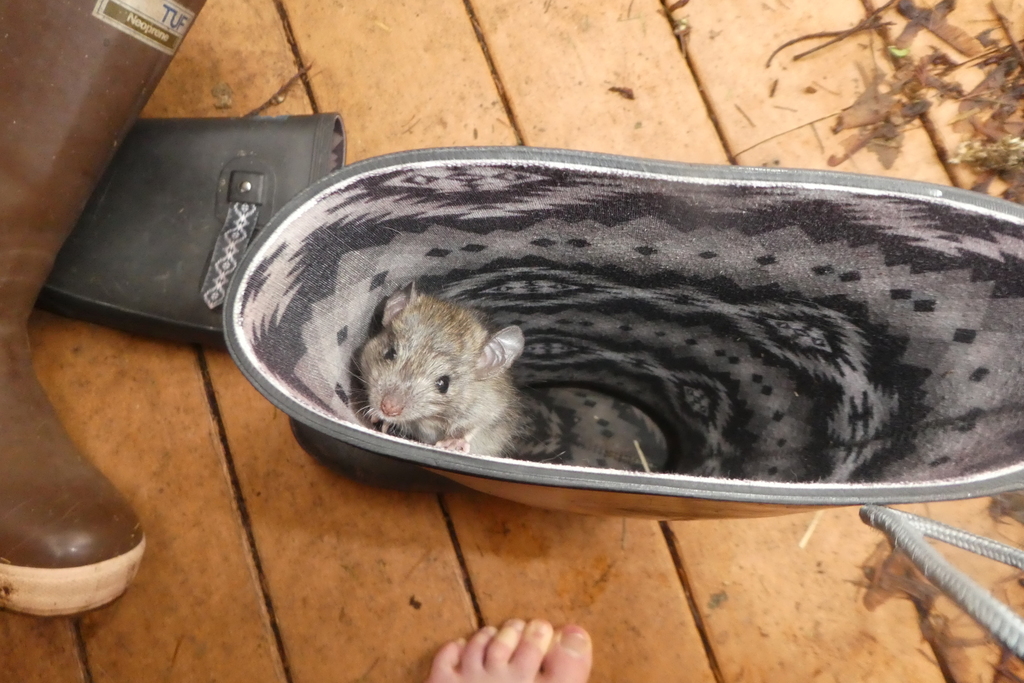
(c) Mara Christensen, some rights reserved (CC BY) · licence
Family: Muridae · Class: Mammalia · Order: Rodentia
Rattus norvegicus (Norway Rat) is a California animal in the Muridae family.
The Norway rat is a large, robust rodent species introduced to California and now established throughout the state. Adults typically measure 200 to 270 mm (7.9 to 10.6 inches) in head-body length, with tails shorter than the body at 150 to 215 mm (5.9 to 8.5 inches). Body weight ranges from 200 to 500 grams (7.1 to 17.6 ounces), with males generally larger than females. The pelage is coarse and brownish-gray dorsally, transitioning to lighter gray or white ventrally. The ears are relatively small and do not reach the eyes when folded forward. The tail is thick, scaly, and sparsely haired with visible ring-like scales. Norway rats are distributed worldwide and occur throughout California, from sea level to montane elevations. The species has established populations in all major urban areas including Los Angeles, San Francisco, Sacramento, and San Diego. Rural populations exist in agricultural areas throughout the Central Valley and coastal regions. The species is absent only from the highest elevation areas of the Sierra Nevada and other mountain ranges above 3,000 meters. This species demonstrates extensive habitat flexibility, occupying human-modified environments including residential areas, commercial districts, warehouses, sewers, and agricultural facilities. Norway rats construct extensive burrow systems in soil, beneath concrete slabs, and within building foundations. Burrows typically extend 0.5 to 1.5 meters deep with multiple entrances and chambers. The species also inhabits garbage dumps, compost areas, and food storage facilities where abundant resources are available. Norway rats are primarily nocturnal and highly social, living in colonies with established dominance hierarchies. Reproduction occurs year-round in favorable conditions, with females producing 4 to 7 litters annually. Gestation lasts 21 to 23 days, and litter sizes range from 6 to 12 young. Sexual maturity is reached at 2 to 3 months of age. The species is omnivorous, consuming grains, fruits, vegetables, meat, eggs, and garbage. Daily food consumption averages 15 to 30 grams per individual. Norway rats are excellent swimmers and climbers, capable of jumping vertically up to 77 cm (30 inches) and surviving falls from heights of 15 meters. As an introduced species, Norway rats have no conservation protection in California and are classified as an invasive pest species. Populations are stable to increasing throughout their California range. The species causes significant economic damage through crop consumption, food contamination, and structural damage to buildings. Norway rats serve as vectors for numerous diseases transmissible to humans including leptospirosis, hantavirus, and salmonellosis. Management efforts focus on population control through trapping, poisoning, and exclusion methods rather than conservation. The species' high reproductive rate and behavioral adaptability make population control challenging in urban environments.
Classification
Class: Mammalia · Order: Rodentia · Family: Muridae
Frequently asked questions
How is Rattus norvegicus classified?
Rattus norvegicus belongs to class Mammalia, order Rodentia, family Muridae.
What family does Rattus norvegicus belong to?
Rattus norvegicus is in the Muridae family.
What is Rattus norvegicus?
The Norway rat is a large, robust rodent species introduced to California and now established throughout the state.
Is Rattus norvegicus found in California?
Yes. Rattus norvegicus is recorded in California in The California Species Project's catalogue.
Related species
Other California species in the same genus, family, or bioregion.
Data from The California Species Project — 14,000+ California species with verified data from CNPS, CDFW, USFWS, and more.