Recurvirostra americana
American Avocet
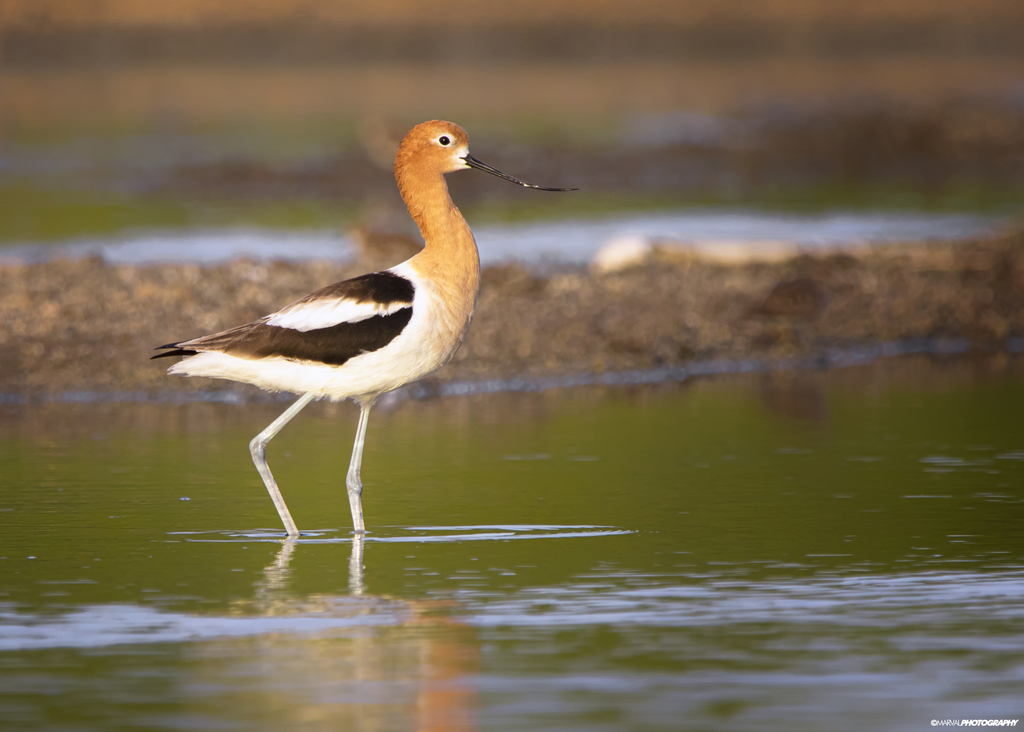
(c) MarvalPhotography19, some rights reserved (CC BY) · licence
Family: Recurvirostridae · Class: Aves · Order: Charadriiformes
Recurvirostra americana (American Avocet) is a California animal in the Recurvirostridae family.
The American Avocet is a large, distinctive shorebird measuring 40 to 46 cm (16 to 18 inches) in length with a wingspan of 61 to 71 cm (24 to 28 inches). Adults weigh between 275 and 420 grams (9.7 to 14.8 ounces). The species is characterized by its thin, black, recurved bill that curves upward, and long, blue-gray legs. During breeding season, the head and neck are cinnamon-rust colored, contrasting with a white body and black wing markings. In winter plumage, the head and neck fade to pale gray. Males typically have shorter, more strongly curved bills than females. The American Avocet breeds across western North America from southern Canada to northern Mexico. In California, the species occurs primarily in the Central Valley, San Francisco Bay Area, and southern California coastal regions. Major breeding populations are found at locations including the San Francisco Bay salt ponds, Tulare Basin wetlands, and Salton Sea. During migration and winter, avocets concentrate in coastal estuaries, inland lakes, and managed wetlands throughout the state's lowland areas. American Avocets inhabit shallow wetlands including salt ponds, alkaline lakes, mudflats, and flooded agricultural fields. They prefer water depths of 9 to 24 cm (3.5 to 9.5 inches) for optimal foraging. Breeding habitat consists of sparsely vegetated islands, mudflats, or shorelines near shallow water. Nesting sites are typically located on bare ground, short grass, or low mounds within 200 meters of water. The species tolerates a wide range of salinity levels, from freshwater to hypersaline conditions. Avocets employ a distinctive side-to-side sweeping motion of their recurved bills to capture prey from water and soft substrates. Their diet consists primarily of aquatic invertebrates including brine shrimp, midges, water boatmen, and small fish. Breeding occurs from April through July, with peak nesting in May and June. Pairs construct shallow scrapes lined with vegetation, shells, or pebbles. Females lay 3 to 4 olive-colored eggs with dark spots, which are incubated for 22 to 24 days by both parents. Chicks are precocial and leave the nest within 24 hours of hatching, reaching fledging at approximately 28 to 35 days. The American Avocet is not federally or state listed in California. Continental populations have remained relatively stable, with North American breeding surveys indicating fluctuating but generally stable trends over the past several decades. According to Partners in Flight, the global population is estimated at 450,000 individuals. In California, the species benefits from wetland restoration projects and managed water levels in wildlife refuges. Primary threats include habitat loss through wetland conversion, water diversions that reduce suitable habitat, and disturbance at breeding colonies. Climate change may affect the species through altered precipitation patterns and increased frequency of drought conditions affecting wetland availability.
Classification
Class: Aves · Order: Charadriiformes · Family: Recurvirostridae
Frequently asked questions
How is Recurvirostra americana classified?
Recurvirostra americana belongs to class Aves, order Charadriiformes, family Recurvirostridae.
What family does Recurvirostra americana belong to?
Recurvirostra americana is in the Recurvirostridae family.
What is Recurvirostra americana?
The American Avocet is a large, distinctive shorebird measuring 40 to 46 cm (16 to 18 inches) in length with a wingspan of 61 to 71 cm (24 to 28 inches).
Is Recurvirostra americana found in California?
Yes. Recurvirostra americana is recorded in California in The California Species Project's catalogue.
Related species
Other California species in the same genus, family, or bioregion.
Data from The California Species Project — 14,000+ California species with verified data from CNPS, CDFW, USFWS, and more.