Regulus satrapa
Golden-crowned Kinglet
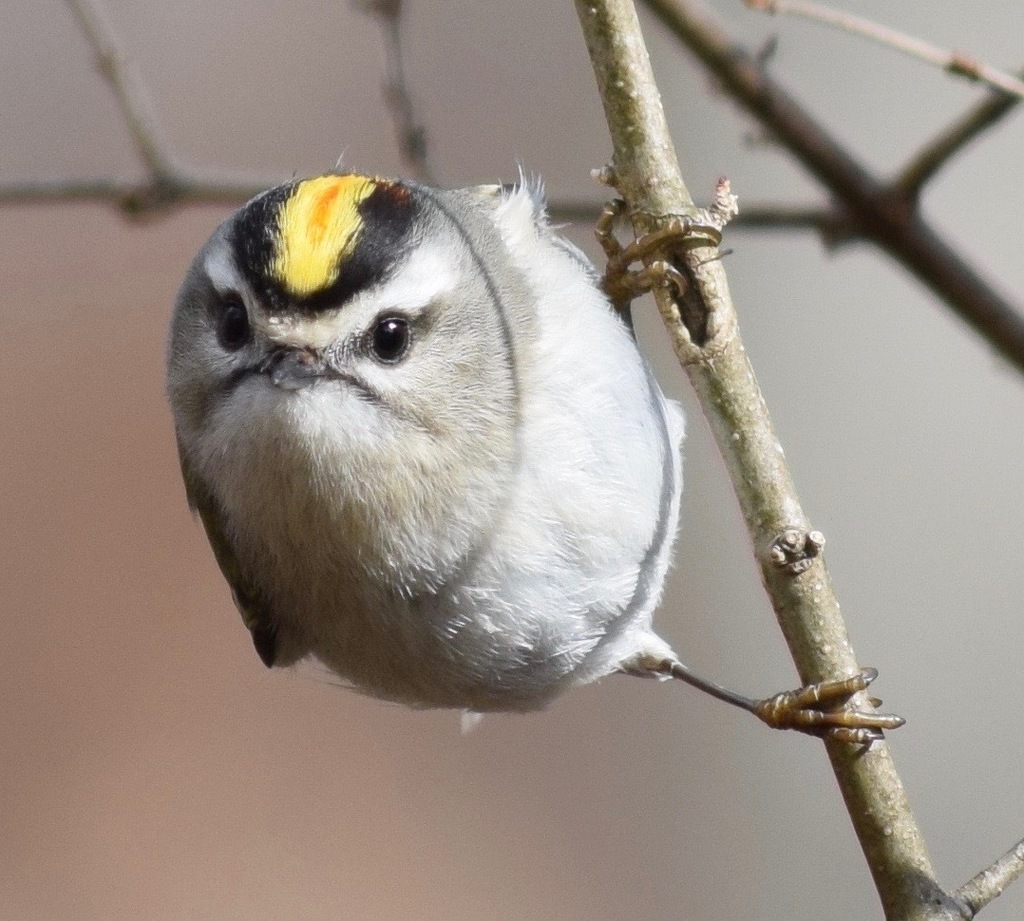
(c) skitterbug, some rights reserved (CC BY) · licence
Family: Regulidae · Class: Aves · Order: Passeriformes
Regulus satrapa (Golden-crowned Kinglet) is a California animal in the Regulidae family.
The Golden-crowned Kinglet is a diminutive songbird measuring 8.5 to 11 cm (3.3 to 4.3 inches) in length with a wingspan of 13 to 18 cm (5.1 to 7.1 inches). Adults weigh only 5 to 6 grams, making this one of North America's smallest passerines. Males display a distinctive orange-red crown stripe bordered by black and white stripes, while females show a yellow crown stripe with similar black and white borders. Both sexes exhibit olive-green upperparts, whitish underparts, and prominent white wing bars. The species has a thin, straight bill adapted for gleaning small insects from foliage. Golden-crowned Kinglets breed across the boreal forests of North America, with their range in California primarily restricted to high-elevation coniferous forests of the Sierra Nevada, Cascade Range, and northern Coast Range. The species occurs year-round in suitable montane habitat above 1,500 meters (4,900 feet) elevation, though some populations move to lower elevations during winter months. Breeding populations are documented in counties including Shasta, Lassen, Plumas, Sierra, Nevada, Placer, El Dorado, Alpine, Mono, Tuolumne, Mariposa, Fresno, Tulare, and Inyo. This kinglet inhabits mature coniferous forests dominated by fir, spruce, pine, and hemlock. The species shows strong preference for dense canopy cover and multilayered forest structure. Nests are typically constructed in the outer branches of conifers at heights of 3 to 18 meters (10 to 60 feet), often suspended from drooping branchlets. During winter, Golden-crowned Kinglets may utilize mixed woodlands and riparian forests at lower elevations. Golden-crowned Kinglets are highly active foragers, constantly moving through tree canopies while gleaning insects, spiders, and insect eggs from bark crevices and foliage. Their diet consists primarily of aphids, scale insects, caterpillars, and beetle larvae. The species exhibits acrobatic feeding behaviors, often hanging upside down to reach prey on branch undersides. Breeding occurs from April through August, with females constructing spherical nests of moss, lichens, and spider webs lined with feathers and plant down. Clutch size ranges from 5 to 11 eggs, with an average of 8 to 9 eggs per clutch. Incubation lasts 14 to 15 days, and nestlings fledge after 14 to 19 days. Golden-crowned Kinglets often form mixed-species foraging flocks with nuthatches, chickadees, and creepers during winter months. The Golden-crowned Kinglet is not federally or state-listed and maintains stable populations across most of its range. The species benefits from forest management practices that maintain mature coniferous stands with diverse canopy structure. Climate change poses potential long-term threats through upward shifts in suitable habitat elevation and altered forest composition. Breeding Bird Survey data indicates relatively stable population trends in California over recent decades, though localized declines may occur due to habitat fragmentation and severe wildfire events that eliminate mature forest canopy.
Classification
Class: Aves · Order: Passeriformes · Family: Regulidae
Frequently asked questions
How is Regulus satrapa classified?
Regulus satrapa belongs to class Aves, order Passeriformes, family Regulidae.
What family does Regulus satrapa belong to?
Regulus satrapa is in the Regulidae family.
What is Regulus satrapa?
The Golden-crowned Kinglet is a diminutive songbird measuring 8.5 to 11 cm (3.3 to 4.3 inches) in length with a wingspan of 13 to 18 cm (5.1 to 7.1 inches).
Is Regulus satrapa found in California?
Yes. Regulus satrapa is recorded in California in The California Species Project's catalogue.
Related species
Other California species in the same genus, family, or bioregion.
Data from The California Species Project — 14,000+ California species with verified data from CNPS, CDFW, USFWS, and more.