Reithrodontomys megalotis
Western Harvest Mouse
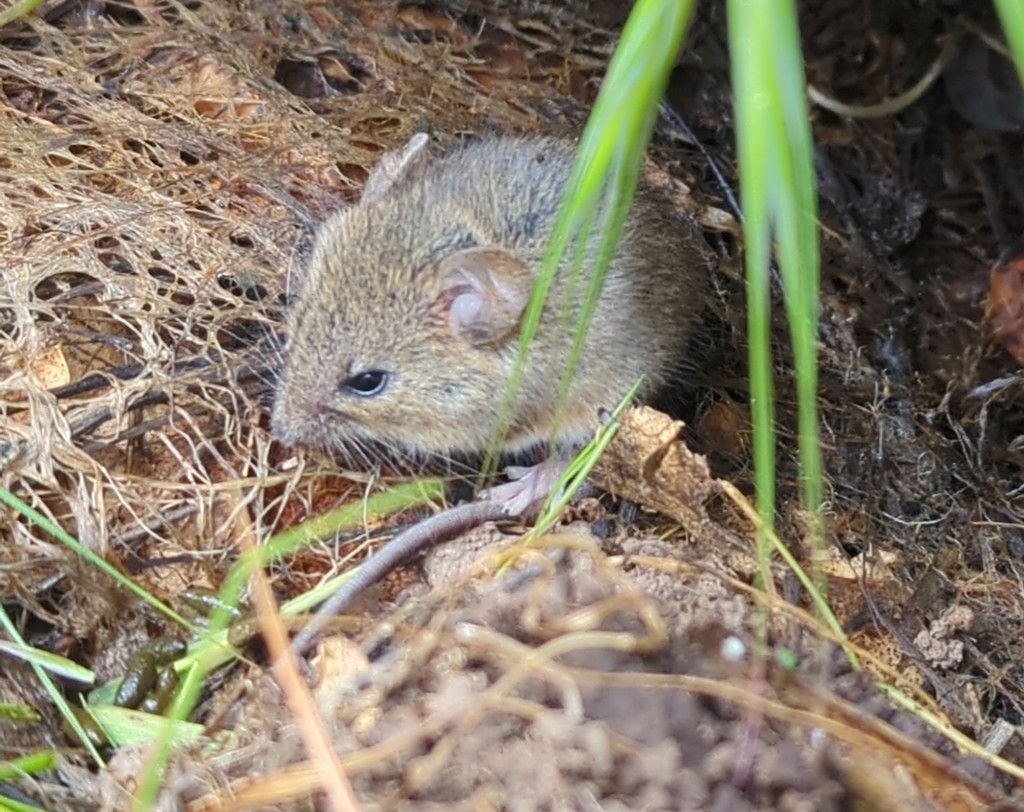
(c) Trevor Van Loon, some rights reserved (CC BY) · licence
Family: Cricetidae · Class: Mammalia · Order: Rodentia
Reithrodontomys megalotis (Western Harvest Mouse) is a California animal in the Cricetidae family.
The Western Harvest Mouse is a small rodent measuring 105 to 171 mm (4.1 to 6.7 inches) in total length, with the tail comprising approximately half of this measurement. Adults weigh 10 to 20 grams (0.35 to 0.71 ounces). The dorsal pelage ranges from pale brownish-gray to rich brown, often with a darker mid-dorsal stripe, while the ventral surface is white to pale gray. The tail is distinctly bicolored, dark above and light below, and sparsely haired. The species is distinguished from other harvest mice by its relatively large ears, measuring 12 to 16 mm, and grooved upper incisors that are characteristic of the genus Reithrodontomys. The Western Harvest Mouse has the broadest distribution of any North American harvest mouse, ranging from southern British Columbia through much of the western United States to central Mexico. In California, the species occurs throughout most of the state except for the high Sierra Nevada and extreme southeastern deserts. Populations are documented from the Central Valley, coastal regions, foothills, and montane areas up to approximately 2,400 meters (7,900 feet) elevation. The species shows considerable geographic variation across its range, with multiple subspecies recognized. This species inhabits diverse grassland and shrubland communities, including native bunch grass prairies, weedy fields, salt marshes, chaparral edges, and agricultural areas. Western Harvest Mice prefer areas with dense herbaceous cover and are particularly associated with tall grasses and forbs that provide both food resources and nesting sites. In coastal areas, they occupy salt marshes dominated by pickleweed and cordgrass. The species adapts well to disturbed habitats and can persist in agricultural landscapes with appropriate cover. Western Harvest Mice are primarily granivorous, feeding on seeds of grasses and forbs, though they also consume green vegetation, especially during periods when seeds are scarce. The species is nocturnal and semi-arboreal, constructing spherical nests of woven grass fibers attached to vegetation 0.3 to 1.2 meters above ground. Breeding occurs from spring through fall in favorable conditions, with females producing two to four litters annually. Litter size ranges from two to nine young, with an average of four to five. Gestation period is approximately 24 days, and young reach sexual maturity at two to three months of age. The Western Harvest Mouse is not federally or state-listed in California and appears to maintain stable populations across much of its range. However, local populations face threats from habitat conversion, particularly the loss of native grasslands to agriculture and urban development. In coastal areas, salt marsh populations are vulnerable to sea level rise and habitat fragmentation. The species' ability to utilize disturbed habitats and agricultural edges has likely contributed to its persistence, though populations in native habitats may be declining due to invasive plant species and altered fire regimes that reduce native grass cover.
Classification
Class: Mammalia · Order: Rodentia · Family: Cricetidae
Frequently asked questions
How is Reithrodontomys megalotis classified?
Reithrodontomys megalotis belongs to class Mammalia, order Rodentia, family Cricetidae.
What family does Reithrodontomys megalotis belong to?
Reithrodontomys megalotis is in the Cricetidae family.
What is Reithrodontomys megalotis?
The Western Harvest Mouse is a small rodent measuring 105 to 171 mm (4.1 to 6.7 inches) in total length, with the tail comprising approximately half of this measurement.
Is Reithrodontomys megalotis found in California?
Yes. Reithrodontomys megalotis is recorded in California in The California Species Project's catalogue.
Related species
Other California species in the same genus, family, or bioregion.
Data from The California Species Project — 14,000+ California species with verified data from CNPS, CDFW, USFWS, and more.