Reithrodontomys raviventris
Salt-marsh harvest mouse
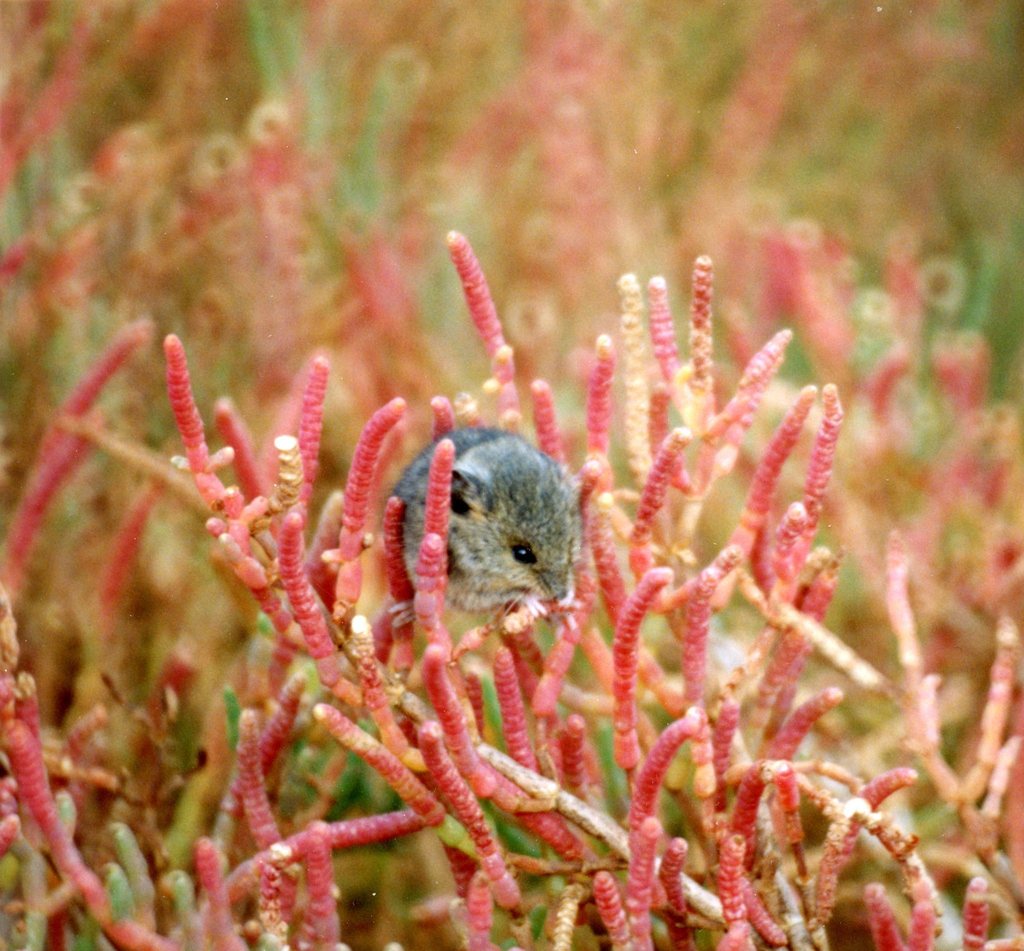
(c) Bob Dodge, some rights reserved (CC BY) · licence
Family: Cricetidae · Class: Mammalia · Order: Rodentia
Conservation status: FP · Endangered · G1G2 S3
Reithrodontomys raviventris (Salt-marsh harvest mouse) is a California animal in the Cricetidae family.
The salt-marsh harvest mouse is a small, semi-aquatic rodent endemic to the salt marshes of San Francisco Bay. Adults measure 125 to 175 mm (4.9 to 6.9 inches) in total length, including a tail of 65 to 95 mm. Body weight ranges from 8 to 21 grams. The species exhibits distinctive coloration with a reddish-brown dorsal surface and a white to pale gray ventral surface, separated by a distinct lateral line. The belly is distinctly paler than in related harvest mouse species, giving rise to its scientific name "raviventris" meaning pale-bellied. The ears are relatively large and prominent, and the tail is bicolored, dark above and light below. The salt-marsh harvest mouse occurs exclusively in the salt marshes surrounding San Francisco Bay, from Marin County south to Santa Clara County. Historically, the species likely occupied all suitable salt marsh habitat around the bay, but current distribution is highly fragmented. The largest populations persist in the North Bay, including marshes in Marin, Sonoma, Napa, and Solano counties. Smaller populations occur in the South Bay in Alameda and Santa Clara counties. The species has been extirpated from much of its historical range in the East Bay and along the Peninsula. This species inhabits only salt marshes dominated by pickleweed (Salicornia pacifica) and saltgrass (Distichlis spicata). The mice require dense vegetative cover for protection from predators and elevated areas that remain dry during high tides. They construct spherical nests woven from grass and sedge fibers, typically placed 15 to 30 cm above ground level in pickleweed or other marsh vegetation. The species demonstrates specialized physiological adaptations to saltwater, including specialized kidneys that can concentrate salt and the ability to drink seawater. Salt-marsh harvest mice are primarily nocturnal and exhibit strong swimming abilities, including the capacity to dive underwater to escape predators. Their diet consists mainly of green shoots and seeds of pickleweed, saltgrass, and other marsh plants. Breeding occurs year-round with peak activity from March through November. Females produce multiple litters annually, with gestation lasting approximately 23 days. Litter size ranges from two to five young, with an average of three. Population density varies seasonally, reaching highest levels in late summer and fall. The U.S. Fish and Wildlife Service listed the salt-marsh harvest mouse as endangered in 1970, making it one of the first mammals protected under federal endangered species legislation. California designated the species as fully protected and endangered. According to USFWS, the primary threats include habitat loss and fragmentation from urban development, sea level rise, invasive species, and altered hydrology from diking and filling of marshes. Approximately 95% of San Francisco Bay's historic salt marsh habitat has been lost. Current population estimates suggest fewer than 3,000 individuals remain across all sites. Recovery efforts focus on habitat restoration, invasive species control, and protection of existing marsh areas from further development and climate change impacts.
Classification
Class: Mammalia · Order: Rodentia · Family: Cricetidae
Conservation status
FP · Endangered · G1G2 S3
Frequently asked questions
How is Reithrodontomys raviventris classified?
Reithrodontomys raviventris belongs to class Mammalia, order Rodentia, family Cricetidae.
What family does Reithrodontomys raviventris belong to?
Reithrodontomys raviventris is in the Cricetidae family.
Is Reithrodontomys raviventris protected or of conservation concern?
Reithrodontomys raviventris carries the following status: FP · Endangered · G1G2 S3.
What is Reithrodontomys raviventris?
The salt-marsh harvest mouse is a small, semi-aquatic rodent endemic to the salt marshes of San Francisco Bay.
Is Reithrodontomys raviventris found in California?
Yes. Reithrodontomys raviventris is recorded in California in The California Species Project's catalogue.
Related species
Other California species in the same genus, family, or bioregion.
Data from The California Species Project — 14,000+ California species with verified data from CNPS, CDFW, USFWS, and more.