Rhinichthys nevadensis caldera
Long Valley Speckled Dace
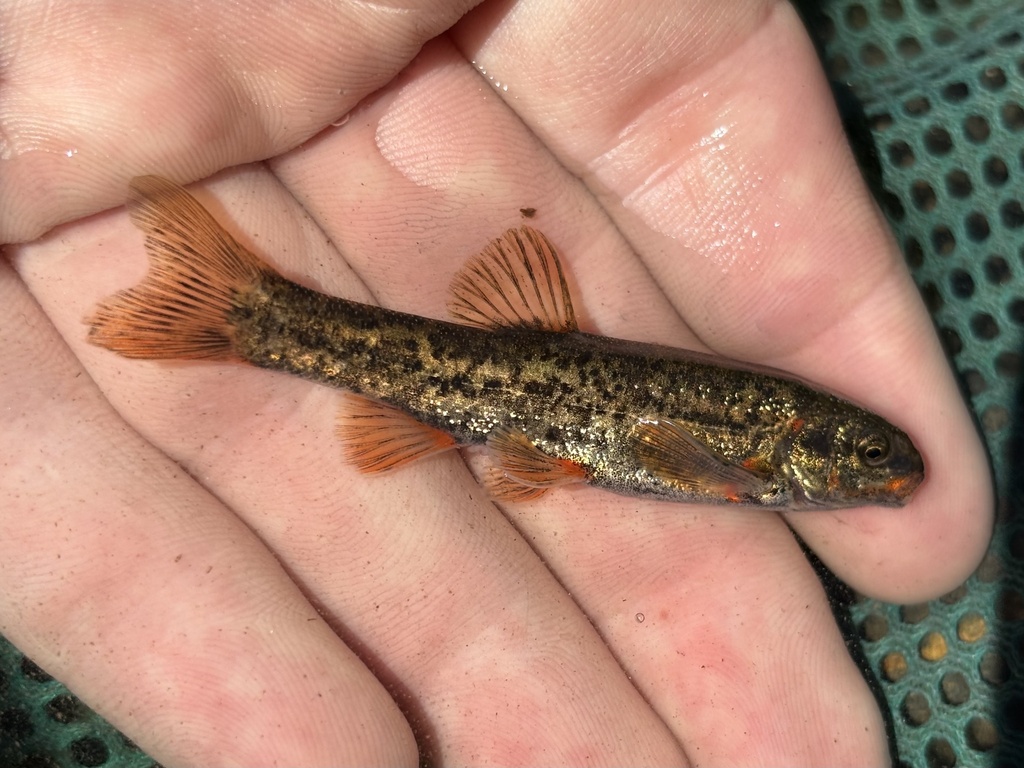
(c) Zakqary Roy, some rights reserved (CC BY) · licence
Family: Cyprinidae · Class: Actinopterygii · Order: Cypriniformes
Conservation status: Proposed Endangered · G5T1 S1
Rhinichthys nevadensis caldera (Long Valley Speckled Dace) is a California animal in the Cyprinidae family.
The Long Valley speckled dace is a small freshwater fish endemic to the eastern Sierra Nevada of California. Adults typically measure 80 to 110 millimeters (3.1 to 4.3 inches) in total length. Like other speckled dace, this subspecies exhibits a streamlined body form adapted for life in flowing water, with a subterminal mouth and small scales that create a speckled appearance along the body sides. This subspecies occurs exclusively in the Long Valley region of Mono County, California, approximately 30 miles from Bishop in the eastern Sierra Nevada. The entire known range is restricted to thermal spring systems in this isolated valley, representing one of the most geographically limited distributions of any North American freshwater fish. Historical distribution may have been slightly broader within Long Valley, but current populations are confined to a very small area. Long Valley speckled dace inhabit warm spring systems and associated outflow channels. According to recent surveys, the primary habitat is at Whitmore Marsh, where thermal springs maintain water temperatures around 89 degrees Fahrenheit (32 degrees Celsius) at the spring head, with temperatures remaining elevated throughout the outflow gradient. The habitat consists of spring-fed channels flowing through marshland dominated by three-square bulrush, with the outflow creating distinct pools downstream from the spring source. These thermal conditions distinguish the habitat from typical cold-water stream environments occupied by most other speckled dace populations. Like other members of the speckled dace complex, this subspecies likely feeds on aquatic invertebrates, algae, and organic detritus. The warm water environment may support a different invertebrate community than cold-water habitats, potentially influencing the species' diet composition. Specific information regarding reproduction, spawning timing, and life history remains limited due to the subspecies' recent taxonomic recognition and small population size. The U.S. Fish and Wildlife Service proposed listing the Long Valley speckled dace as endangered under the Endangered Species Act in August 2024, following a petition and 12-month finding process. The subspecies received its current taxonomic designation as part of a comprehensive revision of California dace taxonomy that recognized three species and six subspecies within the speckled dace complex. With a global rank of G5T1, indicating the subspecies is critically imperiled, and a state rank of S1 in California, this population faces substantial extinction risk. Primary threats include habitat degradation, water diversions, and the extremely limited range that makes the subspecies vulnerable to catastrophic events. The isolated nature of the thermal spring habitat and small population size contribute to the subspecies' precarious conservation status. Current populations are restricted to Whitmore Spring and Little Alkali Lake systems within Long Valley.
Classification
Class: Actinopterygii · Order: Cypriniformes · Family: Cyprinidae
Conservation status
Proposed Endangered · G5T1 S1
Frequently asked questions
How is Rhinichthys nevadensis caldera classified?
Rhinichthys nevadensis caldera belongs to class Actinopterygii, order Cypriniformes, family Cyprinidae.
What family does Rhinichthys nevadensis caldera belong to?
Rhinichthys nevadensis caldera is in the Cyprinidae family.
Is Rhinichthys nevadensis caldera protected or of conservation concern?
Rhinichthys nevadensis caldera carries the following status: Proposed Endangered · G5T1 S1.
What is Rhinichthys nevadensis caldera?
The Long Valley speckled dace is a small freshwater fish endemic to the eastern Sierra Nevada of California.
Is Rhinichthys nevadensis caldera found in California?
Yes. Rhinichthys nevadensis caldera is recorded in California in The California Species Project's catalogue.
Related species
Other California species in the same genus, family, or bioregion.
Data from The California Species Project — 14,000+ California species with verified data from CNPS, CDFW, USFWS, and more.