Rhinocheilus lecontei
Long-Nosed Snake
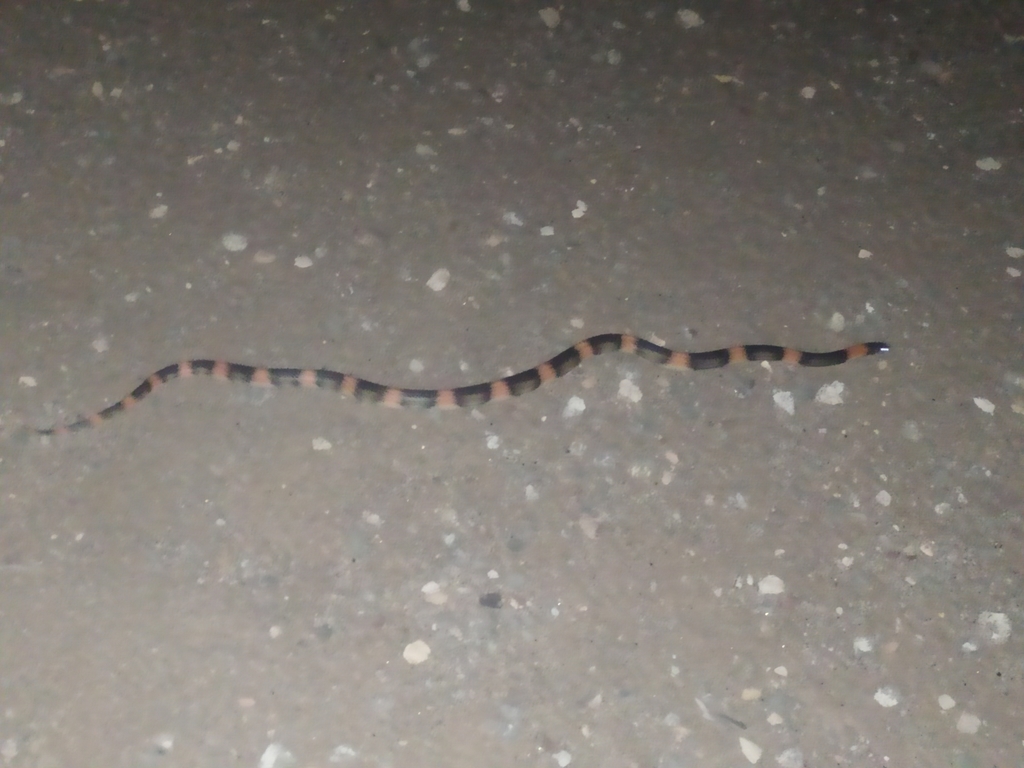
(c) Tereka Lasso, some rights reserved (CC BY-SA) · licence
Family: Colubridae · Class: Reptilia · Order: Squamata
Rhinocheilus lecontei (Long-Nosed Snake) is a California animal in the Colubridae family.
The long-nosed snake is a medium-sized, non-venomous colubrid native to southwestern North America. Adults typically measure 356 to 610 mm (14 to 24 inches) in total length, with a maximum recorded length of 1,016 mm (40 inches). The species is characterized by its distinctly pointed snout, which extends noticeably beyond the lower jaw. The body displays alternating bands of red or orange, black, and white or cream, creating a pattern that superficially resembles that of venomous coral snakes. However, the long-nosed snake can be distinguished by its banded pattern extending across the belly and its single row of subcaudal scales. In California, Rhinocheilus lecontei occurs primarily in the southeastern desert regions, including the Sonoran and Mojave deserts. The species ranges through Imperial, Riverside, and San Bernardino counties, extending eastward into Arizona, Nevada, Utah, Colorado, New Mexico, Texas, and northwestern Mexico. Historical records indicate populations in areas near the Salton Sea, Colorado River valley, and scattered locations throughout the desert mountain ranges of southeastern California. Long-nosed snakes inhabit arid and semi-arid environments, showing preference for desert scrubland, creosote bush flats, rocky hillsides, and desert grasslands. The species occurs from sea level to elevations of approximately 1,830 meters (6,000 feet). They demonstrate adaptability to various substrate types, including sandy washes, rocky outcrops, and areas with loose soil suitable for burrowing. Vegetation associations include creosote bush scrub, desert ironwood washes, and mixed desert shrubland communities. This species exhibits primarily fossorial and nocturnal behavior, spending daylight hours buried in sand or hidden beneath rocks, logs, or debris. Long-nosed snakes are constrictors, feeding predominantly on lizards, small snakes (including rattlesnakes), rodents, and occasionally bird eggs. They possess resistance to rattlesnake venom, allowing them to prey upon juvenile rattlesnakes. Reproduction occurs through egg-laying, with females typically depositing 4 to 9 eggs in summer months. Eggs are laid in sandy soil or under rocks, with incubation lasting approximately 60 to 75 days. Hatchlings emerge measuring 200 to 280 mm (8 to 11 inches) in length. The long-nosed snake currently holds no federal or state conservation listing status in California. Populations appear stable across most of the species' range, though habitat loss and degradation from urban development, agriculture, and recreational vehicle use may impact local populations. The species faces additional threats from road mortality, as individuals often cross roads during nocturnal foraging activities. Climate change may alter precipitation patterns and temperature regimes in desert habitats, potentially affecting prey availability and suitable microhabitat conditions. Despite these localized pressures, the long-nosed snake maintains a relatively widespread distribution and shows no immediate conservation concern at the species level.
Classification
Class: Reptilia · Order: Squamata · Family: Colubridae
Frequently asked questions
How is Rhinocheilus lecontei classified?
Rhinocheilus lecontei belongs to class Reptilia, order Squamata, family Colubridae.
What family does Rhinocheilus lecontei belong to?
Rhinocheilus lecontei is in the Colubridae family.
What is Rhinocheilus lecontei?
The long-nosed snake is a medium-sized, non-venomous colubrid native to southwestern North America.
Is Rhinocheilus lecontei found in California?
Yes. Rhinocheilus lecontei is recorded in California in The California Species Project's catalogue.
Related species
Other California species in the same genus, family, or bioregion.
Data from The California Species Project — 14,000+ California species with verified data from CNPS, CDFW, USFWS, and more.