Rhyacotriton variegatus
Southern Torrent Salamander
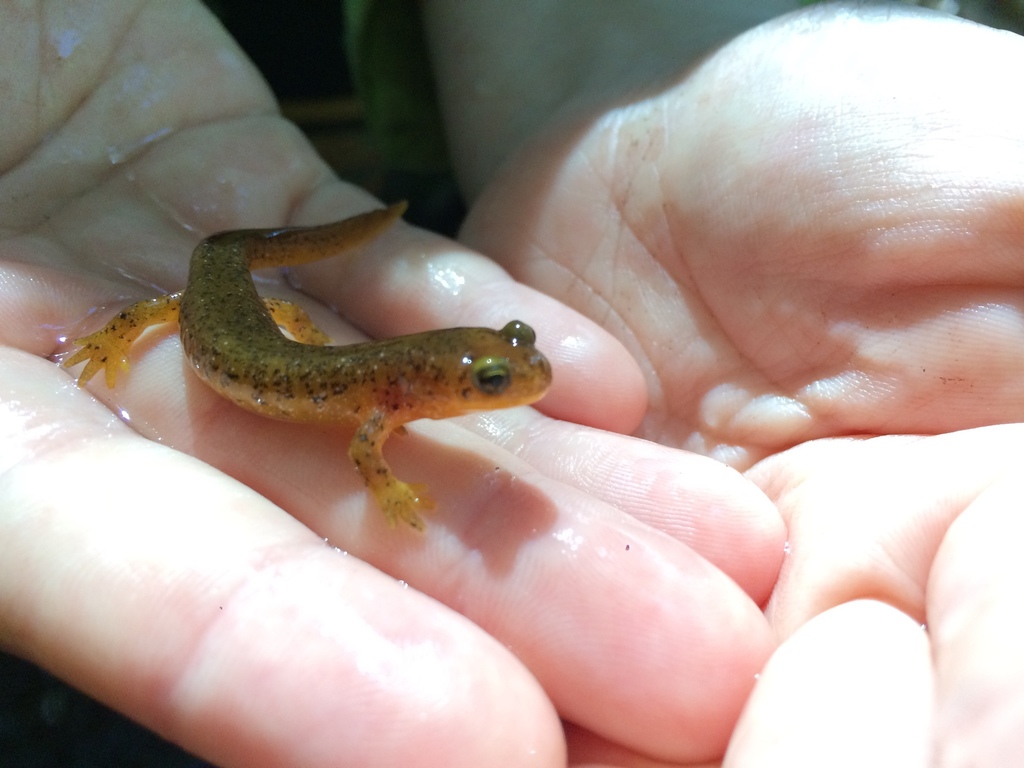
(c) B. Phalan, some rights reserved (CC BY) · licence
Family: Rhyacotritonidae · Class: Amphibia · Order: Caudata
Conservation status: G3? S2S3
Rhyacotriton variegatus (Southern Torrent Salamander) is a California animal in the Rhyacotritonidae family.
The Southern Torrent Salamander (Rhyacotriton variegatus) is a small, semi-aquatic salamander endemic to the Pacific Northwest and a member of the monotypic family Rhyacotritonidae. Adults typically measure 75 to 95 mm (3.0 to 3.7 inches) in total length, with a flattened body and relatively short tail. The dorsal surface ranges from olive-brown to dark brown with irregular yellow to orange spots or patches. The ventral surface is typically yellow to orange with dark mottling. The species exhibits a distinctive flattened appearance that distinguishes it from other salamander families, with a broad, depressed head and small eyes positioned on the dorsal surface. Historically, the Southern Torrent Salamander ranged from the Olympic Peninsula in Washington south through the Oregon Coast Range and into northwestern California. In California, the species occurs in Del Norte, Humboldt, and Mendocino counties, primarily within the coastal fog belt. Current distribution represents a significant reduction from historical range, with many populations extirpated due to habitat loss and degradation. The species is found at elevations from sea level to approximately 1,220 meters (4,000 feet). Southern Torrent Salamanders inhabit cold, clear streams and seeps in old-growth and mature coniferous forests. The species requires cool water temperatures, typically below 15°C (59°F), and high dissolved oxygen levels. Critical microhabitat features include rocky substrates with interstitial spaces, moss-covered rocks, and areas with consistent water flow. Adults are found under rocks, logs, and moss mats along stream margins and within splash zones. The species demonstrates strong fidelity to specific microhabitat conditions, rarely moving more than a few meters from water sources. Reproduction occurs in aquatic environments, with females depositing 6 to 16 unpigmented eggs in rock crevices or under large stones in flowing water. Eggs are attached individually to substrate surfaces and require approximately 9 to 10 months to hatch. Larvae are fully aquatic and undergo a prolonged development period of 3 to 4 years before metamorphosis. Adults feed primarily on small invertebrates including dipteran larvae, amphipods, and small beetles. The species exhibits minimal terrestrial activity, remaining within a few centimeters of water sources throughout its life cycle. The Southern Torrent Salamander is classified as G3? (vulnerable to apparently secure but with questions about status) globally and S2S3 (imperiled to vulnerable) in California according to NatureServe rankings. Primary threats include timber harvest practices that alter stream temperature and flow regimes, sedimentation from logging operations, and climate change effects on precipitation patterns and stream temperatures. The species' dependence on specific microhabitat conditions makes it particularly vulnerable to environmental alterations. Forest management practices that maintain canopy cover and protect riparian zones are essential for population persistence. No specific recovery plans exist, but the species benefits from old-growth forest conservation and best management practices for timber operations in aquatic environments.
Classification
Class: Amphibia · Order: Caudata · Family: Rhyacotritonidae
Conservation status
G3? S2S3
Frequently asked questions
How is Rhyacotriton variegatus classified?
Rhyacotriton variegatus belongs to class Amphibia, order Caudata, family Rhyacotritonidae.
What family does Rhyacotriton variegatus belong to?
Rhyacotriton variegatus is in the Rhyacotritonidae family.
Is Rhyacotriton variegatus protected or of conservation concern?
Rhyacotriton variegatus carries the following status: G3? S2S3.
What is Rhyacotriton variegatus?
The Southern Torrent Salamander (Rhyacotriton variegatus) is a small, semi-aquatic salamander endemic to the Pacific Northwest and a member of the monotypic family Rhyacotritonidae.
Is Rhyacotriton variegatus found in California?
Yes. Rhyacotriton variegatus is recorded in California in The California Species Project's catalogue.
More California species
This species has no close relatives in our California data — here are other species to explore.
Data from The California Species Project — 14,000+ California species with verified data from CNPS, CDFW, USFWS, and more.