Rhynchophanes mccownii
McCown's Longspur
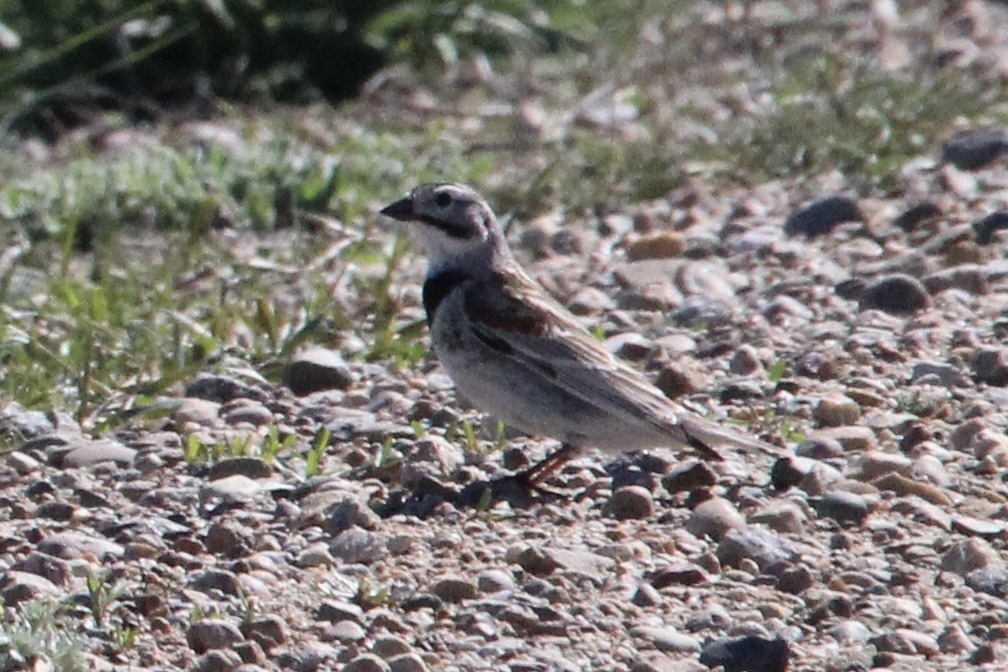
(c) Quinn, some rights reserved (CC BY-SA) · licence
Family: Calcariidae · Class: Aves · Order: Passeriformes
Rhynchophanes mccownii (McCown's Longspur) is a California animal in the Calcariidae family.
The Thick-billed Longspur (Rhynchophanes mccownii) is a medium-sized grassland songbird in the family Calcariidae. Adults measure approximately 15-16 cm (6-6.3 inches) in length with a wingspan of 26-28 cm (10-11 inches). During breeding season, males display a distinctive black crown and facial markings contrasting with white cheeks and throat. The back is mottled brown and buff with dark streaking, while the underparts are white with a prominent black bib. Non-breeding adults and females show more subdued plumage with brownish upperparts and buffy underparts. The species is distinguished from other longspurs by its thick, seed-cracking bill and distinctive tail pattern showing white outer tail feathers with a dark inverted T-shape. Historically, Thick-billed Longspurs bred across the northern Great Plains from southern Alberta and Saskatchewan south to Colorado, Nebraska, and the Dakotas. The species has experienced significant range contraction, with breeding populations now largely restricted to Montana, Wyoming, Colorado, and portions of the Dakotas. During winter, birds migrate to the southwestern United States and northwestern Mexico, with primary wintering areas in Arizona, New Mexico, and western Texas. According to Birds of the World, the species winters rarely in southern California, particularly in the Imperial Valley and southern Mojave Desert near Lancaster (Rising 1996). Breeding habitat consists of short-grass prairie and mixed-grass prairie with sparse vegetation and significant bare ground exposure. The species shows strong preference for native grasslands over cultivated areas, typically selecting sites with vegetation heights of 10-30 cm (4-12 inches). Breeding territories are often located on gentle slopes and ridgetops with good visibility. During winter, birds occupy desert grasslands, agricultural fields, and similar open habitats with short vegetation. Thick-billed Longspurs forage on the ground for seeds and insects (NatureServe Explorer). The species is primarily insectivorous during breeding season, with diet consisting mainly of orthopterans and beetles (NatureServe Explorer). Seeds become increasingly important during fall and winter, particularly grass seeds and forbs. Breeding occurs from May through July, with females constructing cup-shaped nests on the ground in shallow depressions. Clutches typically contain 3-4 eggs, which are incubated for 12-13 days. Males are polygynous and may mate with multiple females within their territories. The Thick-billed Longspur has experienced substantial population declines throughout its range, primarily due to conversion of native prairie to agriculture and urban development. According to the North American Breeding Bird Survey, populations have declined by approximately 87% since 1966. Habitat fragmentation, overgrazing, and invasive plant species present additional threats. While not federally listed, the species is considered a Bird of Conservation Concern by the U.S. Fish and Wildlife Service. Conservation efforts focus on protecting remaining native prairie habitats and implementing grazing management practices that maintain appropriate vegetation structure for breeding longspurs.
Classification
Class: Aves · Order: Passeriformes · Family: Calcariidae
Frequently asked questions
How is Rhynchophanes mccownii classified?
Rhynchophanes mccownii belongs to class Aves, order Passeriformes, family Calcariidae.
What family does Rhynchophanes mccownii belong to?
Rhynchophanes mccownii is in the Calcariidae family.
What is Rhynchophanes mccownii?
The Thick-billed Longspur (Rhynchophanes mccownii) is a medium-sized grassland songbird in the family Calcariidae.
Is Rhynchophanes mccownii found in California?
Yes. Rhynchophanes mccownii is recorded in California in The California Species Project's catalogue.
Related species
Other California species in the same genus, family, or bioregion.
Data from The California Species Project — 14,000+ California species with verified data from CNPS, CDFW, USFWS, and more.