Rhynchopsitta pachyrhyncha
Thick-billed Parrot
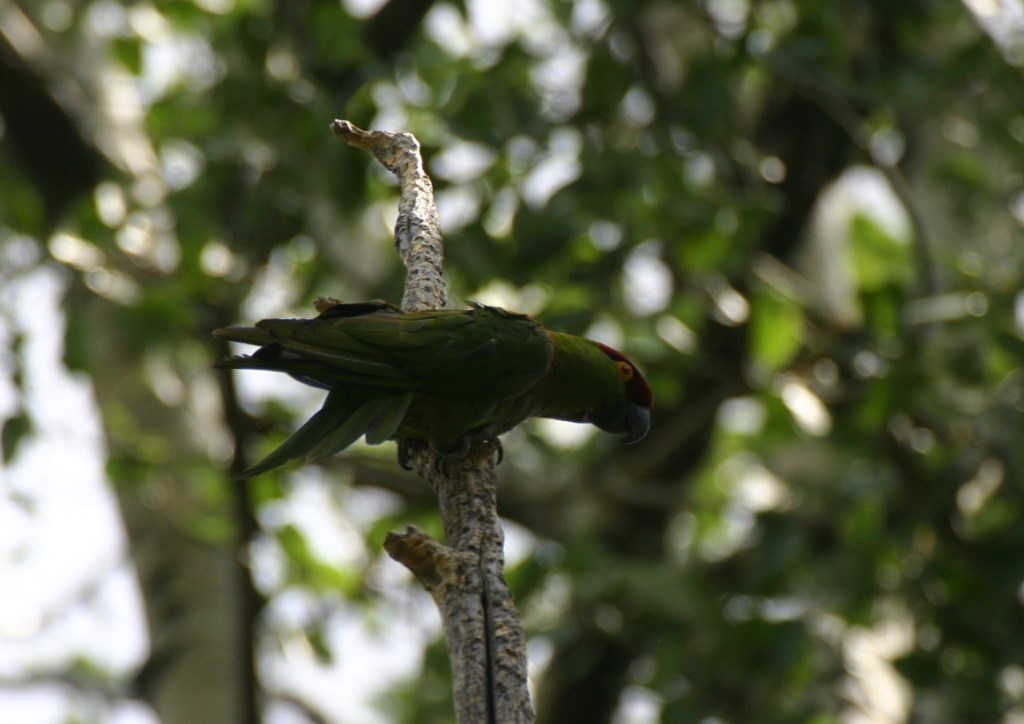
(c) Juan Cruzado Cortés, some rights reserved (CC BY-SA) · licence
Family: Psittacidae · Class: Aves · Order: Psittaciformes
Rhynchopsitta pachyrhyncha (Thick-billed Parrot) is a California animal in the Psittacidae family.
The Thick-billed Parrot is a large, robust parrot measuring 38-43 cm (15-17 inches) in length with a wingspan of approximately 66-71 cm (26-28 inches). Adults display primarily green plumage with a distinctive red forehead, crown, and shoulder patches. The species' namesake thick, black bill is well-adapted for extracting seeds from pine cones. Males and females appear similar, though males may be slightly larger. Juveniles show less extensive red markings and have horn-colored bills that darken with age. Historically, the Thick-billed Parrot's range extended into the southwestern United States, including Arizona and New Mexico (USFWS ECOS). The species was once a regular visitor to the Chiricahua Mountains of Arizona and the Animas and Peloncillo Mountains of New Mexico during late summer and early fall. However, the last confirmed U.S. occurrence was in 1938, and the species is now considered extirpated from the United States. Today, the remaining population is restricted to the Sierra Madre Occidental of northwestern and west-central Mexico, primarily in the states of Chihuahua, Durango, Sonora, and Sinaloa. Thick-billed Parrots inhabit mature coniferous forests, particularly pine-oak and pine forests above 2,000 meters elevation, though they typically occur above 2,400 meters (NatureServe Explorer). Their breeding habitat consists of old-growth forests dominated by species such as Pinus duranguensis, P. engelmannii, and P. strobiformis. The species historically shared habitat with the now-extinct Imperial Woodpecker (Birds of the World). Some foraging occurs in pine forests at lower elevations or in adjacent deciduous forests, but breeding activities remain concentrated in high-elevation mature forests. The species exhibits seasonal migration patterns, moving to lower elevations during winter months when snow covers high-elevation pine forests. Thick-billed Parrots are highly social, typically occurring in flocks of 10-40 individuals, though larger aggregations of several hundred birds have been recorded. They feed primarily on pine seeds, using their powerful bills to extract seeds from large pine cones. Breeding occurs from July to October, with pairs nesting in natural tree cavities, often in large pines or firs. Clutch size ranges from 2-4 white eggs, with an incubation period of approximately 28 days. The Thick-billed Parrot is federally listed as endangered wherever found (USFWS ECOS). The species has experienced severe population decline due to habitat loss from logging, particularly the removal of old-growth pine forests essential for nesting. Additional threats include capture for the pet trade, although this has diminished in recent decades. Climate change poses emerging concerns through potential shifts in suitable forest habitat at high elevations. The current population is estimated at fewer than 2,000-3,000 individuals in Mexico. Conservation efforts focus on habitat protection and restoration in the Sierra Madre Occidental, with ongoing research to better understand the species' ecological requirements and population dynamics.
Classification
Class: Aves · Order: Psittaciformes · Family: Psittacidae
Frequently asked questions
How is Rhynchopsitta pachyrhyncha classified?
Rhynchopsitta pachyrhyncha belongs to class Aves, order Psittaciformes, family Psittacidae.
What family does Rhynchopsitta pachyrhyncha belong to?
Rhynchopsitta pachyrhyncha is in the Psittacidae family.
What is Rhynchopsitta pachyrhyncha?
The Thick-billed Parrot is a large, robust parrot measuring 38-43 cm (15-17 inches) in length with a wingspan of approximately 66-71 cm (26-28 inches).
Is Rhynchopsitta pachyrhyncha found in California?
Yes. Rhynchopsitta pachyrhyncha is recorded in California in The California Species Project's catalogue.
Related species
Other California species in the same genus, family, or bioregion.
Data from The California Species Project — 14,000+ California species with verified data from CNPS, CDFW, USFWS, and more.