Riparia riparia
Bank swallow
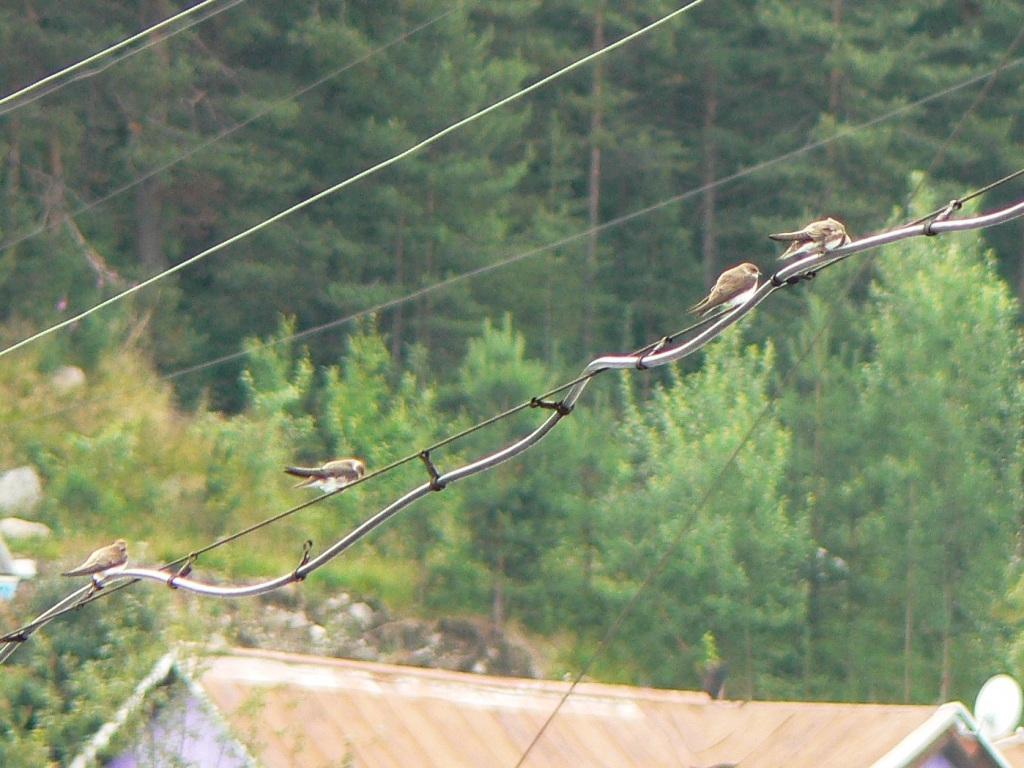
(c) Andrew Bazdyrev, some rights reserved (CC BY) · licence
Family: Hirundinidae · Class: Aves · Order: Passeriformes
Conservation status: ST · G5 S3
Riparia riparia (Bank swallow) is a California animal in the Hirundinidae family.
The bank swallow is a small migratory songbird measuring 120 to 140 mm (4.7 to 5.5 inches) in length with a wingspan of 260 to 280 mm (10.2 to 11.0 inches). Adults weigh 10 to 19 grams (0.35 to 0.67 ounces). The species displays brown upperparts and white underparts with a distinct dark brown breast band across the chest. The tail is slightly forked, and the wings are long and narrow, adapted for aerial foraging. Males and females appear similar, though males are slightly larger during breeding season. Bank swallows breed across much of North America, Europe, and Asia, making them one of the most widely distributed swallow species globally. In California, breeding populations occur primarily in the Central Valley, Sierra Nevada foothills, and coastal regions. Historical breeding sites extended throughout suitable habitat statewide, but current distribution is significantly reduced. The species migrates to Central and South America for winter, traveling distances exceeding 8,000 km (5,000 miles) annually. Breeding habitat consists of vertical banks of sand, clay, or sandy loam along rivers, streams, lakes, gravel pits, road cuts, and coastal bluffs. Banks must be at least 1 meter (3.3 feet) high with minimal vegetation on the face. Colonies require nearby open areas for foraging, including wetlands, agricultural fields, and water bodies that support abundant flying insects. The species typically nests within 3 km (1.9 miles) of water sources. Bank swallows are aerial insectivores, capturing flying insects including flies, beetles, flying ants, mayflies, and mosquitoes during continuous flight. Foraging occurs from dawn to dusk over water surfaces, fields, and wetlands. The species is highly colonial, with breeding colonies ranging from 10 to several thousand pairs. Breeding occurs from April through August, with adults excavating tunnel burrows 60 to 120 cm (24 to 47 inches) deep in suitable banks. Females lay 3 to 6 white eggs, with incubation lasting 14 to 16 days. Young fledge after 18 to 24 days but remain dependent on parents for additional weeks. California listed the bank swallow as threatened in 1989 due to severe population declines. According to the California Department of Fish and Wildlife, breeding populations declined by approximately 95 percent between 1970 and 2015. Current estimates suggest fewer than 500 breeding pairs remain statewide, concentrated primarily in the Sacramento Valley and San Joaquin Valley. Primary threats include habitat loss from bank stabilization projects, aggregate mining regulations that eliminate nesting sites, agricultural intensification, pesticide use reducing prey availability, and climate change affecting migration timing. Conservation efforts focus on protecting existing colonies, creating artificial nesting banks, managing vegetation around colony sites, and coordinating with landowners to maintain suitable habitat during breeding seasons.
Classification
Class: Aves · Order: Passeriformes · Family: Hirundinidae
Conservation status
ST · G5 S3
Frequently asked questions
How is Riparia riparia classified?
Riparia riparia belongs to class Aves, order Passeriformes, family Hirundinidae.
What family does Riparia riparia belong to?
Riparia riparia is in the Hirundinidae family.
Is Riparia riparia protected or of conservation concern?
Riparia riparia carries the following status: ST · G5 S3.
What is Riparia riparia?
The bank swallow is a small migratory songbird measuring 120 to 140 mm (4.7 to 5.5 inches) in length with a wingspan of 260 to 280 mm (10.2 to 11.0 inches).
Is Riparia riparia found in California?
Yes. Riparia riparia is recorded in California in The California Species Project's catalogue.
Related species
Other California species in the same genus, family, or bioregion.
Data from The California Species Project — 14,000+ California species with verified data from CNPS, CDFW, USFWS, and more.