Rissa tridactyla
Black-legged Kittiwake
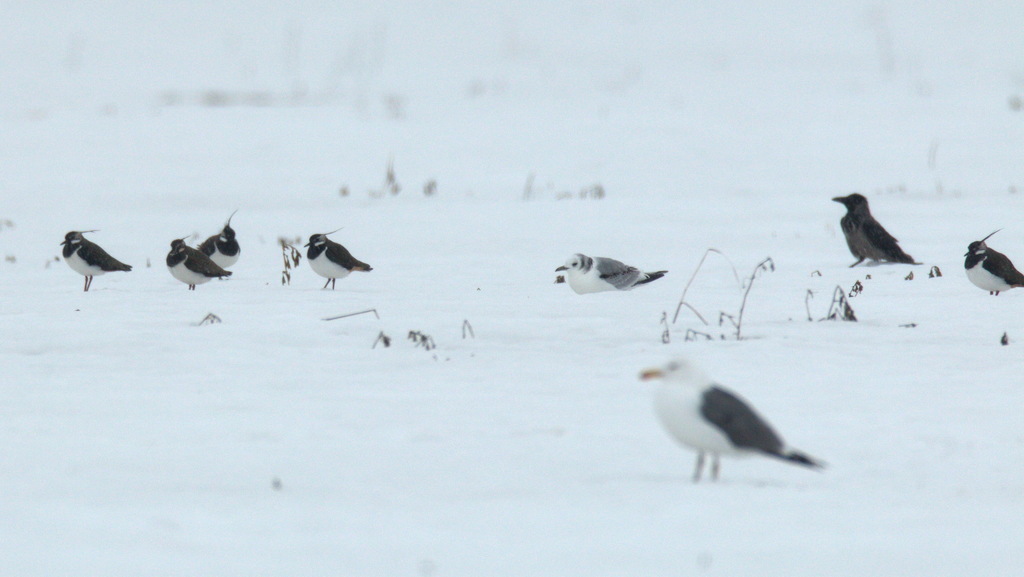
(c) Вячеслав Юсупов, some rights reserved (CC BY) · licence
Family: Laridae · Class: Aves · Order: Charadriiformes
Rissa tridactyla (Black-legged Kittiwake) is a California animal in the Laridae family.
The Black-legged Kittiwake is a medium-sized gull with distinctive characteristics that distinguish it from other members of the Laridae family. Adults measure 37 to 42 cm (14.5 to 16.5 inches) in length with a wingspan of 91 to 105 cm (36 to 41 inches). The species exhibits sexual dimorphism in size, with females averaging slightly smaller than males. Adults display clean white heads, necks, and underparts during breeding season, with pale gray mantles and wing coverts. The wings show distinctive solid black wingtips without white spots, a key identifying feature. The bill is yellow-green and moderately pointed, while the legs are black, giving the species its common name. Non-breeding adults develop a gray wash across the nape and behind the eye. Juveniles display a distinctive black 'W' pattern across the wings and back, with a black collar and black-tipped tail. The Black-legged Kittiwake has a circumpolar distribution in northern oceans. Along the Pacific Coast of North America, the species breeds from Alaska south to central California. In California, breeding colonies are found on offshore islands and remote coastal cliffs from Humboldt County south to the Channel Islands. Major breeding sites include the Farallon Islands, Castle Rock, and various sea stacks along the northern coast. During winter months, birds disperse widely across the Pacific Ocean, with some individuals remaining off the California coast while others migrate as far south as Baja California. This highly pelagic species nests exclusively on steep cliff faces, rocky ledges, and narrow crevices of coastal islands and mainland cliffs. Kittiwakes construct their nests on the smallest available ledges, often less than 30 cm wide, using seaweed, grass, and mud to create a substantial platform. The species shows strong site fidelity, with pairs often returning to the same ledge for multiple breeding seasons. Outside the breeding season, Black-legged Kittiwakes are entirely oceanic, foraging over continental shelf waters and deep ocean environments. Black-legged Kittiwakes are colonial nesters, with breeding colonies ranging from a few pairs to several thousand individuals. The breeding season extends from May through August in California. Pairs engage in elaborate courtship displays including head-tossing and regurgitation feeding. Females typically lay two to three pale blue or greenish eggs spotted with brown markings. Both parents incubate eggs for 25 to 32 days and share chick-rearing duties. Young fledge after 34 to 58 days but may return to the nest for additional feeding. The species feeds primarily on small schooling fish, particularly anchovies, sardines, and juvenile rockfish, captured through surface dipping and shallow plunge-diving. Kittiwakes also consume marine invertebrates, squid, and zooplankton. The Black-legged Kittiwake is not federally or state listed in California as of December 2025. However, the species faces conservation challenges including climate change impacts on prey availability, ocean warming, and human disturbance at breeding sites. El Niño events can significantly affect breeding success by altering prey fish distribution. Pollution, particularly plastic debris ingestion, poses additional threats to this oceanic species.
Classification
Class: Aves · Order: Charadriiformes · Family: Laridae
Frequently asked questions
How is Rissa tridactyla classified?
Rissa tridactyla belongs to class Aves, order Charadriiformes, family Laridae.
What family does Rissa tridactyla belong to?
Rissa tridactyla is in the Laridae family.
What is Rissa tridactyla?
The Black-legged Kittiwake is a medium-sized gull with distinctive characteristics that distinguish it from other members of the Laridae family.
Is Rissa tridactyla found in California?
Yes. Rissa tridactyla is recorded in California in The California Species Project's catalogue.
Related species
Other California species in the same genus, family, or bioregion.
Data from The California Species Project — 14,000+ California species with verified data from CNPS, CDFW, USFWS, and more.