Romaleon antennarium
Pacific Rock Crab
no rights reserved · CC0
Family: Cancridae · Class: Malacostraca · Order: Decapoda
Romaleon antennarium (Pacific Rock Crab) is a California animal in the Cancridae family.
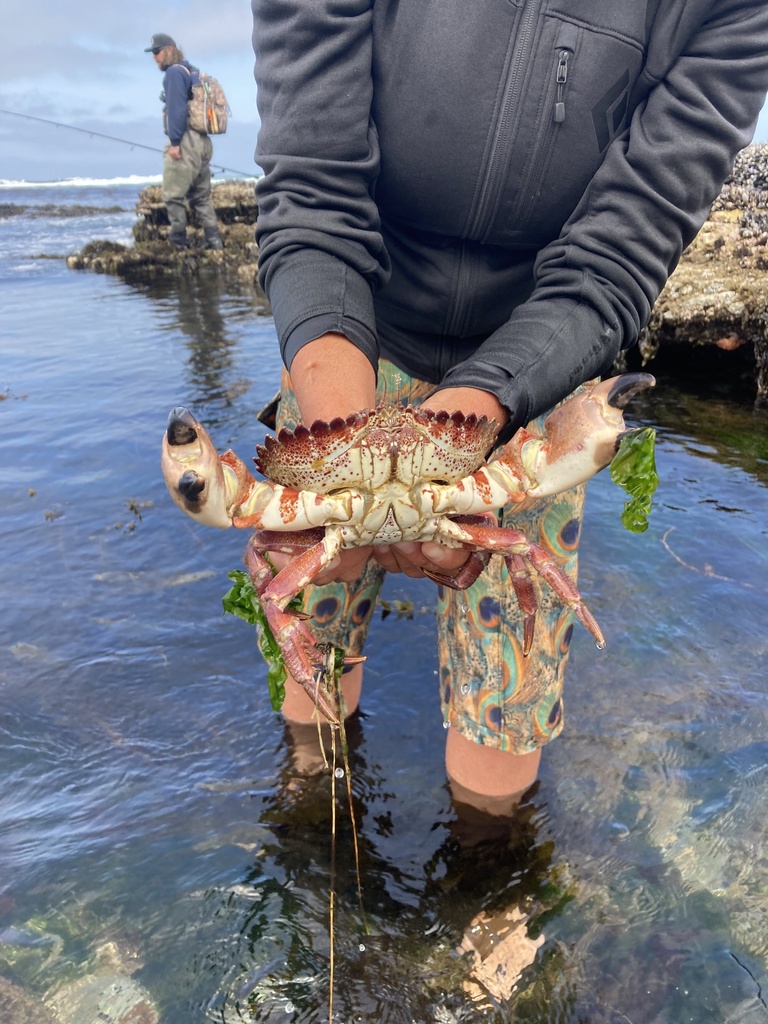
The Pacific rock crab is a medium-sized marine crustacean belonging to the family Cancridae. Adults typically measure 100 to 150 mm (4 to 6 inches) in carapace width, with males generally growing larger than females. The carapace is oval-shaped and moderately convex, displaying a reddish-brown to purplish-brown coloration with darker mottling. The chelipeds (claws) are robust and relatively large compared to body size, with the right claw often slightly larger than the left. The walking legs are hairy and well-developed for movement across rocky substrates. Pacific rock crabs occur along the Pacific coast from Alaska to Baja California, Mexico. In California, they are distributed from the Oregon border south to Point Conception, with populations extending into the Channel Islands. The species is most abundant in central and northern California waters, where suitable rocky habitat is prevalent. This species inhabits rocky intertidal and subtidal zones from the low tide line to depths of approximately 80 meters (262 feet). Pacific rock crabs prefer areas with complex topography including boulder fields, rocky reefs, crevices, and kelp forests. They are also found on mixed substrates of rock, gravel, and coarse sand. Juveniles often occupy tide pools and shallow subtidal areas with algal cover, while adults typically occur in deeper rocky habitats. Pacific rock crabs are opportunistic omnivores, feeding on a diverse diet including algae, barnacles, mussels, small fish, worms, and detritus. They use their powerful claws to crush shells and manipulate food items. The species exhibits nocturnal foraging behavior, emerging from crevices and under rocks during nighttime hours. Mating occurs throughout the year with peaks in spring and summer. After mating, females carry fertilized eggs attached to their abdomens for several months before releasing planktonic larvae. The larvae undergo multiple molting stages in the water column before settling as juveniles. The Pacific rock crab is not listed under federal or state endangered species legislation and appears to maintain stable populations throughout its range. The species supports both commercial and recreational fisheries in California, though catch levels are significantly lower than for Dungeness crab. According to the California Department of Fish and Wildlife, rock crab fisheries operate along the entire California coast from Crescent City to Mission Beach. The species faces typical coastal pressures including habitat modification, water quality changes, and climate-related ocean acidification, but these do not currently threaten population viability. Pacific rock crabs play important ecological roles as both predators and prey in rocky intertidal and subtidal communities, contributing to ecosystem balance in California's marine environments.
Classification
Class: Malacostraca · Order: Decapoda · Family: Cancridae
Frequently asked questions
How is Romaleon antennarium classified?
Romaleon antennarium belongs to class Malacostraca, order Decapoda, family Cancridae.
What family does Romaleon antennarium belong to?
Romaleon antennarium is in the Cancridae family.
What is Romaleon antennarium?
The Pacific rock crab is a medium-sized marine crustacean belonging to the family Cancridae.
Is Romaleon antennarium found in California?
Yes. Romaleon antennarium is recorded in California in The California Species Project's catalogue.
Related species
Other California species in the same genus, family, or bioregion.
Data from The California Species Project — 14,000+ California species with verified data from CNPS, CDFW, USFWS, and more.