Rothschildia cincta
Cincta rothschildia
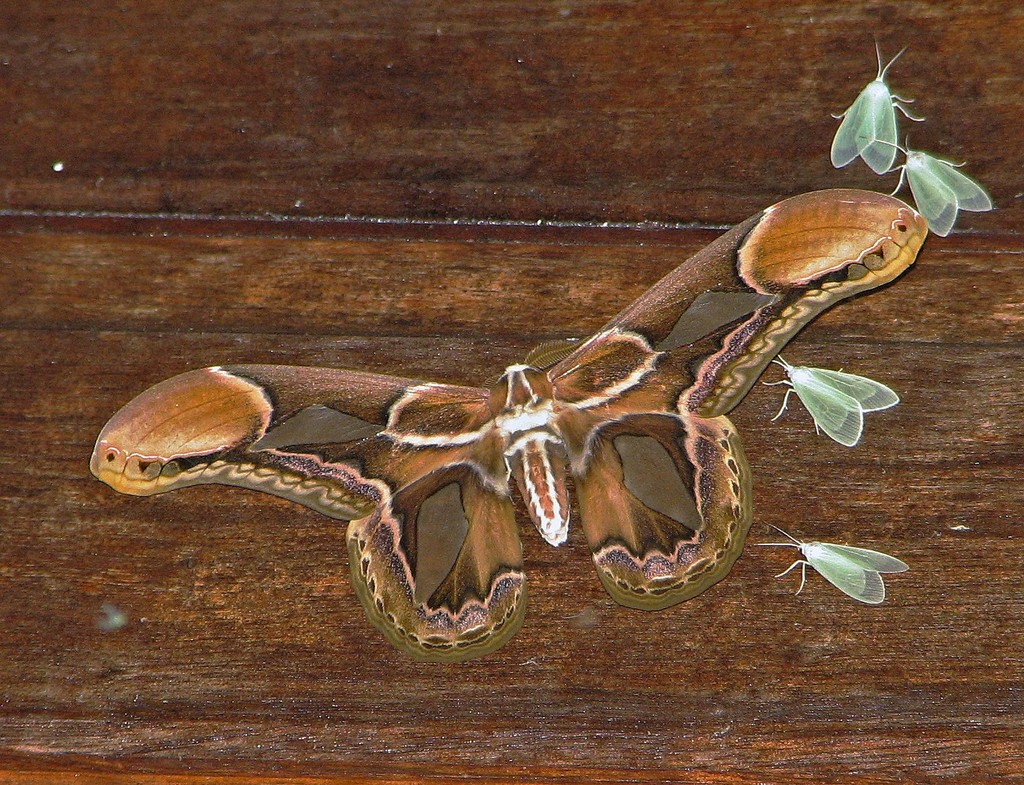
no rights reserved · CC0
Family: Saturniidae · Class: Insecta · Order: Lepidoptera
Rothschildia cincta (Cincta rothschildia) is a California animal in the Saturniidae family.
Rothschildia cincta is a large silk moth belonging to the family Saturniidae. Adults exhibit a wingspan of four to five inches (10.2 to 12.7 cm) with predominantly brown coloration accented by white and reddish vertical bands. Each wing features a distinctive large, triangular transparent patch that resembles glass or mirrors, earning the species its local name 'mariposa cuatro espejos' (butterfly with four mirrors) in Mexican communities. The deep chocolate brown wings create a striking contrast with these four clear eyespots, which are characteristic of the species. Rothschildia cincta occurs in southeastern Arizona south into Sonora, Mexico. In the United States, the species has been documented from Pima and Santa Cruz counties in Arizona, with historical records from the Baboquivari Mountains, particularly Brown Canyon. Observations have been recorded from California Gulch and other locations in the Sonoran Desert ecosystem. The species is more commonly found throughout northwestern Mexico, particularly in the states of Sonora and Sinaloa, extending into Baja California. This species inhabits xeric regions of the Sonoran Desert ecosystem, typically at elevations between 3,900 and 4,400 feet. Rothschildia cincta larvae feed on hopbush (Dodonaea viscosa), with adults observed where this host plant is abundant (Lepidopterists' Society 2005, 2013). The species occupies desert mountain canyons and washes where suitable host vegetation occurs, particularly in areas with mixed desert scrub communities. Adults are active during the summer monsoon season, with flight records from July through September. Peak activity appears to occur in August, when adults can be extremely common at appropriate localities. In 2004, over 70 individuals were observed over three nights in California Gulch, Santa Cruz County, where hopbush was abundant (Lepidopterists' Society 2005). The species exhibits nocturnal behavior, with adults attracted to lights during evening hours. Larvae develop on hopbush foliage, and the species produces distinctive cocoons that are culturally significant in the region, being collected and recycled into cocoon rattles called 'tenábares' by indigenous communities. Rothschildia cincta is not federally or state listed for protection. However, the species has experienced apparent population declines in Arizona, with some reports suggesting it had not been observed in the wild in Arizona for over a decade as of 2023. More recent observations indicate the species persists in southeastern Arizona, with documented encounters in 2017 and sporadic sightings since that time (Lepidopterists' Society 2023). The species remains more stable in its Mexican range, where it is commonly found throughout much of the Sonoran Desert ecosystem. Primary conservation concerns likely include habitat loss and degradation of desert mountain canyon ecosystems, though specific population studies have not been conducted. Climate change may also impact the timing of monsoon seasons that appear critical for adult emergence and reproduction.
Classification
Class: Insecta · Order: Lepidoptera · Family: Saturniidae
Frequently asked questions
How is Rothschildia cincta classified?
Rothschildia cincta belongs to class Insecta, order Lepidoptera, family Saturniidae.
What family does Rothschildia cincta belong to?
Rothschildia cincta is in the Saturniidae family.
What is Rothschildia cincta?
Rothschildia cincta is a large silk moth belonging to the family Saturniidae.
Is Rothschildia cincta found in California?
Yes. Rothschildia cincta is recorded in California in The California Species Project's catalogue.
Related species
Other California species in the same genus, family, or bioregion.
Data from The California Species Project — 14,000+ California species with verified data from CNPS, CDFW, USFWS, and more.