Rynchops niger
Black Skimmer
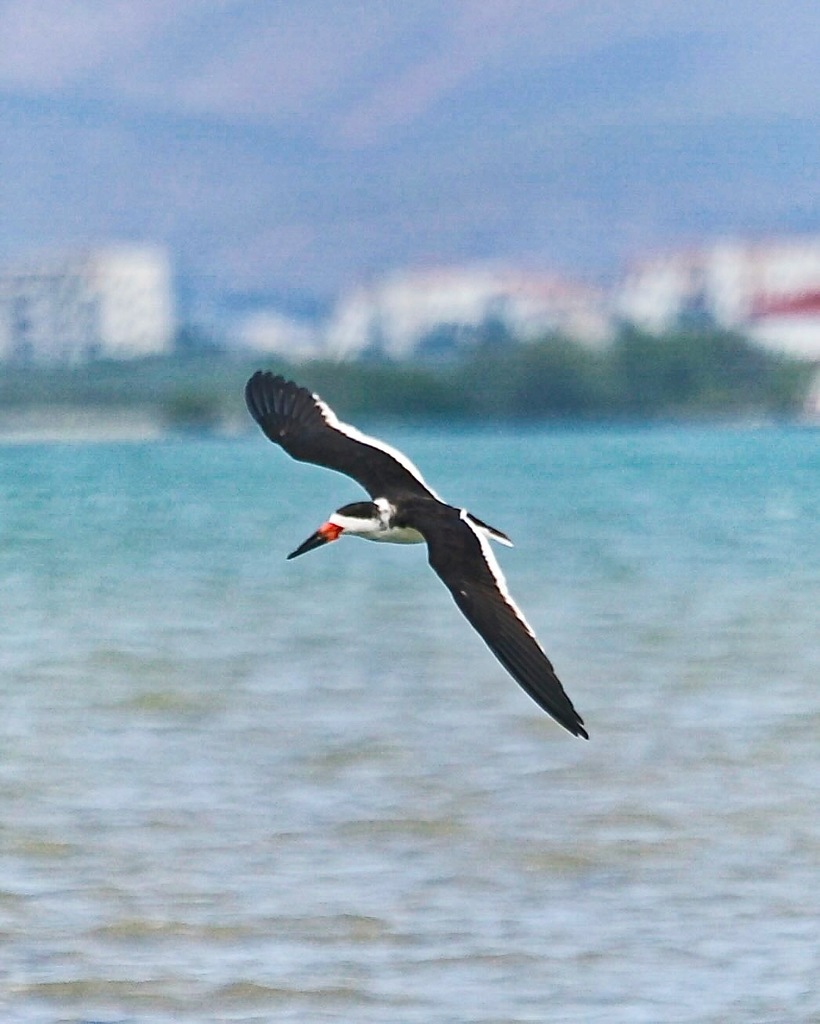
(c) Bill Levine, some rights reserved (CC BY) · licence
Family: Laridae · Class: Aves · Order: Charadriiformes
Conservation status: G5 S2
Rynchops niger (Black Skimmer) is a California animal in the Laridae family.
The Black Skimmer is a distinctive large waterbird measuring 40-50 cm (16-20 inches) in length with a wingspan of 107-127 cm (42-50 inches). Adults weigh 200-400 grams. The species exhibits striking black and white plumage, with black upperparts and wings contrasting sharply with white underparts, forehead, and rump. The most distinctive feature is the laterally compressed bill, which is longer in the lower mandible than the upper, creating a knife-like appearance. During breeding season, the bill base becomes bright orange-red with a black tip, while the legs turn bright red. Non-breeding adults show duller coloration with brownish-black upperparts. Historically, Black Skimmers bred along the Atlantic and Gulf coasts from Massachusetts to Texas, with populations also occurring along the Pacific coast from southern California to Ecuador. In California, the species was first documented breeding in 1976 at the Salton Sea. Current breeding populations are restricted to the Salton Sea, with occasional records from San Diego Bay and coastal Orange County. The species is considered a rare resident and uncommon migrant in California, with population estimates of fewer than 500 breeding pairs statewide. Black Skimmers inhabit shallow coastal waters, lagoons, estuaries, and inland lakes with sandy or shell beaches for nesting. At the Salton Sea, they utilize artificial islands and shoreline areas with minimal vegetation. Nesting colonies are typically established on sandy beaches, shell banks, or dredge spoil islands that provide protection from mammalian predators. The species requires adjacent shallow waters less than 30 cm deep for foraging. Black Skimmers are unique among North American birds for their specialized feeding behavior, flying low over water surfaces with the lower mandible cutting through the water to capture small fish. Primary prey includes anchovies, sardines, and other schooling fish 5-15 cm in length. The species is highly social, nesting in dense colonies of 25-200 pairs. Breeding occurs from April through August, with females laying 3-5 buff-colored eggs with dark markings in shallow scrapes lined with shells and debris. Incubation lasts 21-26 days, and chicks fledge after 23-25 days. Parents continue feeding juveniles for several weeks post-fledging. The Black Skimmer maintains a global conservation status of G5 (secure) but is ranked S2 (imperiled) in California. While not federally listed, the species faces significant challenges in California due to limited suitable habitat and human disturbance at nesting sites. At the Salton Sea, declining water levels and increasing salinity threaten the ecosystem that supports the skimmers' prey base. Recreational activities and development pressure at coastal sites further impact potential nesting areas. The species benefits from habitat management efforts at the Salton Sea National Wildlife Refuge and protection measures during breeding season.
Classification
Class: Aves · Order: Charadriiformes · Family: Laridae
Conservation status
G5 S2
Frequently asked questions
How is Rynchops niger classified?
Rynchops niger belongs to class Aves, order Charadriiformes, family Laridae.
What family does Rynchops niger belong to?
Rynchops niger is in the Laridae family.
Is Rynchops niger protected or of conservation concern?
Rynchops niger carries the following status: G5 S2.
What is Rynchops niger?
The Black Skimmer is a distinctive large waterbird measuring 40-50 cm (16-20 inches) in length with a wingspan of 107-127 cm (42-50 inches).
Is Rynchops niger found in California?
Yes. Rynchops niger is recorded in California in The California Species Project's catalogue.
Related species
Other California species in the same genus, family, or bioregion.
Data from The California Species Project — 14,000+ California species with verified data from CNPS, CDFW, USFWS, and more.