Saldula villosa
Hairy shore bug
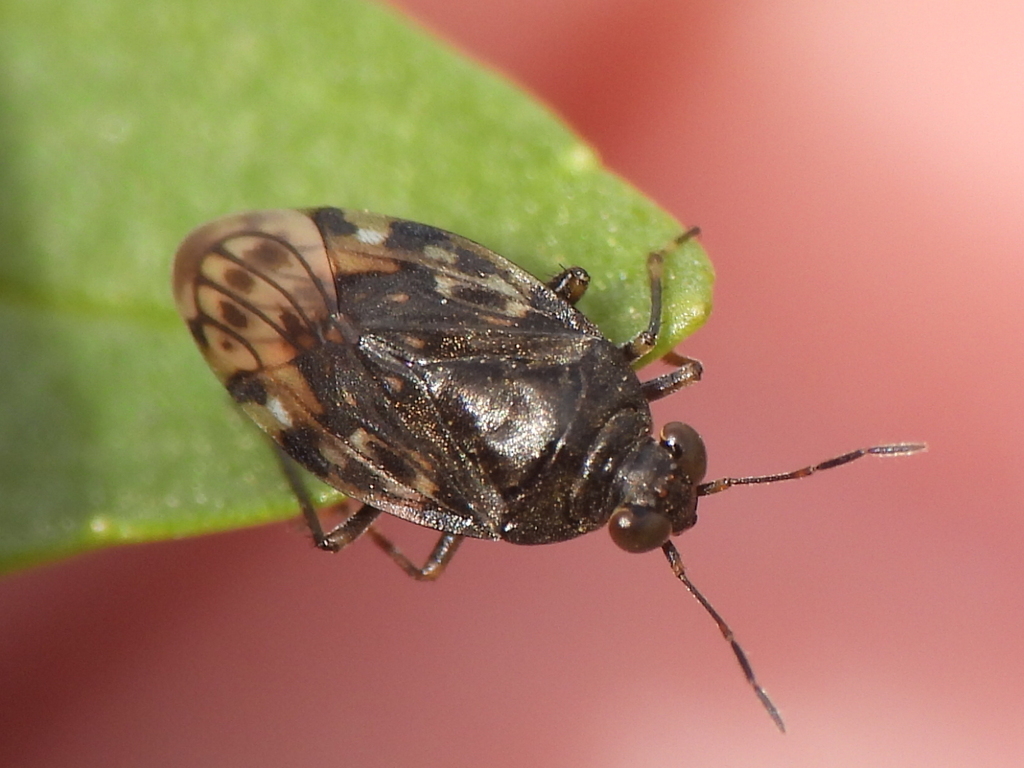
(c) Sam Kieschnick, some rights reserved (CC BY) · licence
Family: Saldidae · Class: Insecta · Order: Hemiptera
Saldula villosa (Hairy shore bug) is a California animal in the Saldidae family.
The hairy shore bug (Saldula villosa) is a small true bug in the family Saldidae (Heteroptera). Adults measure 3.75 to 4.43 mm (0.15 to 0.17 inches) in length with an oval body shape and pronotum width ranging from 1.50 to 2.08 mm (Xerces Society). The species displays a distinctive black coloration with pruinose blue and yellow spots scattered across the body. The head is black with yellow spots positioned on each side, and the eyes are pale brown to red-brown (Xerces Society). The historical range of S. villosa remains poorly documented. Specimens have been collected from Marin and Sonoma Counties in California, with a single specimen found from Coos Bay County in Oregon. The Oregon specimen was collected 4.5 miles north of North Bend on April 26, 1937, and is housed in the OSU Arthropod Collection (Xerces Society). Current distribution data is extremely limited, making it difficult to assess population status or range changes. This species is associated with salt marsh habitats along the Pacific coast (Xerces Society). Salt marshes provide the specialized conditions required for shore bugs, including areas of varying salinity, moisture levels, and substrate types. The specific microhabitat requirements within these ecosystems have not been well documented, but like other Saldidae species, S. villosa likely requires areas near the water's edge where it can hunt for prey. Detailed ecological information for S. villosa is lacking. Shore bugs in the family Saldidae are typically predaceous, feeding on small invertebrates found in their aquatic and semi-aquatic habitats. They are generally active hunters that capture prey along shorelines and in shallow water. Specific information about reproductive biology, seasonal activity patterns, and dietary preferences for S. villosa has not been documented in available literature. The conservation status of the hairy shore bug reflects the uncertainty surrounding this poorly known species. Oregon has assigned it a Heritage State Rank of S1, indicating it is critically imperiled in that state (Xerces Society). The global Heritage Rank is G3, suggesting the species is vulnerable to extirpation throughout its range. Primary threats are difficult to assess due to limited knowledge of current distribution, but loss of salt marsh habitat represents a significant potential threat. Coastal development, pollution, and climate change impacts on estuarine systems could affect remaining populations. The Xerces Society recommends avoiding disturbance of potential salt marsh habitat, implementing measures to maintain or enhance these ecosystems, and conducting surveys within suitable habitats prior to management actions. Surveys of the known historic Oregon location are needed to determine if the species persists at that site. Due to the species' small size and limited understanding of its specific life history requirements, conservation planning remains challenging. Additional research is urgently needed to locate existing populations, define habitat requirements, and assess current threats to guide effective conservation strategies.
Classification
Class: Insecta · Order: Hemiptera · Family: Saldidae
Frequently asked questions
How is Saldula villosa classified?
Saldula villosa belongs to class Insecta, order Hemiptera, family Saldidae.
What family does Saldula villosa belong to?
Saldula villosa is in the Saldidae family.
What is Saldula villosa?
The hairy shore bug (Saldula villosa) is a small true bug in the family Saldidae (Heteroptera).
Is Saldula villosa found in California?
Yes. Saldula villosa is recorded in California in The California Species Project's catalogue.
Related species
Other California species in the same genus, family, or bioregion.
Data from The California Species Project — 14,000+ California species with verified data from CNPS, CDFW, USFWS, and more.