Salpinctes obsoletus
Rock Wren
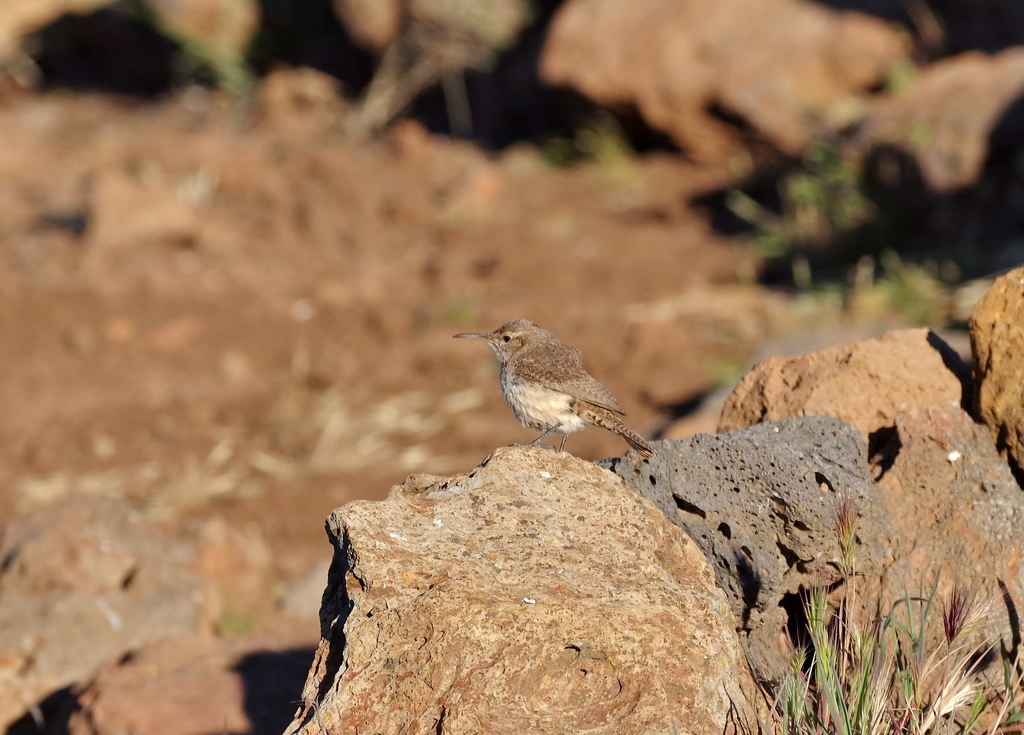
(c) Thibaud Aronson, some rights reserved (CC BY-SA) · licence
Family: Troglodytidae · Class: Aves · Order: Passeriformes
Salpinctes obsoletus (Rock Wren) is a California animal in the Troglodytidae family.
The Rock Wren is a small, compact songbird measuring 12 to 15 centimeters (4.7 to 5.9 inches) in length with a wingspan of 18 to 21 centimeters (7.1 to 8.3 inches). Adults weigh 15 to 18 grams (0.5 to 0.6 ounces). The upperparts are grayish-brown with fine dark barring and streaking, while the underparts are pale gray to whitish with subtle dark spotting on the breast and flanks. The species displays a distinctive white-tipped tail with dark barring, and pale cinnamon-buff coloration on the rump and flanks. Males and females appear similar, though males average slightly larger. Rock Wrens range throughout western North America from southern British Columbia to Central America. In California, the species occurs year-round in suitable habitat throughout most of the state, from the Oregon border south to Baja California. They are found in all major mountain ranges including the Cascades, Sierra Nevada, Coast Ranges, and Transverse Ranges, as well as in desert regions of southeastern California. The species is generally absent from the Central Valley floor and coastal lowlands below 200 meters elevation. Rock Wrens inhabit rocky terrain including canyon walls, cliff faces, boulder fields, and rocky outcrops in both mountainous and desert environments. They occur from sea level to elevations exceeding 3,400 meters (11,155 feet) in the Sierra Nevada, though they are most common between 300 and 2,400 meters elevation. Preferred habitats feature exposed rock surfaces with crevices and caves for nesting, often in areas with sparse vegetation including pinyon-juniper woodland, chaparral, and desert scrub communities. Rock Wrens are primarily insectivorous, foraging for beetles, ants, moths, caterpillars, and spiders among rock crevices and on exposed surfaces. They employ a distinctive foraging behavior, hopping and creeping over rock faces while probing cracks with their slightly curved bills. The species is notable for constructing stone pavements or walkways leading to nest entrances, using small pebbles and rock chips. Breeding occurs from March through August, with peak activity from April to June. Females typically lay 4 to 6 white eggs with fine reddish-brown spotting in cup-shaped nests built in rock crevices or small caves. The species produces one to two broods annually, with incubation lasting 12 to 14 days. Rock Wrens are not federally or state listed and are considered a species of least concern. According to the North American Breeding Bird Survey, populations have remained relatively stable across their range from 1966 to 2019, though some regional declines have been documented. The species benefits from its specialized habitat requirements and ability to occupy areas unsuitable for most other songbirds. Primary conservation concerns include habitat modification from recreational climbing, quarrying operations, and urban development in rocky areas. Climate change may affect the species through altered precipitation patterns affecting insect prey availability in arid regions.
Classification
Class: Aves · Order: Passeriformes · Family: Troglodytidae
Frequently asked questions
How is Salpinctes obsoletus classified?
Salpinctes obsoletus belongs to class Aves, order Passeriformes, family Troglodytidae.
What family does Salpinctes obsoletus belong to?
Salpinctes obsoletus is in the Troglodytidae family.
What is Salpinctes obsoletus?
The Rock Wren is a small, compact songbird measuring 12 to 15 centimeters (4.7 to 5.9 inches) in length with a wingspan of 18 to 21 centimeters (7.1 to 8.3 inches).
Is Salpinctes obsoletus found in California?
Yes. Salpinctes obsoletus is recorded in California in The California Species Project's catalogue.
Related species
Other California species in the same genus, family, or bioregion.
Data from The California Species Project — 14,000+ California species with verified data from CNPS, CDFW, USFWS, and more.