Salticus scenicus
Zebra Jumping Spider
no rights reserved · CC0
Family: Salticidae · Class: Arachnida · Order: Araneae
Salticus scenicus (Zebra Jumping Spider) is a California animal in the Salticidae family.
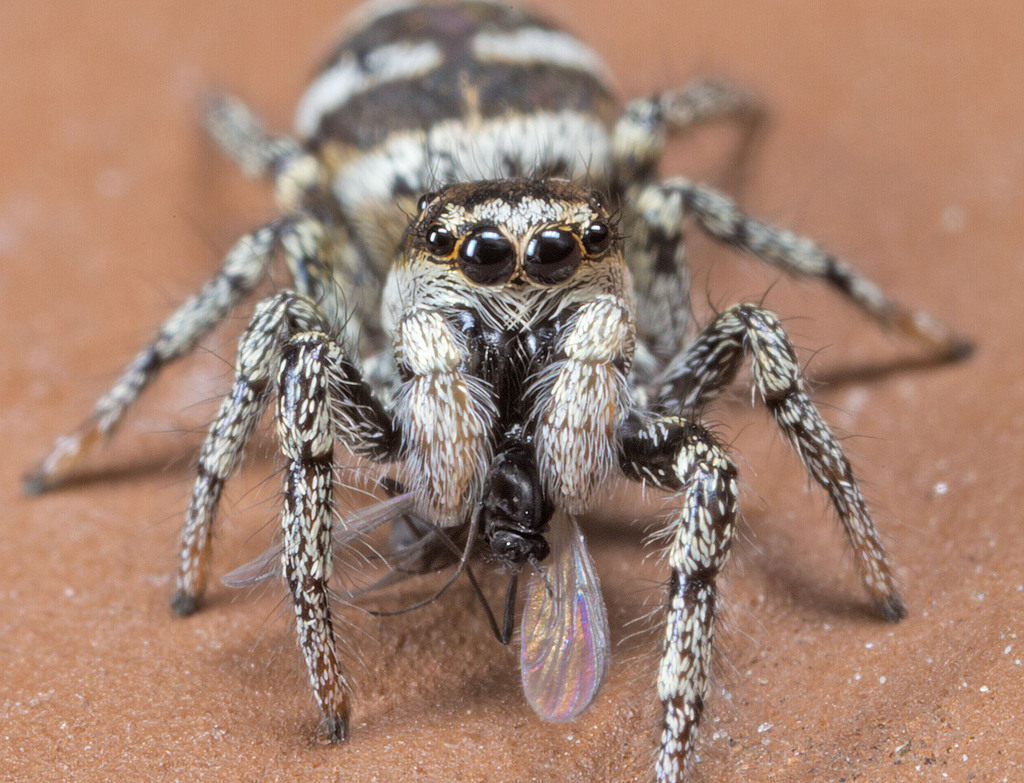
The zebra jumping spider is a small arachnid measuring 5 to 7 millimeters (0.2 to 0.3 inches) in body length. The species exhibits distinctive black and white striped patterns across its cephalothorax and abdomen, resembling zebra markings. Males typically display more contrasting patterns than females, with prominent white stripes bordered by dark bands. The spider possesses four pairs of eyes, with the anterior median eyes being particularly large and forward-facing, providing exceptional binocular vision for hunting. Salticus scenicus has an extensive distribution across North America, Europe, and parts of Asia. In California, the species occurs throughout the state from coastal regions to inland valleys, though specific county-level distribution data remains incompletely documented. The species demonstrates significant adaptability to human-modified environments and has successfully colonized urban and suburban areas across its range. This jumping spider inhabits a diverse array of environments, showing particular affinity for vertical surfaces and three-dimensional structures (BugGuide 2024). Common habitats include building walls, fences, tree bark, rock faces, and bridge structures. The species thrives in both natural and anthropogenic environments, frequently observed on residential and commercial buildings where it hunts for prey. Zebra jumping spiders prefer sunny, exposed locations that provide thermal basking opportunities and abundant hunting grounds (Edwards 2004). Zebra jumping spiders are active diurnal hunters that rely on their exceptional vision and jumping ability to capture prey. According to the Xerces Society, they hunt a variety of prey including moths, mosquitoes, and other spiders, and are capable of capturing creatures larger than themselves (Xerces Society 2019). The species employs a stalking strategy, using their forward-facing eyes to locate and track potential prey before executing precise jumping attacks from distances up to six times their body length (Richman & Jackson 1992). Mating occurs primarily in spring and early summer, with males performing elaborate courtship displays involving leg waving and body positioning to attract females (Crane 1949). Females construct silk retreats where they deposit egg sacs containing 15 to 25 eggs and guard their developing offspring through winter (Edwards 2004). Salticus scenicus holds no special conservation status at federal, state, or global levels as of December 2025. The species appears to benefit from human development, utilizing artificial structures as habitat and hunting grounds. Urban environments often provide abundant prey resources and suitable microhabitats for reproduction. The species' adaptability to diverse environmental conditions and its association with human-modified landscapes suggest stable population trends. Climate change impacts on the species remain poorly studied, though its broad geographic range and habitat flexibility may provide resilience against environmental perturbations. The zebra jumping spider serves important ecological functions as a predator of small arthropods, contributing to natural pest control in both agricultural and urban settings (iNaturalist 2024). Research on this species' biology and ecology remains limited, particularly regarding population dynamics and specific habitat requirements within its California range.
Classification
Class: Arachnida · Order: Araneae · Family: Salticidae
Frequently asked questions
How is Salticus scenicus classified?
Salticus scenicus belongs to class Arachnida, order Araneae, family Salticidae.
What family does Salticus scenicus belong to?
Salticus scenicus is in the Salticidae family.
What is Salticus scenicus?
The zebra jumping spider is a small arachnid measuring 5 to 7 millimeters (0.2 to 0.3 inches) in body length.
Is Salticus scenicus found in California?
Yes. Salticus scenicus is recorded in California in The California Species Project's catalogue.
Related species
Other California species in the same genus, family, or bioregion.
Data from The California Species Project — 14,000+ California species with verified data from CNPS, CDFW, USFWS, and more.