Salvadora hexalepis
Western Patch-Nosed Snake
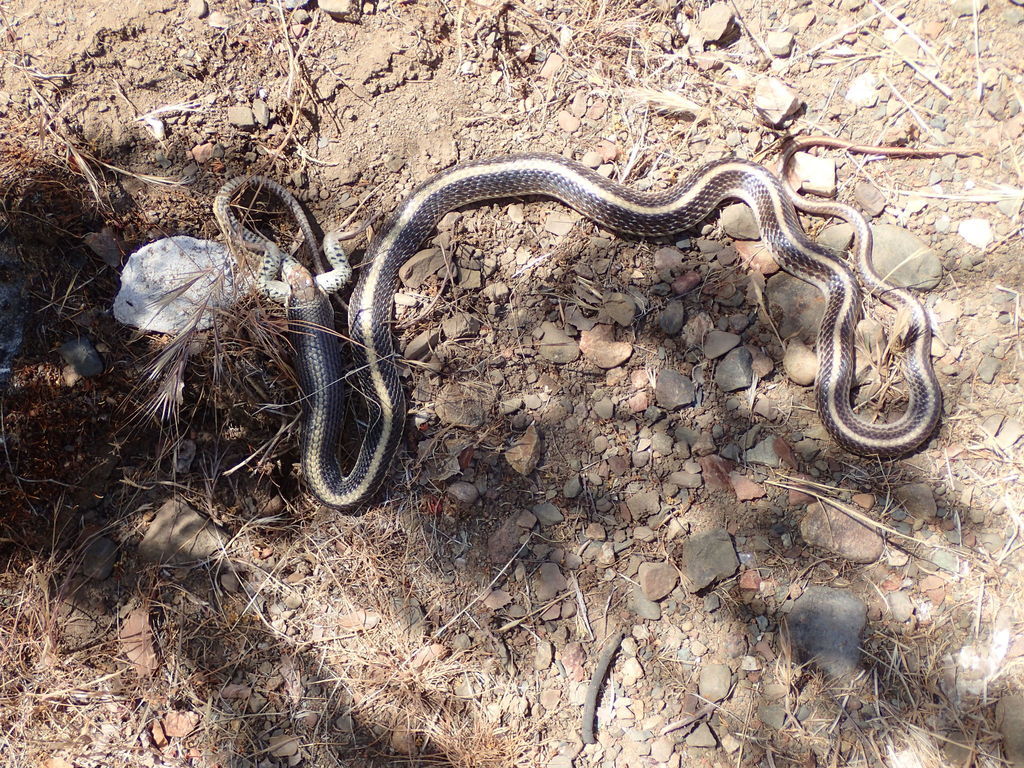
(c) George Williams, some rights reserved (CC BY) · licence
Family: Colubridae · Class: Reptilia · Order: Squamata
Salvadora hexalepis (Western Patch-Nosed Snake) is a California animal in the Colubridae family.
The Western Patch-Nosed Snake is a medium-sized, non-venomous colubrid snake characterized by a distinctive enlarged rostral scale that projects over the snout, forming a triangular patch. Adults typically measure 560 to 1,200 mm (22 to 47 inches) in total length, with females generally larger than males. The dorsal coloration consists of a pale yellow, cream, or light gray background with four distinct dark brown or black longitudinal stripes running the length of the body. The belly is typically white or cream-colored without markings. The enlarged rostral scale, which gives the species its common name, is used for digging and burrowing activities. The Western Patch-Nosed Snake occurs throughout much of the southwestern United States and northwestern Mexico. In California, the species is found primarily in the southern and southeastern portions of the state, including the Mojave and Sonoran desert regions. The range extends from sea level to approximately 2,100 meters (6,900 feet) in elevation, encompassing areas from the Colorado River valley westward to coastal Southern California counties including Los Angeles, Orange, Riverside, San Bernardino, and Imperial counties. This species inhabits a variety of arid and semi-arid environments, including desert scrub, chaparral, coastal sage scrub, and desert grasslands. Western Patch-Nosed Snakes show a preference for areas with sandy or gravelly soils that facilitate burrowing behavior. They are commonly found in washes, flats, and hillsides with scattered rocks and vegetation. The species demonstrates tolerance for disturbed habitats and can persist in areas with moderate human development. Western Patch-Nosed Snakes are primarily diurnal and terrestrial, remaining active during daylight hours when temperatures are moderate. They are fast-moving predators that feed predominantly on lizards, particularly whiptails, fence lizards, and side-blotched lizards, though they occasionally consume small snakes, birds, and rodents. Prey is typically swallowed alive without constriction. Mating occurs in spring, typically from March through May. Females are oviparous, depositing clutches of 4 to 10 elongated eggs in sandy soil or under rocks during late spring or early summer. Eggs incubate for approximately 2 to 3 months, with hatchlings emerging in late summer measuring 180 to 250 mm (7 to 10 inches) in total length. The Western Patch-Nosed Snake is not federally or state-listed and appears to maintain stable populations throughout most of its California range. The species demonstrates adaptability to habitat modification and urban encroachment better than many desert reptiles. However, localized population declines may occur due to habitat loss from development, road mortality, and collection for the pet trade. Climate change and increasing temperatures in desert regions may affect the species' activity patterns and prey availability. The snake's diurnal habits and ground-dwelling behavior make it vulnerable to vehicle strikes on desert roads.
Classification
Class: Reptilia · Order: Squamata · Family: Colubridae
Frequently asked questions
How is Salvadora hexalepis classified?
Salvadora hexalepis belongs to class Reptilia, order Squamata, family Colubridae.
What family does Salvadora hexalepis belong to?
Salvadora hexalepis is in the Colubridae family.
What is Salvadora hexalepis?
The Western Patch-Nosed Snake is a medium-sized, non-venomous colubrid snake characterized by a distinctive enlarged rostral scale that projects over the snout, forming a triangular patch.
Is Salvadora hexalepis found in California?
Yes. Salvadora hexalepis is recorded in California in The California Species Project's catalogue.
Related species
Other California species in the same genus, family, or bioregion.
Data from The California Species Project — 14,000+ California species with verified data from CNPS, CDFW, USFWS, and more.