Salvadora hexalepis virgultea
Coast Patch- Nosed Snake
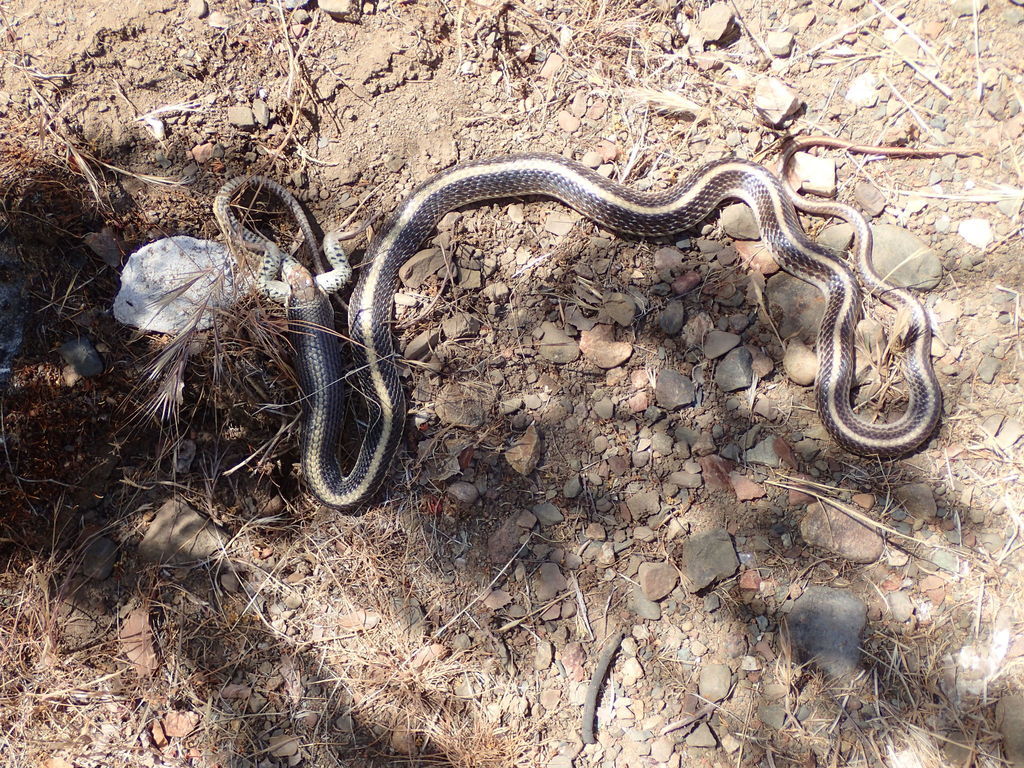
(c) George Williams, some rights reserved (CC BY) · licence
Family: Colubridae · Class: Reptilia · Order: Squamata
Conservation status: G5T4 S3
Salvadora hexalepis virgultea (Coast Patch- Nosed Snake) is a California animal in the Colubridae family.
The Coast Patch-nosed Snake (Salvadora hexalepis virgultea) is a medium-sized, fast-moving snake endemic to California's coastal region. Adults typically reach 36 to 46 inches (91 to 117 cm) in total length, with some individuals exceeding 4 feet. The species is characterized by a distinctive enlarged rostral scale that forms a patch-like projection over the nose, giving the snake its common name. The dorsal coloration consists of a pale yellow to cream background with four distinct dark brown to black longitudinal stripes running the length of the body. The ventral surface is typically white to pale yellow. This subspecies occurs in California from the northern Carrizo Plains in San Luis Obispo County, extending south through the coastal zone to northern Baja California (californiaherps.com). The range encompasses areas south and west of the desert regions, with a historical 1958 record from Corral Hollow in San Joaquin County representing the northernmost documented occurrence. The Coast Patch-nosed Snake is geographically separated from other Salvadora hexalepis subspecies by mountain ranges and desert barriers. Coast Patch-nosed Snakes inhabit brushy areas and chaparral in canyons, rocky hillsides, and coastal plains (californiaherps.com). They occupy semi-arid environments characterized by scattered shrubs, grasslands, and oak woodlands. The subspecies shows a preference for areas with loose soil that facilitates their fossorial tendencies and provides suitable substrate for prey excavation. Elevational range extends from near sea level to approximately 4,000 feet in mountainous terrain. These snakes are primarily diurnal and are most active during morning and late afternoon hours when temperatures are moderate. They are fast-moving predators that hunt actively on the surface, using their keen eyesight to locate prey. The diet consists primarily of lizards, particularly whiptails and fence lizards, though they also consume small mammals, bird eggs, and nestlings. Coast Patch-nosed Snakes possess mild venom that aids in subduing prey, though they are harmless to humans. Reproduction occurs through egg-laying, with females typically depositing 4 to 12 eggs in sandy or loose soil during late spring to early summer. Hatchlings emerge in late summer and are approximately 8 to 10 inches long. The Coast Patch-nosed Snake is designated as a California Species of Special Concern, reflecting population declines due to habitat loss and fragmentation (California Department of Fish and Wildlife). Urban development, agricultural conversion, and fire management practices have reduced suitable habitat throughout the subspecies' range. The Global/State Rank of G5T4 S3 indicates the subspecies is apparently secure globally but vulnerable in California. Climate change poses additional threats through altered precipitation patterns and increased fire frequency. Conservation efforts focus on habitat preservation and restoration within the coastal scrub and chaparral ecosystems that support remaining populations.
Classification
Class: Reptilia · Order: Squamata · Family: Colubridae
Conservation status
G5T4 S3
Frequently asked questions
How is Salvadora hexalepis virgultea classified?
Salvadora hexalepis virgultea belongs to class Reptilia, order Squamata, family Colubridae.
What family does Salvadora hexalepis virgultea belong to?
Salvadora hexalepis virgultea is in the Colubridae family.
Is Salvadora hexalepis virgultea protected or of conservation concern?
Salvadora hexalepis virgultea carries the following status: G5T4 S3.
What is Salvadora hexalepis virgultea?
The Coast Patch-nosed Snake (Salvadora hexalepis virgultea) is a medium-sized, fast-moving snake endemic to California's coastal region.
Is Salvadora hexalepis virgultea found in California?
Yes. Salvadora hexalepis virgultea is recorded in California in The California Species Project's catalogue.
Related species
Other California species in the same genus, family, or bioregion.
Data from The California Species Project — 14,000+ California species with verified data from CNPS, CDFW, USFWS, and more.