Salvelinus fontinalis
Brook trout
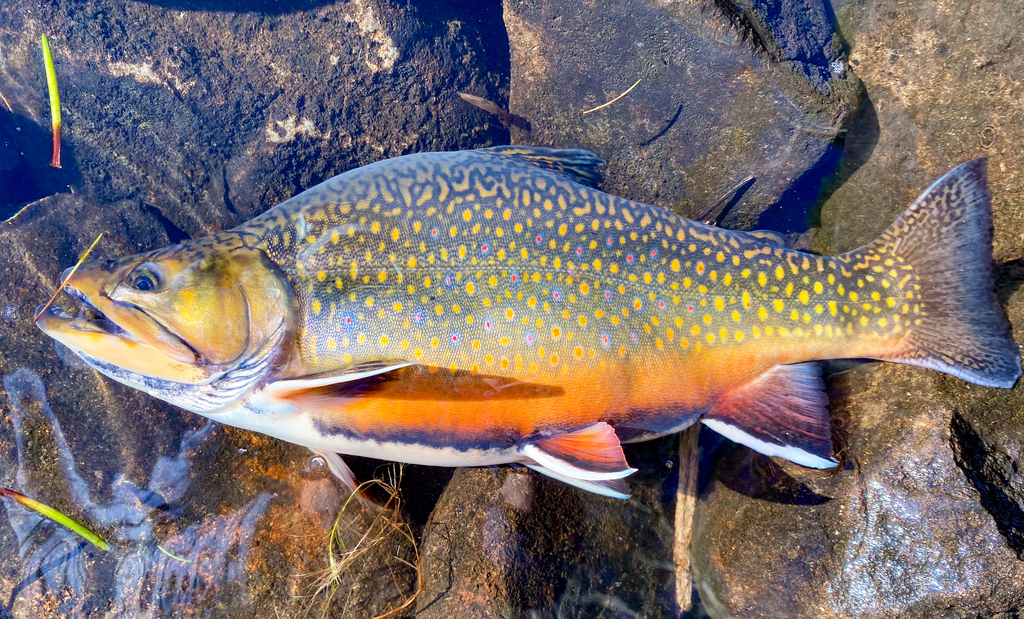
(c) Bruce Deagle, some rights reserved (CC BY) · licence
Family: Salmonidae · Class: Actinopterygii · Order: Salmoniformes
Salvelinus fontinalis (Brook trout) is a California animal in the Salmonidae family.
Brook trout are medium-sized salmonid fish characterized by their distinctive olive-green to dark brown dorsal coloration with lighter, worm-like vermiculations across the back and dorsal fin. The sides display red spots surrounded by blue halos, while the belly ranges from white to yellow-orange. Males develop more vibrant coloration during spawning season, with bright orange-red fins edged in white and black. Adults typically measure 25 to 65 centimeters (10 to 26 inches) in length and weigh 0.3 to 4.5 kilograms (0.7 to 10 pounds), though most individuals in California streams are considerably smaller. Native to eastern North America from Georgia north to Arctic Canada, brook trout were introduced to California waters beginning in the 1870s. The species now occurs in cold, high-elevation streams and lakes throughout the Sierra Nevada, Cascade Range, and other mountainous regions of the state. Established populations exist in numerous counties including Alpine, El Dorado, Fresno, Inyo, Madera, Mono, Nevada, Placer, and Tulare. Brook trout have also been introduced to high-elevation waters in the Coast Range and other mountain systems. Brook trout require cold, well-oxygenated water with temperatures rarely exceeding 20°C (68°F). They inhabit streams, lakes, and ponds at elevations typically ranging from 1,500 to 3,500 meters (4,900 to 11,500 feet) in California. The species prefers areas with clean gravel or rocky substrates and adequate cover from overhanging vegetation, undercut banks, or large rocks. Brook trout are particularly associated with headwater streams and alpine lakes where competition from other fish species is minimal. Brook trout are opportunistic predators feeding on aquatic and terrestrial insects, small fish, crustaceans, and occasionally small mammals that fall into the water. Juveniles primarily consume zooplankton and small invertebrates. The species exhibits fall spawning behavior, typically from September through November when water temperatures drop. Females construct redds in gravel substrates where they deposit 100 to 5,000 eggs depending on body size. Eggs incubate through winter, with fry emerging in spring. Brook trout reach sexual maturity at 2 to 3 years of age and can live up to 10 years, though most individuals in California live 3 to 5 years. Brook trout are not federally listed and have no special conservation status in California as a non-native species. However, their presence in high-elevation ecosystems has raised concerns among biologists studying impacts on native species. Brook trout can hybridize with native bull trout where ranges overlap and may compete with native salmonids for resources. In some watersheds, brook trout populations have been managed or removed to protect endemic species. Climate change poses long-term threats to brook trout populations in California by increasing water temperatures and reducing suitable cold-water habitat in high-elevation streams and lakes.
Classification
Class: Actinopterygii · Order: Salmoniformes · Family: Salmonidae
Frequently asked questions
How is Salvelinus fontinalis classified?
Salvelinus fontinalis belongs to class Actinopterygii, order Salmoniformes, family Salmonidae.
What family does Salvelinus fontinalis belong to?
Salvelinus fontinalis is in the Salmonidae family.
What is Salvelinus fontinalis?
Brook trout are medium-sized salmonid fish characterized by their distinctive olive-green to dark brown dorsal coloration with lighter, worm-like vermiculations across the back and dorsal fin.
Is Salvelinus fontinalis found in California?
Yes. Salvelinus fontinalis is recorded in California in The California Species Project's catalogue.
Related species
Other California species in the same genus, family, or bioregion.
Data from The California Species Project — 14,000+ California species with verified data from CNPS, CDFW, USFWS, and more.