Saropogon luteus
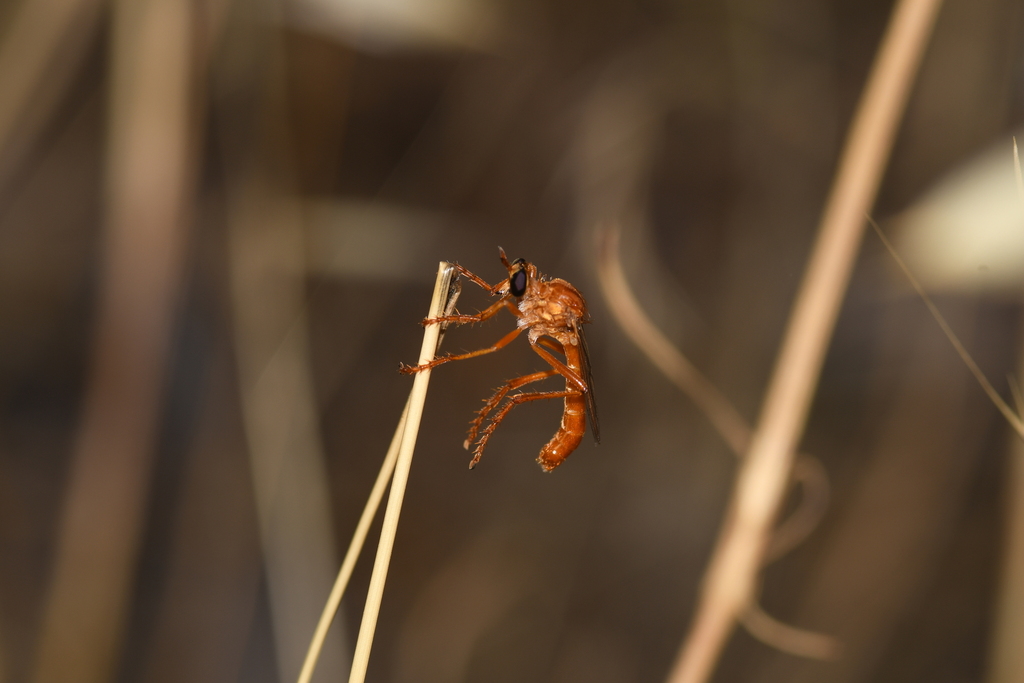
(c) Hawk T., some rights reserved (CC BY) · licence
Family: Asilidae · Class: Insecta · Order: Diptera
Saropogon luteus is a California animal in the Asilidae family.
Saropogon luteus is a robber fly in the family Asilidae, order Diptera. The family Asilidae comprises predatory flies commonly known as robber flies or assassin flies, characterized by their aggressive hunting behavior and bristly appearance. Members of the genus Saropogon are typically medium-sized robber flies with robust bodies and strong legs adapted for capturing prey in flight. The specific distribution and range of S. luteus have not been well documented in readily accessible scientific literature. Robber flies in the genus Saropogon are generally found across various regions of North America, but detailed range maps for this particular species are not available from standard biodiversity databases or government wildlife agencies. Like other members of Asilidae, S. luteus likely inhabits areas where it can effectively hunt flying insects. Robber flies typically prefer open habitats such as grasslands, scrublands, forest edges, and areas with exposed perching sites. These flies require suitable perches from which to launch aerial attacks on prey, including bare branches, fence posts, or exposed ground. Specific habitat preferences for S. luteus remain undocumented. As a member of the robber fly family, S. luteus is presumed to be a predatory species that captures other flying insects. Asilidae species are known for their aggressive hunting behavior, using their powerful legs to grasp prey and their piercing mouthparts to inject enzymes that liquefy internal tissues. Adult robber flies typically feed on a wide variety of flying insects including beetles, flies, bees, wasps, and other arthropods. Mating and reproductive behavior likely follow typical asilid patterns, with females depositing eggs in soil or organic matter where larvae develop as predators of other insect larvae. The conservation status of Saropogon luteus has not been assessed by federal or state wildlife agencies. The species does not appear on the U.S. Fish and Wildlife Service's list of federally protected species, nor is it included in California Department of Fish and Wildlife's special concern categories as of December 2025. This absence from conservation listings may reflect either secure population status or insufficient data to evaluate conservation needs. Many dipteran species, particularly smaller or less conspicuous flies, lack comprehensive population assessments. Scientific documentation for this species remains extremely limited despite thorough searches of government wildlife databases and taxonomic resources. The information presented here synthesizes general knowledge of the family Asilidae applied to this genus. Detailed studies of S. luteus biology, distribution, ecology, and conservation status are lacking. We welcome contributions of verified scientific data, photographs, or field observations to enhance this species account.
Classification
Class: Insecta · Order: Diptera · Family: Asilidae
Frequently asked questions
How is Saropogon luteus classified?
Saropogon luteus belongs to class Insecta, order Diptera, family Asilidae.
What family does Saropogon luteus belong to?
Saropogon luteus is in the Asilidae family.
What is Saropogon luteus?
Saropogon luteus is a robber fly in the family Asilidae, order Diptera.
Is Saropogon luteus found in California?
Yes. Saropogon luteus is recorded in California in The California Species Project's catalogue.
Related species
Other California species in the same genus, family, or bioregion.
Data from The California Species Project — 14,000+ California species with verified data from CNPS, CDFW, USFWS, and more.