Saturnia albofasciata
White-streaked saturnia moth
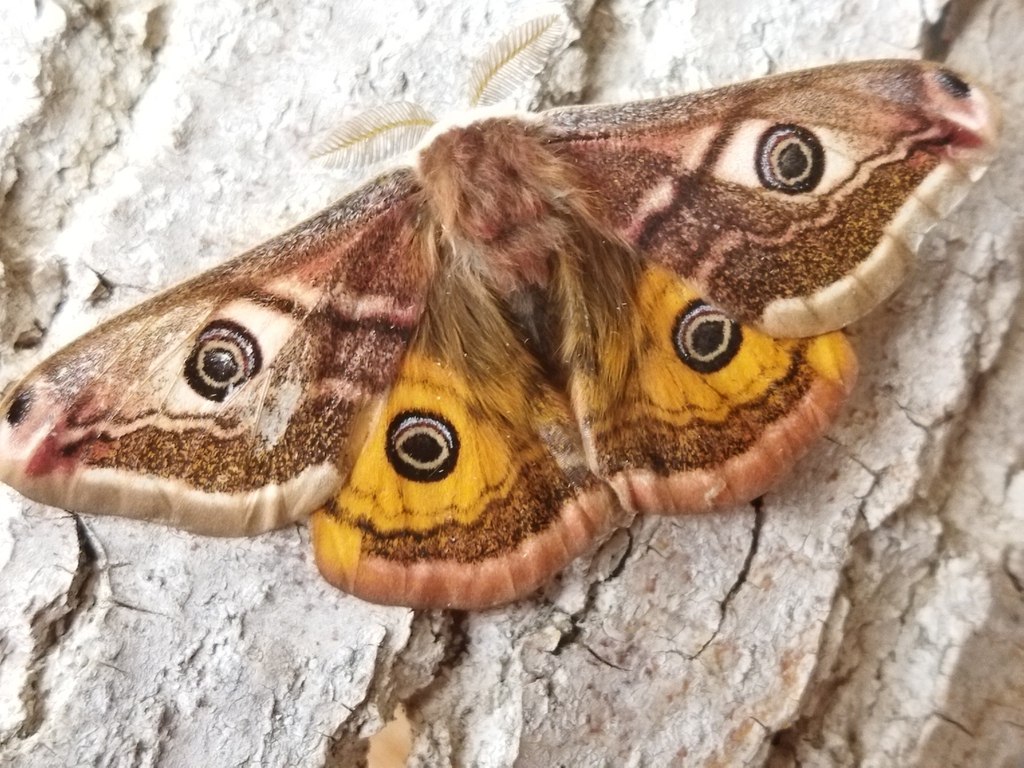
(c) SteveM4560, some rights reserved (CC BY) · licence
Family: Saturniidae · Class: Insecta · Order: Lepidoptera
Saturnia albofasciata (White-streaked saturnia moth) is a California animal in the Saturniidae family.
The white-streaked saturnia moth (Saturnia albofasciata) is a large silk moth endemic to California, belonging to the family Saturniidae. Adults have a wingspan ranging from 75 to 100 mm (3.0 to 3.9 inches), with males typically smaller than females. The forewings display a brownish-gray base color with distinctive white streaks that give the species its common name. Each forewing bears a prominent eyespot with a white center surrounded by concentric rings of brown and yellow. The hindwings are similarly colored but lack the pronounced white streaking pattern. Males possess more feathery antennae compared to females, an adaptation for detecting pheromones. Saturnia albofasciata occurs from Lake County, California south through the Coast Range and extends into the Sierra Nevada foothills. The species is distributed primarily in the California Floristic Province, with documented populations in counties including Lake, Napa, Sonoma, Marin, Santa Clara, and extending southward through the coastal mountains. Historical records suggest a more continuous distribution, though current populations appear fragmented across suitable habitat patches. This species inhabits chaparral and oak woodland communities at elevations ranging from 300 to 1,500 meters (1,000 to 4,900 feet). The moths are closely associated with their host plants: buckbrush (Ceanothus cuneatus), snowbush (C. cordulatus), desert ceanothus (C. greggii), and mountain-mahogany (Cercocarpus betuloides). These shrubland habitats are characterized by Mediterranean climate conditions with wet winters and dry summers. Adults are typically found in areas where these host plants form dense stands or occur in mixed shrub communities. White-streaked saturnia moths are univoltine, producing one generation per year. Adults emerge in late spring to early summer, typically from May through July, depending on elevation and local climate conditions. Mating occurs shortly after emergence, with females releasing pheromones to attract males during evening hours. After mating, females deposit eggs singly or in small clusters on host plant foliage. Larvae feed on the leaves of Ceanothus and Cercocarpus species, developing through five instars over a period of 6 to 8 weeks. Mature caterpillars are green with black and yellow markings and reach lengths of 75 to 90 mm. Pupation occurs in tough cocoons constructed among leaf litter or attached to branches, where they overwinter before adult emergence. Saturnia albofasciata currently lacks federal or state listing status, though populations face pressure from habitat loss due to urban development and fire suppression practices that alter natural fire cycles in chaparral ecosystems. The species' dependence on specific host plants makes it vulnerable to habitat fragmentation. Climate change may affect the timing of emergence and the distribution of suitable habitat at higher elevations. Conservation of this species depends on maintaining intact chaparral and oak woodland communities and preserving natural fire regimes that support host plant regeneration.
Classification
Class: Insecta · Order: Lepidoptera · Family: Saturniidae
Frequently asked questions
How is Saturnia albofasciata classified?
Saturnia albofasciata belongs to class Insecta, order Lepidoptera, family Saturniidae.
What family does Saturnia albofasciata belong to?
Saturnia albofasciata is in the Saturniidae family.
What is Saturnia albofasciata?
The white-streaked saturnia moth (Saturnia albofasciata) is a large silk moth endemic to California, belonging to the family Saturniidae.
Is Saturnia albofasciata found in California?
Yes. Saturnia albofasciata is recorded in California in The California Species Project's catalogue.
Related species
Other California species in the same genus, family, or bioregion.
Data from The California Species Project — 14,000+ California species with verified data from CNPS, CDFW, USFWS, and more.