Saturnia mendocino
Mendocino saturnia moth
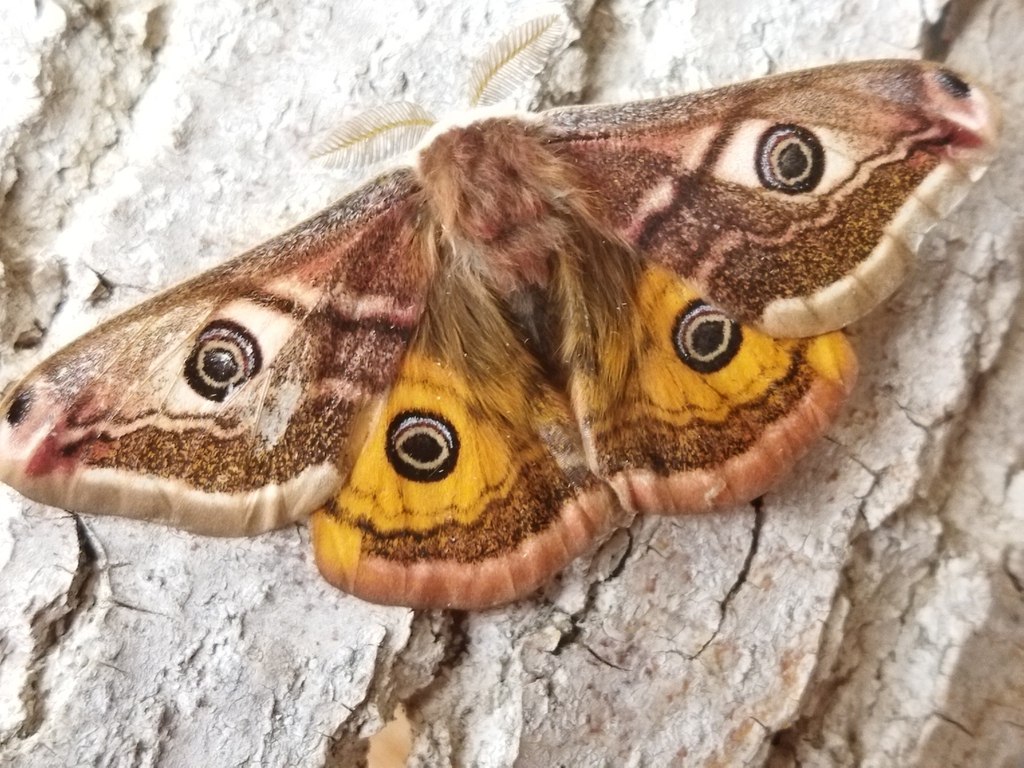
(c) SteveM4560, some rights reserved (CC BY) · licence
Family: Saturniidae · Class: Insecta · Order: Lepidoptera
Saturnia mendocino (Mendocino saturnia moth) is a California animal in the Saturniidae family.
The Mendocino saturnia moth is a large silk moth in the family Saturniidae, endemic to the western United States. Adults exhibit sexual dimorphism, with females larger than males. The upperside forewings display brownish orange coloration, while hindwings are orange to red-orange with a diffuse dark area at the base (Butterflies and Moths of North America). Males typically have more feathery antennae and smaller body size compared to females. The species occurs from Monterey County, California north through the Coast Range and from Tulare County on the western slopes of the California Sierra Nevada, extending north through the Cascade Mountains into southern Oregon. This distribution pattern reflects the moth's association with specific host plant communities throughout the Pacific Coast and mountain regions. Mendocino saturnia moths inhabit chaparral communities where their host plants thrive. The larvae feed exclusively on plants in the heath family (Ericaceae), primarily manzanita (Arctostaphylos species) and Pacific madrone (Arbutus menziesii). These host plants are characteristic of Mediterranean-climate shrublands and mixed evergreen forests found throughout the moth's range. The species' distribution closely follows the natural range of these ericaceous shrubs, which occur from sea level to montane elevations. As members of the Saturniidae family, adults do not feed and live only to reproduce. The species follows a typical saturniid life cycle, with larvae developing through five instars before pupating. Caterpillars construct protective cocoons attached to host plant branches or nearby vegetation. The moths likely have one generation per year, with adults emerging during spring or early summer months to mate and deposit eggs on host plants. Adult flight period and specific breeding behaviors remain poorly documented in the scientific literature. The taxonomic placement of this species has undergone recent revision. Originally described as Saturnia mendocino by Behrens in 1876, the species was transferred to the genus Calosaturnia in 2020 (Moth Photographers Group). This reclassification reflects updated phylogenetic understanding of saturniid relationships. No formal conservation status has been assigned to the Mendocino saturnia moth at federal or state levels. The species appears to maintain stable populations throughout much of its range, though specific population data are lacking. Primary potential threats include habitat loss from urban development, wildfire regime changes, and climate change impacts on host plant communities. The moth's dependence on specific ericaceous host plants makes it vulnerable to factors affecting chaparral and mixed evergreen forest ecosystems. Conservation assessments of related saturniid species suggest the need for habitat protection and population monitoring (Yale Peabody Museum). The species' relatively restricted range within California and Oregon warrants continued observation to ensure population stability, particularly given increasing pressures on chaparral habitats from development and altered fire cycles.
Classification
Class: Insecta · Order: Lepidoptera · Family: Saturniidae
Frequently asked questions
How is Saturnia mendocino classified?
Saturnia mendocino belongs to class Insecta, order Lepidoptera, family Saturniidae.
What family does Saturnia mendocino belong to?
Saturnia mendocino is in the Saturniidae family.
What is Saturnia mendocino?
The Mendocino saturnia moth is a large silk moth in the family Saturniidae, endemic to the western United States.
Is Saturnia mendocino found in California?
Yes. Saturnia mendocino is recorded in California in The California Species Project's catalogue.
Related species
Other California species in the same genus, family, or bioregion.
Data from The California Species Project — 14,000+ California species with verified data from CNPS, CDFW, USFWS, and more.