Satyrium auretorum
Gold-hunter's Hairstreak
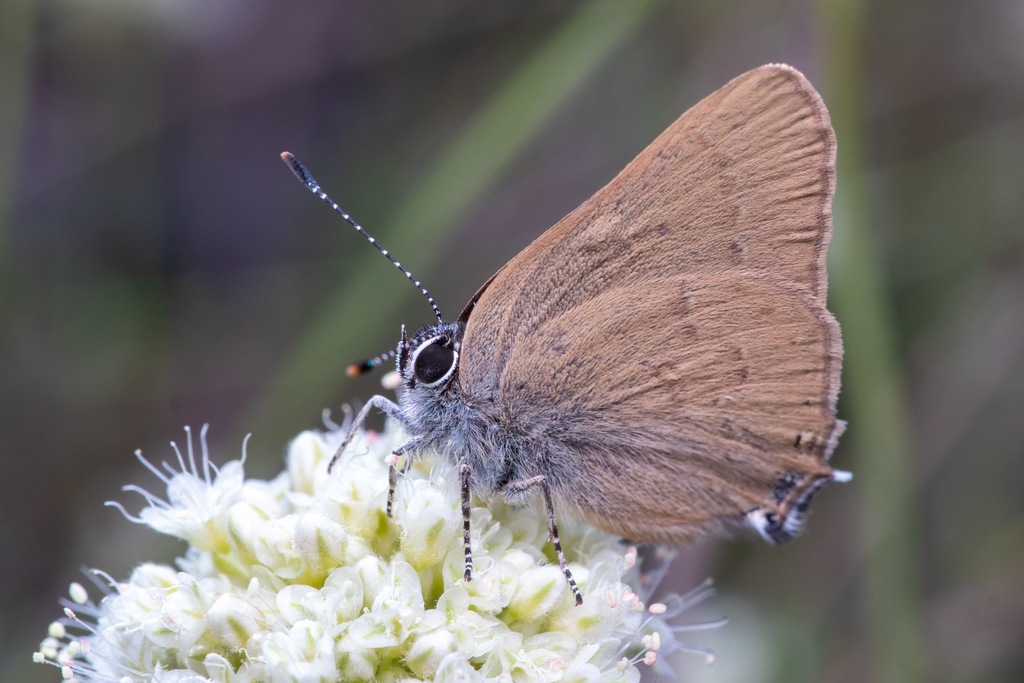
(c) DiegoH, some rights reserved (CC BY) · licence
Family: Lycaenidae · Class: Insecta · Order: Lepidoptera
Satyrium auretorum (Gold-hunter's Hairstreak) is a California animal in the Lycaenidae family.
The Gold-hunter's Hairstreak is a small butterfly in the family Lycaenidae, characterized by its distinctive wing patterns and association with oak woodlands. Adults typically measure 22 to 28 mm (0.9 to 1.1 inches) in wingspan. The dorsal wing surfaces are brown to gray-brown with subtle iridescent highlights. Males display a small patch of specialized scent scales on the forewing. The ventral surfaces are gray with white-edged black postmedian lines and orange marginal spots near the hindwing tails. Two thin, hair-like tails extend from the hindwing, a characteristic feature of hairstreak butterflies. The species occurs in California west of the Sierra Nevada, Transverse Range, and deserts, ranging from Mendocino County south to San Diego County and extending into Baja California Norte, Mexico. This distribution encompasses the Coast Ranges, Central Valley foothills, and coastal mountains. The butterfly's range closely corresponds with the distribution of its oak host plants throughout these regions. Gold-hunter's Hairstreaks inhabit oak woodlands, chaparral, and mixed oak-pine forests from near sea level to approximately 1,500 meters (4,900 feet) elevation. The species shows a strong preference for areas with mature oak trees, particularly where multiple oak species co-occur. Adults are commonly observed in canyon bottoms, hillsides, and ridge tops where oaks are present. The butterfly requires both larval host plants and adult nectar sources, often found in oak woodland edges and clearings. Larvae feed exclusively on several species of oak (Quercus), including coast live oak (Q. agrifolia), interior live oak (Q. wislizeni), blue oak (Q. douglasii), and valley oak (Q. lobata). Eggs are deposited singly on oak twigs or at the base of leaf buds during late summer or fall. Larvae emerge the following spring as oak leaves begin to develop, feeding on fresh foliage. The species produces one generation per year, with adults typically flying from April through June, coinciding with peak oak flowering. Males establish territories on oak trees and patrol for females through rapid, darting flight patterns. Adults nectar on various flowering plants, including buckwheat (Eriogonum species), ceanothus, and other shrubs common in oak woodland understory. Mating occurs on or near host oak trees, with females selecting oviposition sites on healthy oak branches. The Gold-hunter's Hairstreak is not federally or state listed, but faces habitat pressures from urban development, oak woodland conversion, and wildfire management practices. Oak woodland loss represents the primary long-term threat to populations. Climate change may affect the timing of oak leaf emergence and butterfly emergence, potentially disrupting synchronization between larval development and food availability. Conservation efforts focus on protecting oak woodland habitats and maintaining connectivity between oak stands to support population persistence across the species' range.
Classification
Class: Insecta · Order: Lepidoptera · Family: Lycaenidae
Frequently asked questions
How is Satyrium auretorum classified?
Satyrium auretorum belongs to class Insecta, order Lepidoptera, family Lycaenidae.
What family does Satyrium auretorum belong to?
Satyrium auretorum is in the Lycaenidae family.
What is Satyrium auretorum?
The Gold-hunter's Hairstreak is a small butterfly in the family Lycaenidae, characterized by its distinctive wing patterns and association with oak woodlands.
Is Satyrium auretorum found in California?
Yes. Satyrium auretorum is recorded in California in The California Species Project's catalogue.
Related species
Other California species in the same genus, family, or bioregion.
Data from The California Species Project — 14,000+ California species with verified data from CNPS, CDFW, USFWS, and more.