Satyrium behrii
Behr's Hairstreak
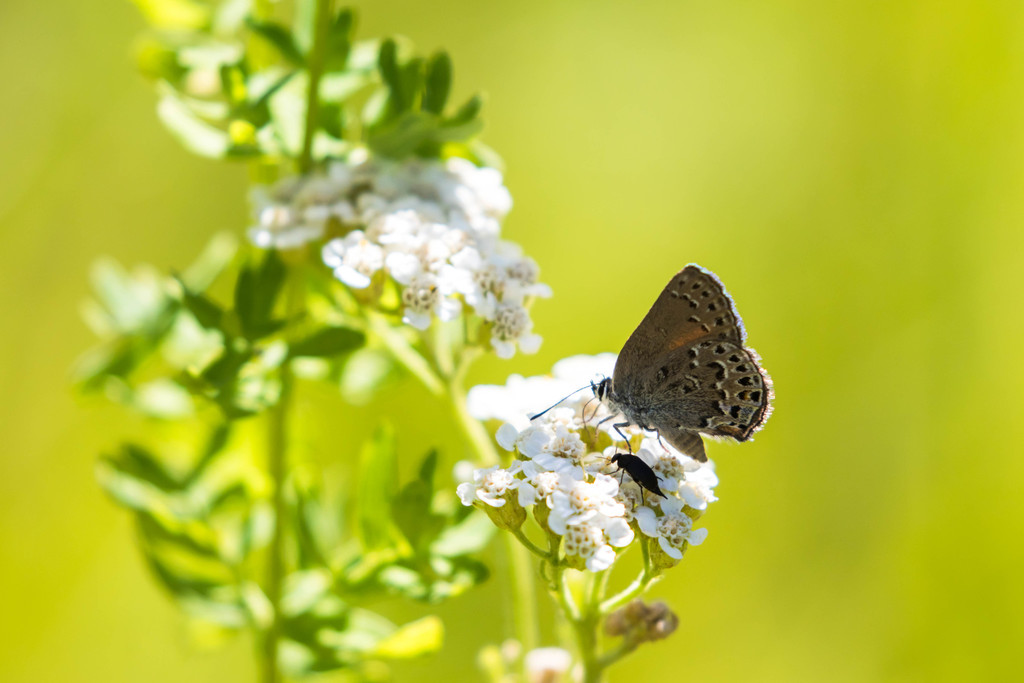
(c) Melissa McMasters, some rights reserved (CC BY) · licence
Family: Lycaenidae · Class: Insecta · Order: Lepidoptera
Satyrium behrii (Behr's Hairstreak) is a California animal in the Lycaenidae family.
Behr's Hairstreak is a small butterfly in the family Lycaenidae, characterized by its compact size and distinctive wing patterns. Adults have a wingspan of approximately 25 to 30 mm (1.0 to 1.2 inches). The dorsal wing surfaces are typically gray-brown to dark brown, while the ventral surfaces display a more complex pattern of gray, brown, and white markings. The hindwings feature characteristic hairstreak tails and often display orange or red spots near the wing margins. Males and females show subtle differences in coloration and wing shape, with males typically having slightly more pointed forewings. Behr's Hairstreak occurs across a broad range in western North America, extending from western Texas north and west through New Mexico, Arizona, and southern California to British Columbia. Within California, the species is found primarily in mountainous regions and foothills, including the Sierra Nevada, Cascade Range, and various Coast Range locations. The distribution is often localized within suitable habitat areas, with populations concentrated where host plants are abundant. The species inhabits open woodlands, chaparral, sagebrush scrub, and montane shrubland communities, typically at elevations ranging from 1,200 to 2,400 meters (4,000 to 8,000 feet). Behr's Hairstreak shows a strong association with areas containing its primary host plants: antelope brush (Purshia species) and mountain-mahogany (Cercocarpus montanus), both members of the rose family (Rosaceae). These shrubland habitats provide both larval food sources and adult nectar resources. The butterfly occurs in areas with well-drained soils and moderate to steep slopes, often in transitional zones between different vegetation types. Adults are active from late spring through early summer, with flight periods typically occurring from May through July, depending on elevation and local climate conditions. Males establish territories near host plants and engage in perching behavior to locate females. Mating occurs on or near the host plants, and females deposit eggs singly on young shoots and leaves of Purshia and Cercocarpus. Larvae develop through several instars, feeding on the host plant foliage. The species overwinters in the egg stage, with hatching occurring the following spring when new host plant growth emerges. Adults feed on nectar from various flowering plants, including buckwheat (Eriogonum species), rabbitbrush (Ericameria species), and other native shrubs and wildflowers. Behr's Hairstreak does not currently hold federal or state endangered species listing status. However, like many western butterflies dependent on specific shrubland habitats, the species faces potential threats from habitat loss due to development, altered fire regimes, invasive plant species, and climate change effects on montane ecosystems. Land use changes that eliminate or fragment shrubland communities containing host plants can impact local populations. Conservation of this species depends on maintaining intact shrubland habitats and the natural plant communities that support both larval development and adult feeding requirements.
Classification
Class: Insecta · Order: Lepidoptera · Family: Lycaenidae
Frequently asked questions
How is Satyrium behrii classified?
Satyrium behrii belongs to class Insecta, order Lepidoptera, family Lycaenidae.
What family does Satyrium behrii belong to?
Satyrium behrii is in the Lycaenidae family.
What is Satyrium behrii?
Behr's Hairstreak is a small butterfly in the family Lycaenidae, characterized by its compact size and distinctive wing patterns.
Is Satyrium behrii found in California?
Yes. Satyrium behrii is recorded in California in The California Species Project's catalogue.
Related species
Other California species in the same genus, family, or bioregion.
Data from The California Species Project — 14,000+ California species with verified data from CNPS, CDFW, USFWS, and more.